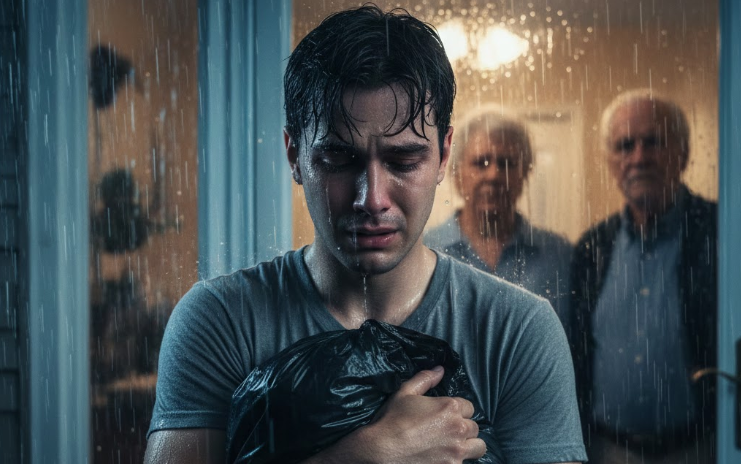
It happened on the morning of my eighteenth birthday. Cold water struck my face like a sudden storm. My mother stood above me, lips curved in a sharp smile, while Mark, my stepfather, waited in the doorway, holding a black trash bag heavy with everything I owned.
“Time to stand on your own,” she said, voice steady and final.
I wiped my eyes, heart racing. “You mean this?”
She gave a short laugh. “Ever since your father was gone, you’ve needed constant care— nightmares, therapy appointments, endless expenses. How long did you expect us to carry you?”
Mark nodded slowly, arms folded. “Eighteen years of food and shelter. That’s generous by any measure.”
Before another word left my mouth, they pressed the bags into my arms and guided me across the threshold. The door closed. The lock turned with a soft, definite click.
I stood on the porch a long time. Knocking felt pointless. Something inside already understood this moment had been coming for years.
I walked without direction, hands deep in my pockets, talking quietly to God, scratching the ears of thin stray cats huddled near the supermarket doors, waiting for the world to prove it was all a mistake. By afternoon I found myself at the downtown shelter, filling out forms while my fingers shook like leaves.
My phone lit up. Mom: Stop telling relatives you’re homeless. You’re making us look bad. Mark: At least your dad died doing something useful in Afghanistan. Followed by a face-palm emoji.
The air left my lungs. Tears came hard and fast. The intake counselor crossed the room and rested a warm hand on my shoulder. “Sweetheart, breathe. Tell me what happened.”
I handed her the phone. She read, frowned, then glanced at my paperwork and froze. “Your father—was he killed in Afghanistan?”
I nodded. “When I was six.”
She studied me a moment. “Did you ever see his body? Was there a casket? Did anyone in uniform ever come to the house afterward?”
“I… don’t remember any of that. Why?”
Her fingers flew across the keyboard. The color drained from her face. “James… your father never died. He’s been a patient at Palmer VA Medical Center for the past twelve years.”
The walls seemed to tilt. “We buried him,” I whispered. “There was a whole service.”
She locked eyes with me, voice low and urgent. “You need to go to him today—right now— before your mother and stepfather realize you know. Once they do, they’ll understand someone is coming for the money they’ve been taking every month.”
Every memory rearranged itself like pieces of a shattered mirror: the way Mom changed the channel whenever war footage appeared, the sudden move right after the funeral, the photographs that disappeared one by one. It had never been grief. It had been fear of discovery.
The counselor grabbed her keys. “I’m driving.”
The hospital corridors smelled of floor polish and sharp antiseptic. She stopped outside a door, touched my arm, and nodded.
He sat by the window in soft afternoon light. The same eyes I remembered from faded pictures. The same crooked nose. Not a memory. Not a ghost. My father—alive.
“Dad?” The word cracked in my throat.
He turned. His face folded with twelve years of pain and wonder. “James.” His voice broke. “They told me you wanted nothing to do with me. That you believed I abandoned you.”
“I thought you were dead,” I managed. “Mom said you died a hero.”
He closed his eyes, shook his head. “They told me you knew everything and chose to stay with them.”
My phone buzzed—bank alert. Account closed. Every dollar of college savings, every birthday check—gone.
Dad read the screen over my shoulder. “All my combat pay was supposed to go to you,” he said softly. “Every month. For your future. I signed whatever they put in front of me because they promised it was for you.”
A doctor entered, clipboard in hand. “Mr. Kravski has been medically cleared for discharge for years. He only needs a family member to sign the release forms.”
I signed without hesitation.
The next morning he walked out wearing borrowed jeans and a flannel shirt that carried the faint scent of hospital soap. I felt pride and fear in equal measure.
We drove to the house that had thrown me out the day before. Dad’s breathing grew quick and shallow. “Twelve years,” he whispered. “Twelve years stolen.”
We stood together on the porch. The door opened. Mark turned the color of ash. Behind him, Mom’s coffee mug slipped from her fingers and shattered across the tile.
Dad spoke first, calm and clear. “Hello, Mark. We need to discuss my death benefits.”
Mark’s expression flashed through shock, calculation, fury, and finally raw fear. Mom tried to smile, trembling. “James, honey, you look confused. You shouldn’t have left the hospital. You need your medication.”
Her syrupy tone lit something cold inside me. I slipped my phone from my pocket, pressed record, and kept my face perfectly still.
Mark saw the glowing screen too late. He stepped forward. Dad moved between us—thin, unsteady, but immovable. The man who had survived war and institutional betrayal did not step aside.
“Back away,” Dad said quietly.
Mark retreated, muttering about trespassing and delusions. Mom switched tactics, voice honeyed again. “Come inside. We’ll talk.”
Dad’s chest rose too fast. Panic flickered behind his eyes. I touched his arm. “We’re done here.”
We walked away. I never looked back, but I felt their stares burning through the blinds.
That night in the motel, under flickering fluorescent light, Dad sat on the edge of the bed staring at his hands. I spread every document across the small desk like evidence in a trial: discharge papers, birth certificate, bank alerts, screenshots of cruel texts, the porch recording. Twelve years of theft disguised as love.
“I don’t know where to begin,” I said.
“Begin by staying alive,” Dad answered.
Morning brought Carla’s number from the shelter. She arranged a week’s motel voucher and connected us with legal aid. “File a police report today,” she said. “What they did has a name: fraud and financial exploitation of a disabled veteran.”
The words sounded impossible—my father, a soldier, reduced to a victim. Yet when I watched his hands tremble around a paper cup of coffee, I understood both truths could live side by side.
I backed up every file three times over. Documentation became our shield.
At the VA we requested twelve years of payment records. Pages spilled from the printer— monthly deposits intended for my education, every dollar diverted.
Dad read them like autopsy reports. “They promised me it was for your college,” he said.
“They spent it on themselves,” I answered, voice breaking.
That afternoon Carla called again. Adult Protective Services had assigned Giovani Mercer, a caseworker who specialized in stolen veteran benefits.
When Giovani phoned that night, his voice carried steady authority. He listened, asked precise questions, then said, “We’re opening an investigation. Do not contact them directly.”
Family had become suspects. The word felt both wrong and exactly right.
Distant relatives refused my calls or repeated Mom’s lies. Isolation had always been part of their plan.
Mom texted at midnight: Come home. We’ll fix everything if you stop this nonsense.
I screenshotted, saved, and set the phone face-down.
Dad and I made rules: no answering their calls, no revealing our location. “Let them search,” I told him. “This time we stand still.”
Legal aid assigned Ms. Bruno— sharp-eyed, calm, fearless. She listened to the entire story, reviewed the growing mountain of proof, and said, “You’ve already built a powerful case. Civil claims for fraud and conversion are clear. Criminal charges will depend on the prosecutor, but the evidence speaks for itself.”
Days later Giovani confirmed the investigation was active. Interviews had begun. Our names stayed off the paperwork—for now.
At the police station, Detective Larkin typed while I spoke, the steady rhythm of keys marking every betrayal. When I finished, he slid the report across the desk for my signature. “This is only the beginning,” he said, “but it’s a solid one.”
The VA revealed Mom had been listed as Dad’s representative payee for over a decade. Changing that required legal authority— authority we were earning, form by form, day by day.
The funeral home confirmed the service twelve years earlier had been nothing more than a rented chapel and an empty casket. I read their letter twice and felt the floor drop away again. They had stolen even my grief.
Bank investigator Agatha discovered years of transfers from Dad’s account into one controlled by Mom and Mark. Suspicious activity flags froze every dollar. Progress, slow and hard-won.
Giovani’s unannounced visit turned up a power-of-attorney document thirteen years old with a notary seal that looked suspiciously worn. Ms. Bruno examined it under a magnifying glass. “The signature doesn’t match,” she said. “We’ll prove forgery.”
Dad received his first official state ID in over a decade. He held the temporary paper like it was made of gold.
The caregiving stipend was approved. A modest monthly check, but it meant rent and groceries and the quiet dignity of work that mattered.
Then Mark appeared outside our motel window, truck idling in the dark. I called 911. Police arrived minutes after he fled. Ms. Bruno filed for a restraining order the next morning.
In court, the judge reviewed the police report, the timestamped photo, Mark’s weak excuses. Six months. Five hundred feet. One warning.
The VA scheduled the representative-payee interview. Dad told them clearly: “I want my son to manage my benefits.” His statement carried the weight of twelve lost years.
APS substantiated financial exploitation of a disabled veteran. The words, stamped and official, felt like oxygen.
The bank confirmed the forged power of attorney and began returning stolen funds to a protected account in my name.
Ms. Bruno secured an asset freeze. Mom and Mark could no longer hide what they had taken.
At the settlement conference Mom looked smaller, older. She reached for me; I stayed still. After two hours of evidence laid bare, she agreed to restitution—money returned, month by month, into accounts only we controlled.
Mark violated the restraining order again. Handcuffs this time. The order became permanent.
The thick envelope from the VA arrived at last: Representative Payee Change Approved. My name beside the words Authorized Recipient.
Our caregiver stipend began. HUD-VASH housing came through— a clean one-bedroom apartment with sunlight through the windows and a kitchen that smelled of possibility.
We moved in with two duffel bags and borrowed dishes. When the door closed that first night, the silence felt whole.
Months passed in steady rhythm: my online classes, Dad’s therapy appointments, shared dinners, ordinary evenings.
Mom still sent letters full of manipulation and guilt. They went straight into the shredder.
One Thursday the bank called with final numbers— a large portion of twelve years’ theft recovered and deposited.
That night a single handwritten note arrived in Mom’s perfect cursive: You’ll regret turning on your family.
I fed it to the shredder and listened to the clean mechanical sound.
Dad looked up from the couch. “You did the right thing.”
I surveyed our small apartment— secondhand furniture, warm light, the smell of dinner on the stove— and felt something settle into place.
This life was modest, hard-earned, and entirely ours.
We still woke some nights from nightmares—his and mine— but every morning we built another ordinary, untouchable day.
This wasn’t revenge. This was reclamation.
And sometimes the strongest answer to those who tried to bury you is to stand in the home they swore you’d never have, breathing free air they can never again control, knowing they will never take another piece of your future.