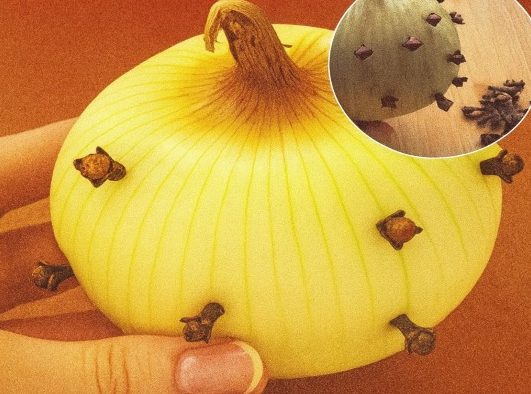
In many homes around the world, particularly when the weather turns cold and the air feels heavy, families bring back a gentle old custom that has traveled through generations: a fresh onion, carefully peeled and decorated with whole cloves, left to sit peacefully in a bedroom through the night.
At first, the sight might appear unusual or even charmingly old-fashioned, yet for countless people it carries the quiet weight of love and protection. Long before bedrooms filled with electric humidifiers, menthol chests rubs, or essential-oil diffusers, households relied on ordinary ingredients from the pantry to create a sense of ease and calm. Seeing that small clove-studded onion on a nightstand often awakens memories of snowy evenings, restless sleep, and a mother or grandmother moving softly through the house, doing whatever she could to help everyone breathe a little easier.
The preparation requires almost no effort, which helps explain why the habit has stayed alive for so long. Someone selects a firm onion, removes the papery outer layers, and presses whole cloves into its surface at regular intervals. The finished creation then rests on a saucer or small plate somewhere close to the bed—perhaps on a dresser, a windowsill, or the floor beside a child’s pillow.
As hours pass in the quiet darkness, the onion slowly releases its unmistakable pungent aroma, while the cloves add their own warm, sweet, and slightly spicy notes. Together, these two scents mingle and fill the room with something distinctive, something that many remember as clean and opening, especially when windows stay closed against winter chill.
People who grew up with this practice seldom claim that the onion and cloves cure colds or drive away viruses. Instead, they speak of how the fragrance made stuffy rooms feel lighter and how the simple presence of that object signaled that somebody cared enough to try.
The sharp smell of onion contains natural sulfur compounds, and cloves carry eugenol, the same fragrant oil found in many classic remedies. When the two combine in a closed space, the effect resembles a very basic form of aromatherapy: nothing complicated, nothing expensive, yet capable of shifting the atmosphere in a subtle, comforting way. Deep breaths come more easily, shoulders relax, and sleep often arrives sooner than it would have otherwise.
Over time, this small ritual has become more than a home remedy; it has turned into a thread that ties children to their parents and grandparents. Even families who own the latest air purifiers sometimes peel an onion and reach for the clove jar when the first cough echoes down the hallway.
They do it because the act itself feels like a whisper from the past, a way to say “I am looking after you” without words. In an age of quick pharmaceutical answers and glowing screens full of health advice, the clove-studded onion remains beautifully uncomplicated. It asks for no batteries, no subscription, no perfect technique—only a few moments of attention and the willingness to carry forward something that once brought comfort to someone we loved.
Today, younger generations occasionally smile when they hear about the tradition for the first time, yet many of them try it anyway and discover the same gentle magic their elders knew. The room smells different, the night feels softer, and the knowledge that a parent or grandparent once did the very same thing creates an invisible bridge across years.
Warmth, after all, arrives in many forms. Sometimes it comes from a blanket, sometimes from a hug, and sometimes from a humble onion pierced with cloves sitting quietly in the dark, doing its small, faithful work of making the world feel a little kinder, one breath at a time.
That quiet bedroom scene repeats itself in houses across continents each winter, proof that care often wears the simplest disguise. The onion and cloves will never appear in medical journals or replace proper treatment when illness grows serious, but they continue to hold a cherished place in family stories. They remind us that healing is not always about powerful interventions; sometimes it lives in the rituals we inherit, the scents that take us home, and the gentle knowledge that someone, somewhere, is still watching over the night.