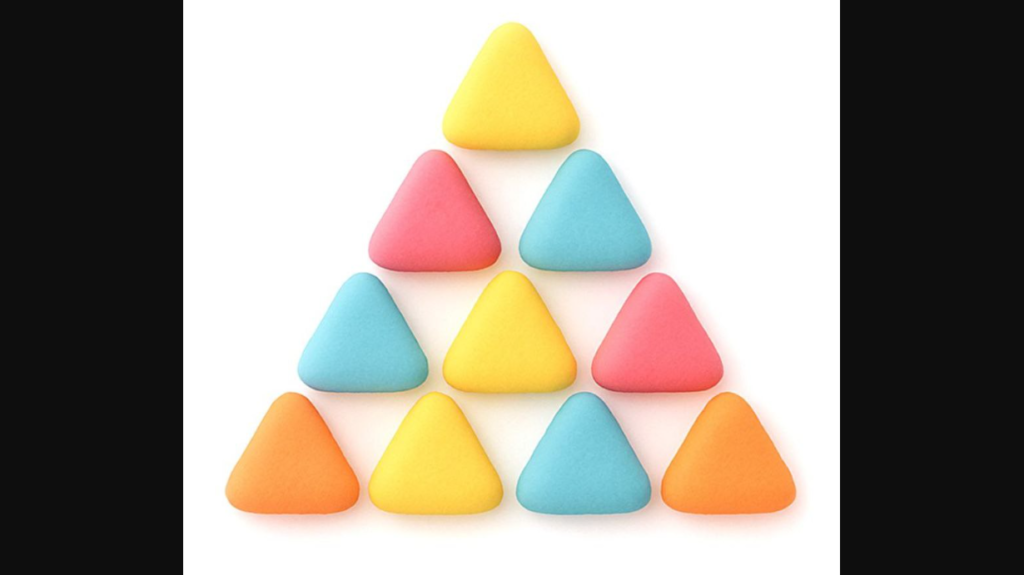
At first glance, the image feels lighthearted and uncomplicated. A collection of colorful triangles forms a pyramid-like arrangement, the kind of visual that often blends into a fast-moving feed without leaving much of an impression. Yet something subtle shifts when you slow down and give it more attention.
As your eyes trace the edges and intersections, the picture begins to transform. What once looked straightforward now feels layered. Some viewers confidently identify nine triangles. Others arrive at thirteen, sixteen, or numbers far beyond that. Each person feels certain in their conclusion, and that confidence becomes part of the puzzle’s appeal.
This triangle image has circulated widely online, capturing attention across different age groups and backgrounds. Its popularity does not stem from complexity or advanced logic. Instead, it draws people in by quietly inviting them to observe their own thinking. The exercise encourages curiosity and reflection, prompting viewers to pause and notice how their minds interpret what they see. The act of counting shifts into an exploration of perception itself, revealing how easily the brain fills in gaps and builds meaning from simple shapes.
How the Mind Interprets Visual Patterns
The experience of viewing this image involves more than eyesight. The brain actively organizes visual information, grouping lines and shapes into patterns that feel coherent. Psychologists often describe this process through Gestalt principles, which explain how people naturally perceive unified forms rather than disconnected pieces.
When your eyes first land on the image, your mind chooses a focal point almost instantly. Some people register the smallest, most clearly defined triangles first. Others notice larger shapes created by overlapping lines. This initial choice guides everything that follows, shaping how additional details are discovered or overlooked. It reflects the way the brain prioritizes information and builds understanding from what it considers most relevant.
This same pattern appears in daily life. Some people approach situations by examining individual elements closely. Others step back to see how those elements connect. Many shift between these approaches depending on context. These tendencies are not flaws. They represent different cognitive strengths influenced by experience, personality, and environment.
If You Counted Nine Triangles
People who arrive at nine triangles often have a grounded and practical outlook. You tend to trust what is clearly visible and measurable. Facts, clarity, and direct evidence guide your thinking. In discussions, you value transparency and straightforward communication.
This mindset supports reliability and focus. You often address challenges methodically, breaking them into manageable steps. Others may appreciate your ability to remain steady when situations feel uncertain or emotionally charged.
At times, this emphasis on what is immediately observable can mean that subtle emotional signals or underlying dynamics take longer to surface. Even so, your consistency offers balance in group settings, helping keep decisions anchored in reality.
If You Counted Thirteen to Sixteen Triangles
Seeing a number in this range often points to a balanced perceptual style. You notice details while maintaining awareness of the overall structure. Logic and intuition work together rather than competing for attention.
You tend to read situations carefully, recognizing nuance without becoming overwhelmed. Friends and colleagues often seek your input because you listen attentively and respond thoughtfully. You acknowledge complexity while still moving toward resolution.
This combination of analysis and empathy supports strong relationships and effective problem-solving. You recognize layers and context without feeling pressure to force quick conclusions.
If You Counted More Than Twenty Triangles
Those who identify many triangles often think in terms of patterns, connections, and possibilities. You naturally explore how smaller elements interact within larger systems. Creativity and imagination play a central role in how you interpret information.
This perspective supports innovation and original thinking. You may feel drawn to design, storytelling, strategy, or fields that reward exploration and synthesis. Ideas often spark other ideas, creating momentum in your thinking.
At times, strong confidence in your interpretation can influence collaboration when others see things differently. Maintaining awareness of multiple viewpoints supports open communication and shared understanding.
Why Visual Puzzles Hold Our Attention
Images like this resonate because they highlight how differently people experience the same stimulus. They invite conversation rather than competition. The value comes from comparing perspectives and reflecting on differences, not from reaching a single correct answer.
These puzzles reveal an important truth: perception is shaped by experience, emotion, and mental habits. What stands out immediately to one person may emerge slowly for another. Each approach reflects a valid way of engaging with the world.
Visual challenges encourage patience and curiosity. They remind us that understanding often deepens when we slow down and allow space for multiple interpretations.
What Simple Shapes Can Reveal
Triangles on a screen may seem minor, yet they mirror how the mind organizes complexity into meaning. They show that perception extends beyond vision into thought, emotion, and personality.
Whether you counted nine, sixteen, or far more, the image offers insight without judgment. It invites reflection on how you process information and how others may do so differently.
In the end, the image itself matters less than the awareness it creates. It reminds us that perspective shapes experience, and that deeper understanding often begins when we take a second look at what we think we already know.