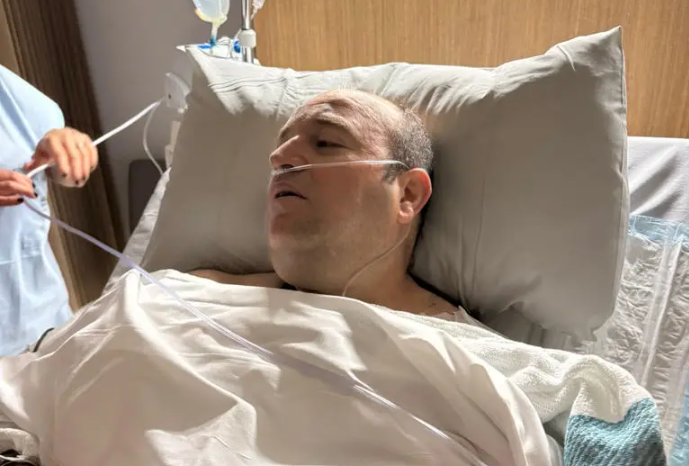
Ahmed Al-Ahmed, the man widely recognized for confronting and disarming one of the attackers during the Bondi Beach shooting, remains in hospital as he continues a long and demanding recovery. From his hospital bed, he has made it clear that, if faced with the same circumstances again, he would make the same choice without hesitation. His words reflect the mindset that guided him in a moment when fear and danger surrounded him, yet action felt necessary to protect others.
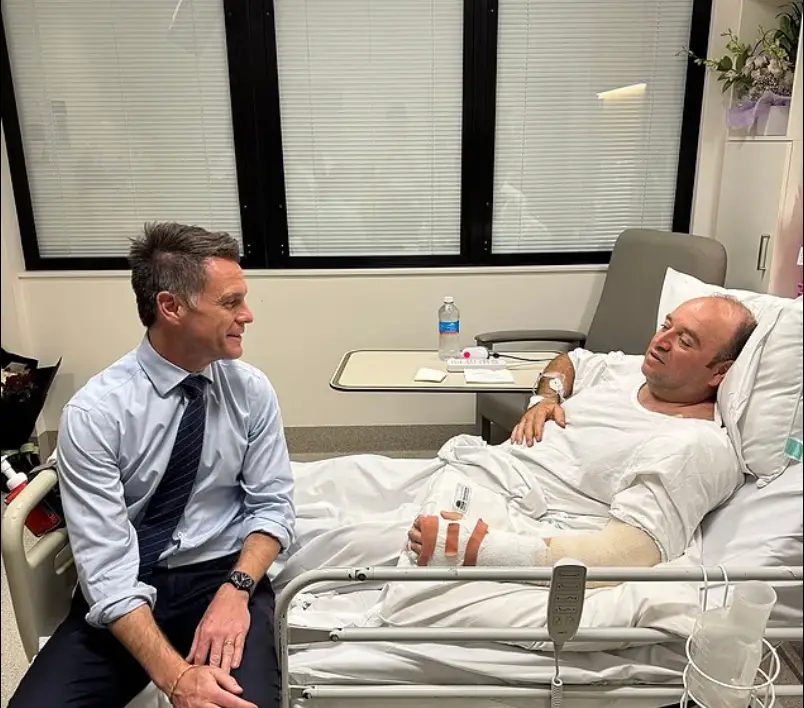
Recent photographs released to the public show Al-Ahmed receiving ongoing medical treatment, offering a sobering look at the physical consequences of his actions. The images reveal a man clearly marked by trauma, yet still composed, his expression steady despite the pain he continues to endure. Those close to him say his determination remains unchanged, even as his body works through the difficult process of healing.
While much of the public conversation has focused on his courage, new details have clarified that the injuries he sustained were far more severe than initially understood. According to his former migration lawyer, Sam Issa, Ahmed Al-Ahmed suffered multiple serious gunshot wounds during the incident, injuries that required immediate intervention and ongoing surgical care.
Issa explained that Al-Ahmed has already undergone several medical procedures and may require additional treatment in the future. He confirmed that Al-Ahmed sustained five gunshot wounds, each presenting its own complications. These injuries have required careful monitoring by doctors, along with continuous assessment to ensure no further damage develops during recovery.
One of the most concerning aspects of his condition involves his arm. Issa shared that Al-Ahmed has experienced a loss of sensation, raising the possibility of nerve damage. While Issa emphasized that he is not a medical expert, he relayed that Al-Ahmed has been told one of the bullets may have struck a nerve. Medical specialists continue to evaluate his condition, and further procedures remain a possibility depending on how his recovery progresses.
Despite the physical toll and ongoing uncertainty, those who know Al-Ahmed describe his mental strength as remarkable. Issa noted that Al-Ahmed has expressed no regret for intervening during the attack. He has stated openly that he would step in again if others were at risk. At the same time, Issa acknowledged that repeated surgeries and persistent pain have begun to wear on him. Recovery has been physically exhausting, and the emotional strain of the experience has been significant.
As news of his condition became more widely known, public support for Al-Ahmed grew rapidly. By Monday, more than $1.2 million had been raised through a crowdfunding campaign established to assist with medical expenses and to support his family. The campaign gained early momentum after U.S. billionaire Bill Ackman reportedly contributed $99,000. Since then, donations have continued to arrive from across the globe, reflecting widespread admiration and gratitude for Al-Ahmed’s actions.
Video footage of the incident has circulated extensively online, showing the 43-year-old father of two approaching the attacker from behind and wrestling the firearm away. Millions have viewed the footage, with many observers crediting his quick judgment and physical courage with reducing the potential for further harm. Analysts and commentators have pointed out that his actions created a crucial interruption during an extremely volatile situation.
Reports indicate that the confrontation occurred in the presence of another alleged gunman, identified as Sajid Akram’s 24-year-old son, Naveed, who was positioned on a nearby footbridge. Although armed, Naveed did not continue the attack and was later taken into custody. He was transported to hospital in critical condition under police guard, while Sajid Akram was fatally shot by police at the scene.
After disarming the attacker, Al-Ahmed moved to take cover behind a tree, where he was struck twice in the shoulder and arm. Even after securing the rifle, witnesses noted his restraint. He placed the weapon against a tree rather than using it. Another bystander then moved toward the fleeing attacker, throwing an object as the suspect escaped the immediate area. These moments, now closely examined, illustrate how civilians were forced to make rapid decisions under intense pressure.
Al-Ahmed is currently receiving care at St George Hospital, where medical teams remain focused on stabilizing his condition and supporting long-term recovery. Family members and friends have expressed deep appreciation for the messages, donations, and encouragement sent from around the world, noting that the support has provided strength during an overwhelming period.
Across Australia and beyond, Ahmed Al-Ahmed has come to represent courage grounded in compassion. He did not seek attention or recognition, yet his actions have resonated widely as a reminder that ordinary people can rise to extraordinary moments. As his recovery continues, many hope that the same resolve he displayed during the incident will carry him forward, supported by a community that recognizes the profound impact of his choice.