I spent a little more than two weeks confined to a hospital room after a devastating car accident. Time behaved strangely there. Days blurred together, marked by the steady glow of overhead lights that never fully dimmed and the constant murmur of machines keeping watch. Nurses moved in and out with practiced calm, offering care and reassurance, while the hours stretched in unfamiliar ways.
The doctors told me I was fortunate to have survived. I listened, nodded, and tried to absorb their words, yet inside I felt suspended between recovery and uncertainty. My body ached, my thoughts drifted, and for a period of time, I was unable to speak at all.
Everything I wanted to say stayed locked inside me. Questions, fears, and a deep sense of isolation gathered in the silence.
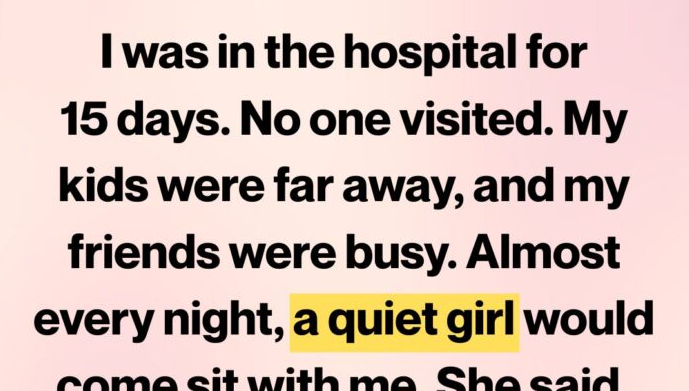
No visitors came.
My children lived far away, anchored by responsibilities they could not abandon on short notice. Friends called when they were able, offering kindness through a phone line, but their lives continued while mine paused in that room.
Each day felt heavier. When night arrived, the quiet pressed in, making the loneliness sharper and more difficult to ignore.
That was when she began to appear.
The Girl Who Came After Dark
Nearly every evening, often when the hallway outside my room settled into stillness, a young girl would slip inside. She looked to be in her early teens, with dark hair that she kept brushing behind her ears. Her face was youthful, yet her eyes carried a gravity that suggested she had already seen more than most her age.
She entered without sound. She would pull a chair close to my bed and sit as though the space belonged to her, hands resting together, posture calm and respectful.
I could not speak. I could not ask who she was or why she came. Somehow, she seemed to understand the limits of my silence.
At times, she leaned forward and spoke softly, careful not to disturb the room.
“Hold on,” she whispered one evening. “You’re going to be okay.”
Those words anchored me. I repeated them in my mind during moments of pain and during the long hours before dawn when fear crept in uninvited.
I began to look forward to her presence. In a place where I felt invisible, she made me feel acknowledged.
She never interfered with the machines. She never asked questions. She stayed, offering companionship without demand. And that presence mattered more than I could explain.
Questions Without Answers
When my voice finally returned, one of the first things I asked a nurse about was the girl. The nurse listened with patience, then gently explained that no visitor fitting that description had been recorded. There were no notes, no entries, no indication that anyone had been coming to sit with me in the evenings.
The explanation was delivered carefully. Medication, trauma, and stress can blur perception. The mind, they said, sometimes creates comfort during extreme circumstances.
I accepted their reasoning. It made sense. Still, something lingered. The girl had felt tangible, grounded, unmistakably real. I told myself to let it go.
Going Home
Several weeks later, I was discharged. I returned home unsteady and tired, grateful to step back into familiar surroundings. As I stood on my porch that afternoon, fumbling with my keys, a familiar stillness washed over me. It was the same feeling I remembered from those hospital nights.
I turned around, and my breath caught.
She stood there.
The same girl. The same dark hair. The same quiet posture, hands twisting together as if unsure whether she should speak.
“My name is Tiffany,” she said gently.
Understanding the Connection
As she spoke, the missing pieces fell into place. Tiffany told me her mother had been injured in the same accident. They had been taken to the same hospital that night.
While I fought my way through recovery, her mother lay elsewhere in the building, surrounded by uncertainty and long hours of waiting.
Tiffany spent those nights wandering the halls, unable to return home alone. She was young, frightened, and searching for reassurance wherever she could find it.
She told me she peeked into rooms, looking for signs of resilience. Watching me continue to breathe, continue to heal, gave her hope. Sitting with me made her feel less isolated.
Her mother did not survive.
She said it quietly, without embellishment. It was clear she had learned to carry that loss with remarkable composure.
An Unexpected Gift
Before she left, Tiffany reached into her pocket.
“I brought something back to you,” she said.
She placed a necklace in my palm. I recognized it immediately. It had belonged to my grandmother, something I wore the night of the accident for comfort. I believed it had been lost.
Tiffany explained she found it and kept it safe, worried it might disappear during the confusion.
Emotion overwhelmed me. Gratitude, sorrow, and understanding converged in that moment. I hugged her and thanked her for a kindness she offered while carrying her own grief.
A Lasting Bond
In the months that followed, Tiffany and I stayed connected. Over time, I became a steady presence in her life. We shared meals, conversations, and quiet moments of support. She grew, learned, and found ways to carry both hope and loss together.
Years have passed. We still speak often. She visits when she can.
Each time I smile, I think of the girl who pulled up a chair beside my hospital bed when the nights felt endless. She showed me that kindness often arrives without ceremony.
Sometimes it comes quietly, stays patiently, and changes everything without asking for recognition.
When life feels uncertain, I remember her and the truth she taught me: even in our darkest hours, connection can find us in unexpected ways.