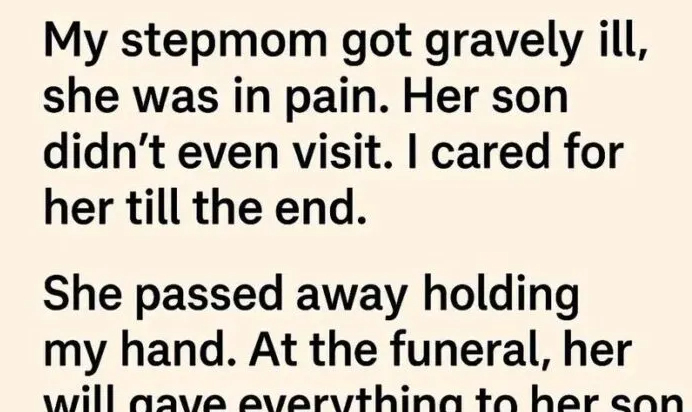
I never expected anything tied to her affairs, which is why the call caught me off guard. The day after the service, I was sitting quietly with my thoughts, trying to process the finality of everything, when my phone rang. It was her son. His voice carried tension, layered with confusion and frustration that surfaced before he could steady himself.
He told me he had been going through a box of his mother’s belongings. It was filled with small, ordinary things—notes, papers, keepsakes she had tucked away over the years. While sorting through it, he found a letter. The envelope wasn’t addressed to him.
It was addressed to me.
He paused before explaining further, as if still unsure how to feel about it. When I opened the letter later, her words slowed me down completely. She wrote with a tenderness that felt familiar. She thanked me for the patience I showed during her most fragile moments, for listening without rushing her, and for staying steady when she felt overwhelmed by the weight of her own declining health.
She explained that the formal details of her estate had been decided long before her health changed. Revisiting them would have required energy and emotional strength she no longer had. Still, she wanted me to know that what I offered her in those final months mattered deeply. More deeply than any object or financial gesture ever could.
That letter alone would have been enough to stir emotion. But it wasn’t the letter that unsettled her son.
In the same box, he discovered receipts, handwritten notes, and a few photographs. Together, they revealed something he had never known. At one point, she had considered setting up a small trust for him. The idea had been there, planned out, nearly complete. Yet she never finalized it.
Instead, as her health shifted and time began to feel shorter, she redirected her energy. Rather than focusing on documents and logistics, she focused on repairing their strained relationship. She wrote drafts of messages she never sent. She saved photos from happier years. She made notes to herself about conversations she wanted to have with him.
He hadn’t seen any of this until that afternoon.
Reading her regrets, written in her own hand, brought emotions forward all at once. He spoke in uneven waves, moving between anger, sadness, guilt, and confusion. I listened. I didn’t interrupt. I understood that sometimes the most supportive thing we can do is allow someone the space to unravel thoughts they’ve been carrying silently.
When he finally slowed down, I spoke carefully.
I told him the truth as gently as I could. The letter she wrote to me was not meant to diminish him or replace anything she felt toward her son. It wasn’t a comparison, a judgment, or a statement of preference. It was simply gratitude expressed in the quiet way she knew how to manage.
There was no hidden message between the lines. No accusation. No intent to cause pain.
Her hope, more than anything else, was that he would come to understand how quickly time moves, and how essential it is to show up while there is still room to do so. The letter was her attempt to express something she hadn’t found the right words for during years filled with distance, misunderstandings, and unspoken expectations.
She wanted him to learn from what she felt she had not done well enough herself.
After the call ended, I returned her letter to its envelope. Holding it, I realized she had given both of us something that extended beyond possessions or formal arrangements. She left behind a lesson about presence, about patience, and about the quiet ways people try to make peace with their past.
For her son, the discovery became a moment of reflection. Not about what he received, but about what had been missed. About the gap that can grow when intentions stay unspoken and time moves forward regardless.
Some inheritances are not tangible.
They don’t arrive in boxes, accounts, or envelopes.
They appear in moments of clarity, carrying insight that reshapes how we understand love, regret, and responsibility.
And sometimes, those lessons arrive later than expected, yet still exactly when they are needed most.