Sometimes one small detail can shift the entire picture. And still, how many times do we skim past that detail without realizing it was there? A quick glance, a confident assumption, and our mind moves on—until a visual puzzle shows up and asks us to slow down.
These little challenges have a way of hooking our attention. Whether you’re killing time in a waiting room, taking a pause between emails, or settling in with a warm cup of coffee, curiosity tends to take the lead. You see the setup, you feel the pull, and you want the answer.
There’s something deeply satisfying about that moment when the solution clicks.
Why Our Brain Keeps Coming Back to Puzzles
Puzzles work like a mini workout for the mind. They invite logic, memory, and imagination to cooperate in real time. You scan, you compare, you test possibilities, and you refine your guess.
That process wakes up your attention in a quiet, steady way. It also creates a rewarding kind of focus—the kind that doesn’t feel heavy, because it comes with a clear goal.
And when you solve one, there’s a small surge of pride. Not because it changes your life, because it proves your brain can still spot what others might miss.
Visual Puzzle: Can You Tell Who Is Still Alive?
Today’s challenge is simple to describe and surprisingly tricky to solve.
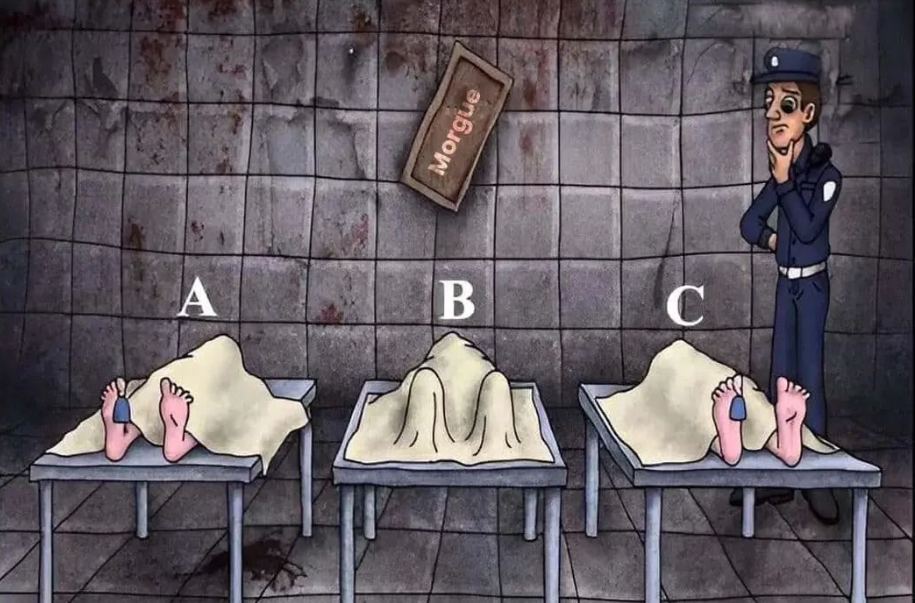
You’re looking at a frozen scene. Three people appear motionless, as if time stopped at the same moment for all of them. The question is direct:
Which one is still alive?
No special equipment is needed. No complicated calculations. The answer is sitting inside the image, tucked into a detail that many viewers overlook on the first pass.
Take a moment to picture the scene carefully.
Three people. A room that feels still. A table nearby. Everything appears quiet, settled, and final at first glance.
And then the puzzle asks you to become an observer, not a passerby.
Today’s Challenge: Who Is Still Alive?
Approach it the way an investigator would.
Look at posture. Look at placement. Look at what objects are doing in the scene. Look at what would require motion, warmth, or circulation. Look at what could only exist if something is still happening in the present moment.
This puzzle rewards patience.
It also rewards a shift in attention. Many people search faces first. Many people focus on clothing, hands, or the overall arrangement. Those clues can distract from the thing that matters most: a small sign that indicates the body is still functioning.
The key is not hidden in a dramatic feature.
The key is hidden in a quiet one.
The Revelation: A Detail That Solves the Mystery
Ready for the answer?
Person A is still alive.
And the clue is located beneath the table.
A small red puddle sits on the floor where many people fail to look early enough. The moment your eyes catch it, your brain starts building a story. Some people interpret it as a sign that everything is already over.
The puzzle points in a different direction.
A fresh puddle signals active circulation. It suggests the body is still producing movement within, because bleeding requires flow. In a scene where everything appears motionless, that ongoing flow becomes the strongest indicator of life.
That’s the “tiny detail” the puzzle is built around.
The image invites you to assume stillness means absence of life.
The puddle invites you to notice what still requires a working body.
A Lesson That Goes Beyond the Image
This small puzzle carries a bigger takeaway.
First impressions can feel reliable. They often feel efficient. They also skip steps. When the mind rushes to certainty, it tends to accept the easiest interpretation available.
This challenge encourages a different habit.
Slow observation.
Willingness to scan beyond the obvious.
Comfort with pausing long enough to be thorough.
It’s also a reminder that clues often sit in places we ignore: below eye level, near the edges, under objects that seem ordinary.
In daily life, the same pattern shows up in conversations, decisions, and emotions. We notice the loudest signal first. We react to what is most visible. We miss the subtle signs that reveal what is truly happening.
Puzzles like this train the opposite skill: careful attention.
Puzzles as a Simple Way to Keep the Mind Active
Beyond entertainment, brain teasers can support mental sharpness over time. They encourage focus, flexibility, and pattern recognition. They also create a healthy habit of checking your work before locking in an answer.
That matters at any age.
So the next time a puzzle crosses your path, treat it like a short practice session for your mind. Observe. Reflect. Recount. Give yourself permission to revise your first thought.
Because the real reward is not the answer alone.
The real reward is building the ability to see what others miss.