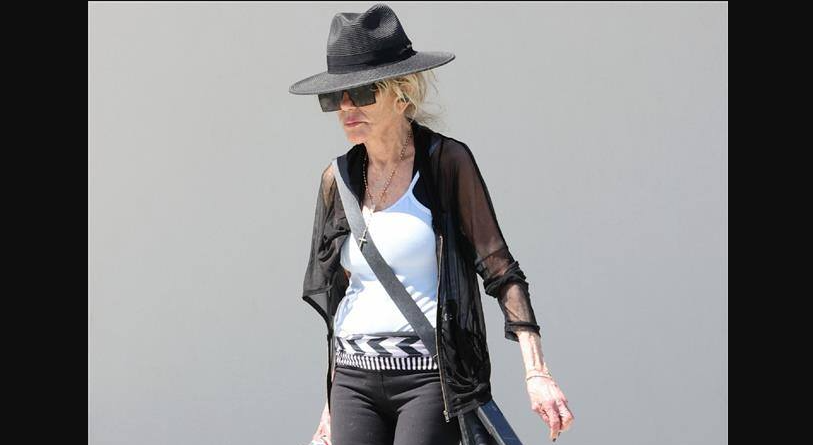
Dyan Cannon spent much of her life under the bright, unrelenting lights of Hollywood, becoming one of the most familiar and admired faces of her era. With her expressive smile, quick intelligence, and unmistakable screen presence, she embodied a kind of charm that felt both glamorous and approachable. To audiences looking in from the outside, her story appeared to follow a familiar cinematic arc: talent discovered, fame achieved, legacy secured. Yet the reality behind that polished image was far more layered and complex.
Her professional career unfolded across decades, marked by versatility and consistency rather than fleeting stardom. Cannon moved easily between comedy and drama, earning respect for performances that balanced wit with emotional nuance. Over the years, she received three Academy Award nominations and several Golden Globe nominations, recognition that reflected not only popularity but sustained craft. Winning a Saturn Award further highlighted her range, and in 1983, her contributions to film were formally honored with a star on the Hollywood Walk of Fame. That moment symbolized permanence in an industry often defined by impermanence.
Audiences continue to associate Cannon with memorable films such as Bob & Carol & Ted & Alice, Heaven Can Wait, The Last of Sheila, and Deathtrap. In each role, she brought a distinct energy—sometimes playful, sometimes restrained, always grounded. Her performances resonated because they felt lived-in, shaped by curiosity and emotional intelligence rather than spectacle. She did not rely on a single persona, instead allowing her work to evolve as she did.
One of the most talked-about chapters of her life, however, unfolded away from the camera. Her marriage to Cary Grant drew enormous public attention at the time. After a relatively brief courtship, the two married in the early 1960s. Cannon was 28 years old, while Grant was 61, a difference that immediately became a subject of fascination and commentary. To many, the pairing looked glamorous, even iconic. To Cannon herself, it would later represent a period of profound personal struggle.
In interviews years later, Cannon spoke candidly about the emotional toll the marriage took on her. She described feeling constrained, explaining that Grant attempted to exert control over her appearance, her behavior, and the direction of her career. Over time, she said, those pressures led her to lose a sense of her own identity. The relationship, while filled with affection, became increasingly difficult to sustain. After three years, the marriage ended.
Despite that painful experience, Cannon has consistently emphasized that her feelings were sincere and free of bitterness. She has said that she loved Grant deeply and entered the marriage without calculation or hidden motives. From that union came their daughter, Jennifer, born in 1966. Even after the divorce, Jennifer remained the most enduring connection between them, grounding Cannon’s life in motherhood and purpose beyond public perception.
As the years passed, Cannon continued to attract attention, sometimes for reasons unrelated to her work. In her late 80s, photographs of her walking her dogs circulated online, prompting a mix of admiration and commentary. The reactions revealed less about Cannon herself and more about society’s ongoing discomfort with women aging visibly in the public eye. Still, she met the scrutiny with composure, neither retreating nor reshaping herself to meet external expectations.
Now in her late 80s, Cannon speaks openly about a sense of peace that came with time. She credits her faith as a central source of stability and meaning, explaining that spirituality helped her process earlier hardships and let go of long-held emotional weight. Through reflection and resilience, she says she has arrived at a place of genuine contentment. In her own words, she describes herself as “a happy puppy now,” a phrase that captures both lightness and acceptance.
Her story, viewed in full, is not one of effortless glamour, but of endurance. It reflects a life shaped by achievement, vulnerability, reinvention, and growth. Dyan Cannon’s legacy is not limited to awards or famous films. It also lives in her willingness to speak honestly about loss, identity, and healing—and in the quiet confidence of someone who has finally made peace with every chapter of her journey.