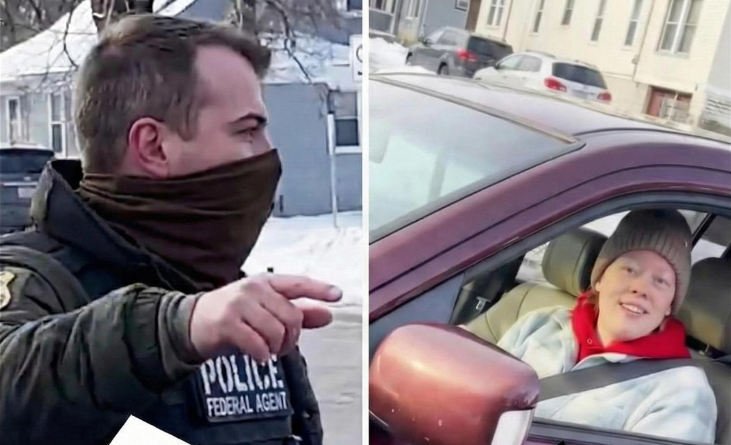
A short cellphone recording captured on a quiet, snow-lined residential street in Minneapolis has moved to the center of a widening public conversation following a fatal encounter involving federal immigration agents and members of the local community.
The footage, which runs for less than one minute, documents a tense moment near a parked sport utility vehicle as agents approach and nearby residents watch closely. Despite its brief length, the video offers a rare visual window into the moments leading up to an incident that ended with the loss of a community member’s life.
Since the recording began circulating online, it has been viewed and shared widely. Viewers across the country have studied the footage frame by frame, trying to understand what unfolded in those final seconds and how an encounter connected to a routine enforcement action escalated so rapidly. The limited visuals and lack of complete audio have fueled both concern and uncertainty, leaving many questions unanswered.
In the video, a woman later identified as Renee Good is seated inside a maroon SUV parked along the curb. At the beginning of the clip, she appears composed while speaking with an approaching agent. Nearby, another woman records the interaction on her phone, positioning herself close enough to capture voices and movement. The exchange includes spoken remarks between the people in the vehicle and the agents, with the tone growing increasingly strained as the seconds pass.
As the camera angle shifts, additional officers can be seen arriving from farther up the street. Their presence changes the atmosphere of the scene, and the interaction appears to intensify. Within moments, the SUV begins to move. Loud noises are heard, though the source is not fully visible in the recording. The video ends abruptly, offering no further explanation or resolution and leaving viewers with fragments rather than a complete account.
In the days following the incident, Renee Good’s family stepped forward to share their grief and provide context about who she was beyond the brief images seen online. Her wife described Renee as a poet, a devoted mother of three children, and a person known among friends and neighbors for compassion and generosity. She spoke publicly about Renee’s strong belief in caring for others and said those values influenced their decision to pause and observe the immigration activity unfolding on their street that day.
Members of the community echoed these memories during a vigil held in Renee’s honor. Candles lined the sidewalk as neighbors gathered to remember her life and reflect on the circumstances surrounding her death. Many described her as someone who consistently stood up for others and lived according to principles of kindness, solidarity, and mutual support. The gathering became both a memorial and a space for collective reflection.
At the same time, federal authorities offered their own description of the event. Officials stated that agents from U.S. Immigration and Customs Enforcement were carrying out an operation when a crowd formed and the situation became confrontational. According to their statement, officers perceived a threat and responded based on established procedures and training.
This account has drawn sharp criticism from local leaders and residents, many of whom have called for greater transparency and an independent investigation. City officials questioned aspects of the federal explanation, pointing to discrepancies between official statements and what appears in the video. Community advocates have emphasized the importance of a full and impartial review of the incident.
National political figures have also weighed in, offering differing interpretations that reflect broader debates about immigration enforcement and public safety. As multiple inquiries continue, the cellphone video remains a central reference point, frequently cited in discussions, protests, and public meetings.
For many observers, the tragedy has come to represent more than the loss experienced by one family. It has become a moment prompting reflection across Minneapolis and beyond, raising questions about trust, accountability, and the relationship between federal authorities and local communities. While investigations move forward, the brief recording continues to hold significant weight, symbolizing unresolved concerns that extend far beyond the snowy street where it was filmed.