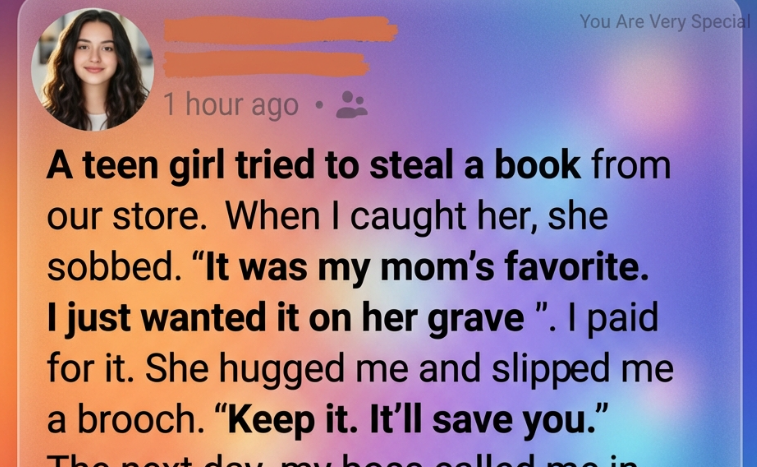
The bookstore had always been my quiet refuge from everything outside—sunlight pouring through tall windows, the familiar scent of aging paper drifting through the air, and a peaceful hush that made ordinary days feel gentle. I was shelving classic novels the way I had many times before, settling into the comfort of routine, when the doorbell chimed sharply and broke the stillness.
A teenage girl walked in, moving as if she hoped no one would notice her, swallowed by an oversized hoodie and weighed down by a backpack that hung awkwardly from her shoulders. Something about her presence shifted the atmosphere of the room, adding a subtle tension to the calm. Even before I understood why, a strange certainty settled in me that the rest of that day would unfold differently than my usual shift.
She lingered in the paperback section with hands that trembled, scanning titles with an urgency that felt deeper than browsing. Then I saw her slide a worn book into her open bag, and a heavy uneasiness ran through me. I knew the protocol—alert security, follow procedures, report the incident. I walked toward her expecting resistance, but she didn’t run or argue. Instead, she froze, turned to face me, and broke down in a way that felt raw and overwhelming.
Through shaking breaths, she told me the book was her mom’s favorite, the story her mother used to read every night before illness took over. Her mother had passed away the previous year, and the girl wanted to place that same story on her grave as a final, familiar token of love.
Standing there with her, the strict rules felt hollow. I took the book from her bag and carried it to the register. Without hesitation, I paid for it with my own card and handed it back to her. The way she looked at me—relief mixed with disbelief—felt like witnessing a weight lift off her shoulders.
She hugged me tightly, shaking, and whispered thank you in a way that held as much sorrow as gratitude. Before leaving, she slipped something into my hand: a silver flower brooch with a bright blue stone. She said her mom always called it lucky and believed it brought good things to kind people. I tried to return it, but the girl was already stepping back, offering a fragile smile before hurrying out the door.
The next morning, my manager called me into the office and played the security footage as if it were evidence of wrongdoing. He focused entirely on policy and regulations, dismissing the circumstances entirely. Within minutes, I was let go. I left the store with a cardboard box tucked under my arm, wondering if my decision had cost me more than I could afford. For several days, that question echoed around my mind—until the day I wore the brooch to an interview at an architectural firm I never imagined would even consider me.
Halfway through the interview, the hiring manager stopped mid-sentence, her eyes widening at the sight of the brooch pinned to my jacket. She asked where I had found it, and after hearing the story, she guided me directly to the owner’s office.
The moment he saw the silver flower, the expression on his face shifted from curiosity to something far more emotional. He revealed that the brooch had belonged to his late wife and that his daughter had disappeared with it years earlier after loss fractured their family.
That interview changed everything. Not only did the firm hire me, but the story of that day in the bookstore became an unexpected bridge between a grieving parent and his missing daughter. What began as a small act of compassion during a quiet moment in a dusty aisle ended up altering the course of my life and helping a family find a path back toward each other. It was a reminder that even the smallest choices can reach farther than we ever expect.