Before you attempt to explain your reaction or search for a logical reason behind it, the choice you made has already taken shape inside you. It did not come from a calculated decision. A deeper, quieter part of the mind responded first. Human perception often works this way: the unconscious observes, recognizes, and selects long before the conscious mind begins to reason.
Even the simplest choices—like feeling drawn to a familiar everyday object—carry emotional meaning. The cup that catches your attention does so through an inner association rather than coincidence. In the symbolic language of psychology, ordinary items can function as mirrors, revealing what the heart is processing beneath the surface.
Coffee itself symbolizes pause, retreat, stillness, and emotional grounding. People drink it in moments of reflection, stress, recovery, or conversation. Over time, the act of holding a cup or choosing one becomes linked to feelings of safety, familiarity, and internal regulation. This is why selecting a cup becomes an emotional act rather than an aesthetic one.
From the lens of analytical psychology, individuals continuously project parts of their inner experience onto the outside world. Shapes, colors, and textures act as symbols that resonate with present emotional needs. The connection is not about your entire personality, but about where your internal focus rests in this moment. This is what makes such an exercise simple, reflective, and surprisingly revealing.
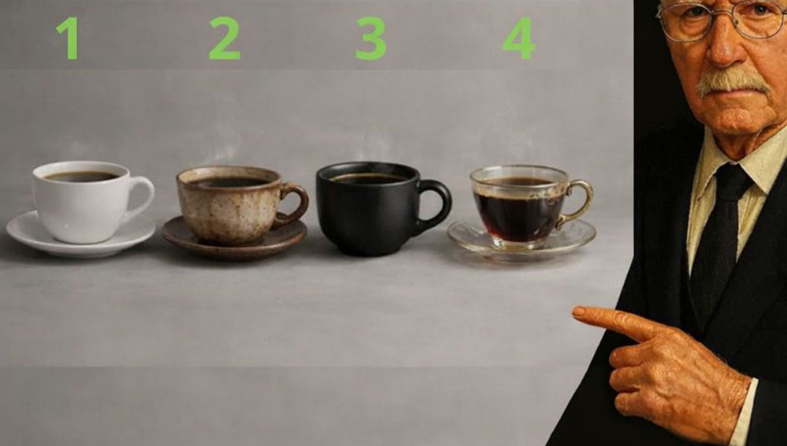
In front of you are four cups. Allow yourself to pause. Avoid analyzing or comparing them. Notice which one calls to you quickly, without explanation. Trust that immediate response.
If you chose the first cup: clarity, structure, and emotional regulation
This choice reflects a desire for order, balance, and coherence. You function best when life feels organized and predictable. You process emotions thoughtfully, preferring to understand them rather than express them impulsively. Others often see you as composed, steady, and able to remain clear-headed under pressure.
Deep down, you carry a quiet commitment to keeping life manageable for yourself and those around you. However, this tendency toward control can sometimes lead to emotional suppression. You may avoid asking for help or hesitate to reveal vulnerability. This does not come from coldness—it comes from high internal expectations. The cup signals a need to soften without losing your center.
If you chose the second cup: memory, emotional depth, and meaningful connection
Your inner life is closely tied to past experiences. Small details carry significance, and you value sincerity in relationships. You absorb moments deeply, remembering the emotions long after the events fade. This gives you natural empathy, allowing you to understand others without requiring explanations.
Your sensitivity to memory also brings challenges. It can be difficult to release attachments or step away from old chapters. Nostalgia can become a place of comfort, even when it limits you. The cup speaks to a need for integration—honoring the past while allowing new experiences to enter.
If you chose the third cup: strength, independence, and emotional intensity
A powerful inner presence defines you. You understand complex emotions and often carry strength that others rely on. You have learned to depend on yourself, building resilience through experience. You recognize emotions such as fear or anger without being overwhelmed by them.
However, this strength can become a form of emotional armor. You may keep distance to protect your inner world, and intimacy can feel risky. Suppressed feelings sometimes surface unexpectedly. The cup points toward a balance between courage and openness—maintaining your independence while allowing safe connection.
If you chose the fourth cup: intuition, sensitivity, and emotional attunement
You navigate life through feeling rather than logic. You sense energies, atmospheres, and unspoken emotions. Your empathy allows you to form meaningful bonds and understand others without words. Creativity and imagination flow naturally.
Your deep perceptiveness can also leave you vulnerable to emotional overload. You may take on the feelings of others without realizing it, leading to exhaustion. This cup highlights the need to create boundaries that protect your sensitivity while preserving your compassion.
Integration: seeing the four cups as one emotional map
The four cups do not define personality types. They represent emotional states that exist within everyone. The state you selected reflects your present internal landscape, not a permanent identity.
Clarity without emotional openness creates pressure.
Emotion without movement becomes stagnation.
Strength without softness becomes isolation.
Sensitivity without boundaries becomes overwhelm.
Growth emerges when each quality finds a place in your inner world.
Reflection and guidance
• Notice whether your chosen cup reflects balance or a protective pattern.
• Ask yourself which emotion you may have been postponing.
• Explore whether you need more release, more structure, more softness, or more grounding.
• View this exercise as a moment of observation rather than a final conclusion.
• Try the exercise again at a different time—your choice may shift with your emotional landscape.
The cup you felt drawn to does not speak about the object itself. It speaks about your current needs, your quiet desires, and the emotional space you are standing in right now. Self-understanding is a continuous path. Listening to the subtle signals of your inner world can guide you toward greater stability, compassion, and balance.