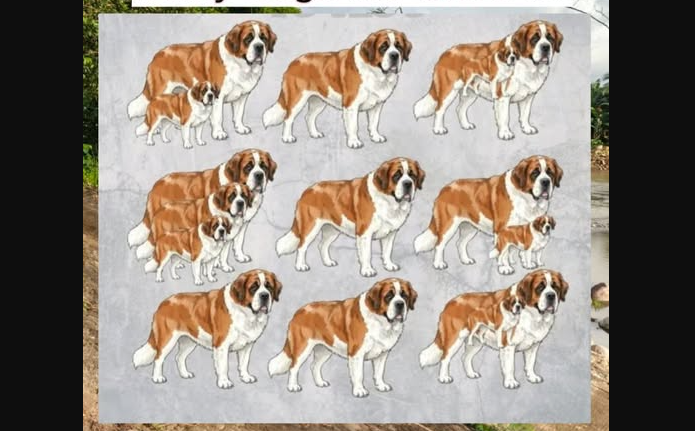
At first glance, this picture seems like a simple logic game. A group of St. Bernards appear lined up, calm and fluffy, waiting to be counted. The scene feels straightforward, so many people feel confident after a quick look. The image appears easy, familiar, and harmless. That sense of simplicity is exactly what makes this visual puzzle so intriguing, because there is far more going on than the first impression suggests.
When most people look for the first time, they usually arrive at the number 9. Those are the dogs that stand out immediately. They are clearly drawn, easy to recognize, and placed in the most visible parts of the picture. Our brains naturally lock onto the largest, sharpest shapes in any scene, and once they find a pattern that seems complete, they tend to stop searching. In many cases, the viewer feels confident, satisfied, and ready to move on, convinced the puzzle is solved.
The real challenge begins when you slow down and look again. Some dogs are not fully visible. A few are partially hidden behind others, tucked into corners, or blended into the background. Small shadows, curved lines, and faint outlines reveal heads, ears, paws, and tails that can easily be overlooked. A curve that first looked like part of the scenery may actually be the back of a dog. A patch of color that seemed decorative can turn into a muzzle once you trace it carefully.
Tiny details become clues. The tip of an ear near the edge of the image, a faint eye shape between two larger dogs, or a tail wrapping along a border can all signal a hidden animal. The more you practice this kind of careful observation, the more you notice how cleverly the shapes are arranged. The design takes advantage of the way the human eye prefers bold figures and tends to ignore subtle transitions.
This type of puzzle is an exercise in attention, patience, and visual discipline. A quick glance rewards speed, while a longer inspection rewards depth. The hidden dogs are placed so that they merge with existing outlines, encouraging the viewer to accept an incomplete count. The challenge is to resist the urge to stop when the answer “feels” correct and continue looking for what your mind has filtered out on the first pass.
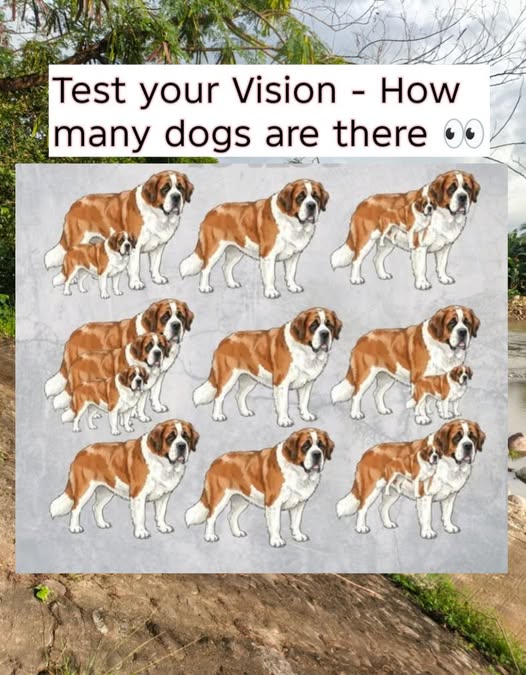
In total, there are 15 dogs in the image. That means six additional dogs remain hidden beyond the obvious nine. Some appear in overlapping lines. Others share their outlines with neighboring dogs, creating illusions where one contour serves two figures. Once you manage to spot one of the hidden six, something interesting happens: your brain begins to recognize the visual tricks that were used, and new dogs start to emerge more quickly. The pattern of concealment becomes familiar.
This puzzle does more than entertain dog lovers. It also delivers a gentle reminder about how perception works. Life often places information right in front of us, and the mind still skips over important details because the first story feels complete. When you train yourself to look closer, you strengthen the ability to notice what others pass by. That skill applies to conversations, decisions, and daily situations far beyond a single drawing.
The image itself is a small lesson in design. The artist has combined overlapping bodies, carefully placed lines, and subtle shading to hide the extra dogs without making them impossible to see. They are not invisible. They are simply quiet, waiting for a viewer who takes the time to explore every part of the picture. The satisfaction that comes from finally reaching all 15 is very real. It feels like unlocking a level of awareness that was there all along, waiting to be recognized.
If you stopped at nine dogs, that does not mean you failed. It simply shows how most minds prioritize strong shapes and central information. If you return to the image and search again, you give yourself another chance to train focus and patience. A helpful approach is to divide the picture into small sections. Study each corner, each edge, and each cluster of lines slowly. When you look at smaller areas, shapes that once disappeared into the whole scene become easier to pick out.
Another useful strategy is to search for repeated curves or patterns. Hidden dogs often share lines with other dogs or with background elements. If you notice a curve that resembles an ear, a nose, or a paw in more than one place, you may be looking at the outline of a concealed animal. Comparing nearby shapes and asking, “Could this belong to another dog?” can reveal outlines that were not obvious at first.
This kind of visual game becomes even more enjoyable when shared. You can invite friends or family to count the dogs and compare answers. Some will stop at nine. Others may claim twelve. A few will proudly insist they see all fifteen. The conversations that follow often lead to laughter, friendly debate, and plenty of “How did I miss that one?” moments.
So take a little extra time with this image. Let your eyes move slowly, explore every curve, and see how many of the fifteen dogs you can uncover. The challenge offers more than a number. It offers a chance to experience how your perception works, to stretch your attention, and to discover that reality often holds more than you noticed the first time you looked.