Most families talk about their holiday traditions with ease. They describe busy gatherings, familiar dishes, shared songs, and photos repeated year after year. Our tradition did not look like theirs. It was quiet. It was steady. And for many years, I did not understand the meaning behind it.
Every Christmas Eve, my mother prepared a full holiday meal in our small apartment. She moved through the narrow kitchen for hours, humming softly as she went from stove to counter. There was always a beautifully glazed ham, mashed potatoes rich with butter, green beans simmered with bits of bacon, and warm cornbread wrapped carefully in foil so the heat would not escape.
She set the table the way she always did. But one plate never stayed with us.
As a child, I finally asked her about it. I remember climbing onto a chair so I could see better while she placed food on the extra plate.
“That one is not for us,” she told me gently. “It is for someone who needs it.”
She spoke with complete calm, as though this was the most ordinary explanation in the world.
A Quiet Walk on Christmas Eve
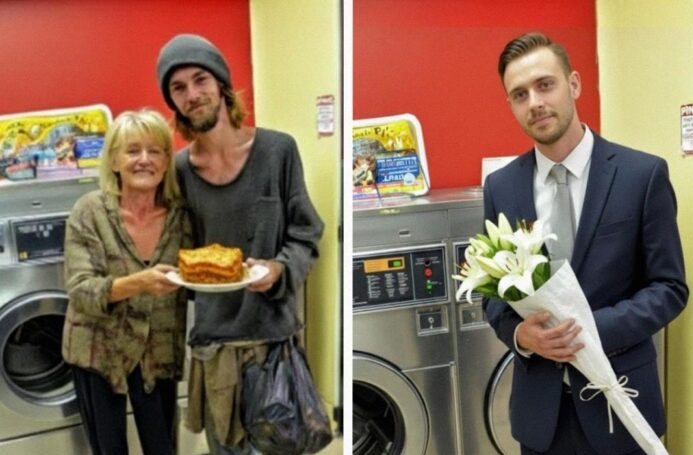
At the end of our street was a small laundromat that stayed open through the night. Its windows glowed into the darkness, and from a distance you could hear the soft hum of the machines. That was where a young man named Eli slept.
He kept to himself. A plastic bag. A worn backpack with frayed straps. He never asked anything of anyone. He tried to stay unnoticed.
Every Christmas Eve, my mother and I walked there together. She carried the plate with two hands, holding it the way someone carries something delicate. When she reached Eli, she always knelt beside him before offering the meal.
“I brought you dinner,” she said every year.
And his answer never changed. “Thank you, ma’am. You did not have to.”
Her reply was always the same: “I know. I wanted to.”
When I once asked if she ever felt afraid, she shook her head. She explained that true danger was not a polite man accepting a warm meal. True danger, she said, was hunger mixed with the feeling of being forgotten.
Lessons Learned by Watching
Over time, Eli shared pieces of his life with her. He talked about growing up in foster care. About losing his sister in an accident. About how stability made him uneasy. My mother listened without judgment and without stepping over his words.
She offered help more than once—resources, information, small steps toward change—but she never pushed. When he declined, she accepted his answer immediately.
And she kept showing up.
As a child, I did not recognize how much I was learning. There were no speeches about generosity. No rules or reminders. Only repetition. Each year, the same walk. The same plate. The same act of care.
For my mother, kindness was a way of living, not a special occasion.
The First Christmas Without Her
Years later, when my mother became very ill, our world grew quieter. Holidays passed with less celebration. When she was no longer with us, the thought of Christmas Eve felt overwhelming. I nearly avoided it entirely.
But her voice stayed in my memory. Steady. Certain. “It is for someone who needs it.”
So I cooked.
I followed her recipes as closely as I could. The kitchen felt still without her humming. I wrapped the cornbread in foil the way she always had and made the walk down the street on my own.
I hesitated when I reached the laundromat. I did not know what I would find. Eli had always been there before. A part of me feared the spot would be empty.
He was there. But not as I remembered him.
A Moment I Will Never Forget
Eli stood near the doorway wearing a pressed suit. In his hands, he held a small bundle of white lilies. For a long second, we said nothing.
He greeted me by name. Then he explained why he had come. He wanted to honor my mother. He told me she had changed the direction of his life in ways I never knew.
As we sat together, he shared something my mother had never mentioned.
Years earlier, at a crowded county fair, I had wandered off. In the confusion, I stepped into danger without realizing it. Eli had seen it and pulled me back to safety.
My mother never told me.
Instead, she quietly remained part of his life. She encouraged him. She helped him believe he deserved something better. She supported him without drawing attention to it.
The suit he wore was his. The confidence was his as well.
Understanding the Full Circle
We ate together that evening. Words were not needed. The silence felt meaningful and full.
In that moment, I finally understood what my mother had been doing all those years. It was not only about feeding someone in need. It was about honoring a connection. Returning care with care. Offering dignity without fanfare.
She helped him find stability again. And through those quiet actions, she protected me too.
Family, I realized, is not defined only by blood or shared names. Sometimes it grows from presence, from kindness offered freely, from showing up without expecting anything in return.
A Tradition That Continues
That Christmas Eve changed the way I see generosity. It does not always come with recognition. It does not always need an audience. Often, it looks like a warm meal carried down a quiet street.
My mother’s tradition continues in the way I try to move through the world now—in the way I pay attention to people who are easy to overlook, in the way I choose compassion even when it requires effort.
Every holiday season, I remember her words. And I remember Eli standing with lilies, a reminder that the impact of kindness often stretches farther than we ever expect.
Some traditions never need photographs. They continue in the lives they touch.