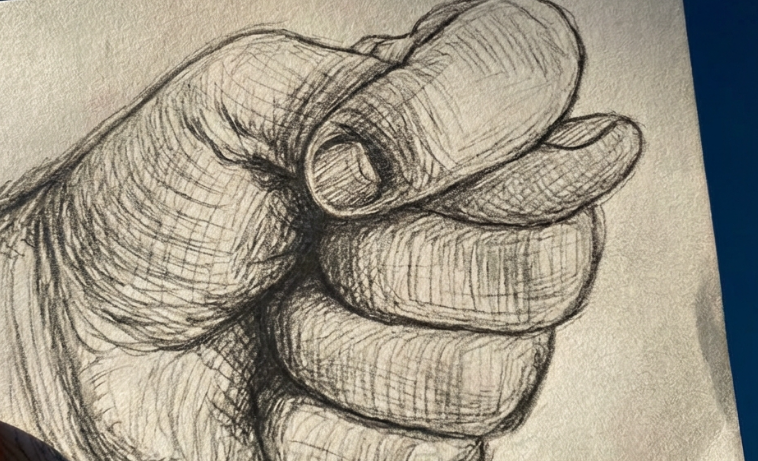
At first glance, the image appears to show nothing more than a closed hand, the fingers wrapped firmly together in a simple fist. But a closer look reveals something distinctive: the thumb is pressed tightly between the index and middle fingers.
This small detail shifts the meaning of the gesture entirely. What seems ordinary at first becomes a symbol once widely recognized across different cultures, known as “making a fig.” Before rapid communication and digital expressions took over, this understated motion carried messages that people understood instantly. With a single movement, someone could decline a request, express quiet resistance, or convey a playful refusal without speaking a word.
In the rural communities of 19th-century Europe, this gesture became an important part of daily interaction. It allowed people to communicate emotion and intent without escalating disagreements. Instead of raised voices or open confrontation, the hidden thumb offered a way to express firm boundaries with calm confidence.
Villagers used it to decline unreasonable demands, counter small acts of authority, or gently tease someone who pushed limits. Alongside its social function, the gesture held deeper symbolic meaning. Many traditions taught that the closed fist represented strength kept inward, while the tucked thumb served as a small charm meant to protect the person who displayed it. In some regions, it was quietly shown to guard against misfortune or shield oneself from the effects of what was known as the evil eye.
As years passed, the gesture settled into the rhythm of family life. Grandparents shared it with children during playful moments, using it as a safe and lighthearted response to teasing. It became a familiar sign during games, practical jokes, and simple banter.
For others, the gesture carried emotional significance. It appeared during departures at train stations, at the doors of homes before loved ones left, or in moments filled with nervous anticipation. It offered comfort without fanfare and reassurance without explanation. Through these experiences, it became part of a quiet vocabulary passed from one generation to the next.
Although time has moved forward and methods of communicating have changed, the memory of this gesture has not disappeared completely. With the rise of smartphones, social media, and digital icons, people now express refusal, humor, and emotion through screens instead of subtle hand movements.
Even so, for those who grew up seeing the fig gesture, its significance remains intact. It symbolizes a different era when communication relied more on presence, perception, and shared understanding. The gesture recalls a period when messages were expressed through small, intentional actions instead of typed characters.
Despite its simplicity, the fig gesture reflects a broader truth about human expression. People have always searched for ways to communicate meaningfully without causing conflict. This small motion allowed individuals to maintain dignity, express autonomy, and preserve harmony at the same time.
Even though it may no longer appear in everyday exchanges, the ideas it represents remain familiar: protection, self-assurance, humor, and the desire to express oneself with grace.
In the end, the gesture serves as a reminder of how much can be said with the hands alone. It shows that communication is not limited to spoken words.
A single movement, nearly hidden within the palm, can deliver a message filled with personality and purpose. For those who remember it, the fig gesture remains a quiet tribute to ingenuity in human connection, proving that subtlety often carries more truth than noise ever could.