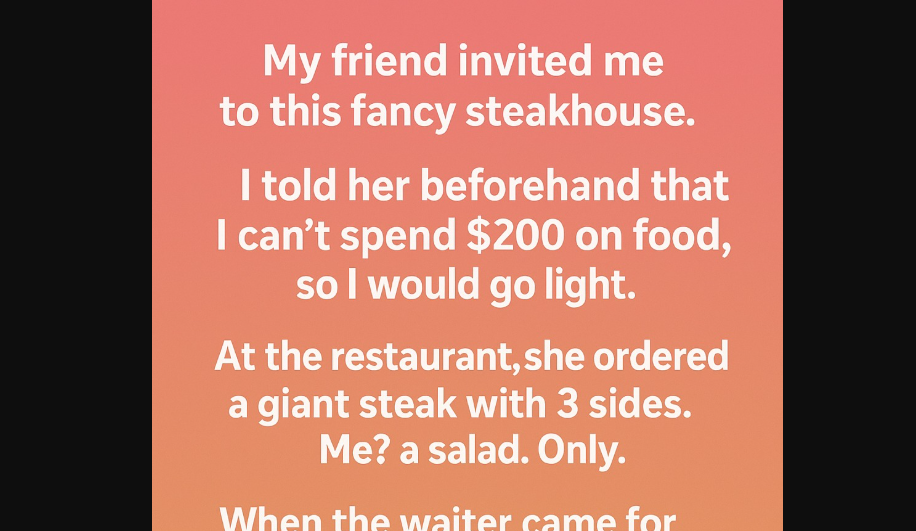
When my friend invited me to a high-end steakhouse, I felt both excited and uneasy. I looked forward to catching up, though I knew the restaurant had a reputation for steep prices. Before we finalized plans, I told her clearly that I could not afford an expensive dinner and would be ordering something modest. She responded cheerfully and said that was completely fine. Her tone reassured me, and I assumed we were on the same page.
When we arrived, the setting was elegant. Soft lighting reflected off polished glasses. The scent of grilled meat filled the air. As soon as the menus were placed in front of us, I felt a quiet reminder of why I had spoken up beforehand.
Without hesitation, she ordered the largest steak available, along with extra sides and a pair of specialty drinks. She seemed relaxed and confident in her choice. I kept my promise to myself and selected a simple salad and water. I reminded myself that the purpose of the evening was connection, not comparison.
We laughed and shared stories throughout the meal. The conversation flowed easily. I focused on enjoying her company rather than thinking about the cost of what sat in front of us.
When the plates were cleared and the waiter approached with a polite smile, she spoke quickly. “We’ll split the bill,” she said, as if it were the most natural conclusion.
My stomach tightened. I had already explained my situation. I had trusted that she understood. For a brief moment, I considered how uncomfortable it would feel to object in front of the waiter.
Then something unexpected happened.
The waiter returned carrying two separate checks and placed one in front of each of us.
Her expression shifted from certainty to surprise. She looked at me, confused. What she did not know was that earlier that afternoon, I had called the restaurant privately. I explained that I was meeting a friend, that my budget was limited, and that I wanted to pay for my portion in advance to avoid awkwardness. They were kind and discreet about it.
She glanced at her bill, then at mine. Realization dawned slowly.
“You could’ve told me,” she said quietly.
I answered gently. “I did mention that I couldn’t afford much tonight.”
Her shoulders relaxed, though a hint of embarrassment crossed her face. She admitted she assumed everything would balance out, because that is how she usually approaches shared meals. She had not paused to think about how different financial situations can shape comfort levels.
I felt no anger. I did not want the evening to become tense. Instead, I saw an opportunity to protect my boundaries while preserving our friendship.
“Next time,” I said with a light smile, “let’s go somewhere simpler. Tacos are always a good idea.”
She laughed, the tension dissolving almost instantly. The atmosphere shifted back to ease.
Moments like that are rarely about money alone. They are about listening. They are about respecting what someone shares, even when it seems small. Clear communication matters, though it only works when both sides pay attention.
As we left the restaurant, she hugged me tightly.
“Thank you for handling that the way you did,” she said. “You showed me something tonight.”
I realized I had learned something as well. Protecting your limits does not weaken a connection. It strengthens it. Boundaries are not barriers. They are expressions of self-respect.
That evening could have ended in resentment. Instead, it became a lesson in clarity and kindness.
The salad turned out to be fresh and satisfying. The real value, however, came from walking out with my dignity intact, my budget respected, and a friendship that felt more honest than before.
Sometimes the most meaningful part of a night out is not what is ordered at the table. It is the quiet confidence that comes from standing by your limits and discovering that true friends can grow from moments of truth.