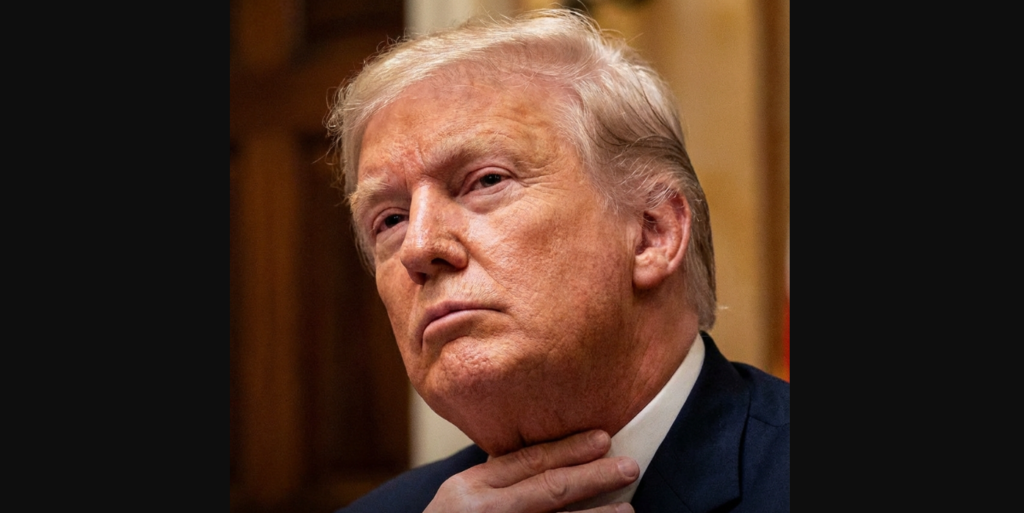
What began as a routine ceremony at the White House soon drew unexpected attention online. During a public appearance by Donald Trump, photographers captured images that showed a small mark near his neck along with noticeable bruising on one of his hands.
At first glance, the moment seemed like any other official event. Cameras flashed, guests gathered, and reporters documented the proceedings as they usually do. Within hours, however, those images began circulating widely on social media. Viewers zoomed in on the photos and started discussing what they had noticed.
In the modern digital landscape, even minor changes in the appearance of a public figure can generate widespread curiosity. Images spread quickly across news sites, online forums, and social media platforms. Many people asked whether the marks indicated a health concern, while others suggested they might have a routine explanation.
Attention had already been drawn earlier to bruising visible on Trump’s right hand. The mark appeared in photographs taken during meetings with several world leaders. One of the most widely shared images came from a visit involving Emmanuel Macron, when photographers captured the two leaders greeting one another during a formal engagement.
Observers quickly began offering theories. Some suggested the bruise could have resulted from routine medical procedures, while others proposed more ordinary explanations. Political leaders frequently shake hands with hundreds of people during public events, diplomatic visits, and campaign appearances. Repeated handshakes over long periods of time can occasionally leave marks, especially when combined with a demanding schedule.
The White House later addressed the topic. Officials explained that the discoloration likely resulted from the president’s frequent public interactions, including handshakes during official events. For individuals in high-profile leadership roles, these interactions can happen continuously throughout the day.
More recently, a separate moment drew renewed attention. During a Medal of Honor ceremony held at the White House, viewers watching the event noticed a reddish area on the right side of Trump’s neck. Photographs captured during the ceremony spread rapidly online, and discussions quickly followed.
Speculation soon appeared across multiple platforms. Some users wondered if the mark signaled a health concern, while others assumed it might be related to routine skin care or minor irritation.
In response to the growing online conversation, the president’s physician offered clarification. According to the medical explanation provided, Trump had been using a commonly prescribed topical cream as part of a preventative dermatological treatment. Certain medications applied to the skin can cause temporary redness or irritation while the treatment is active.
Doctors note that mild redness can remain visible for a short time after applying these types of creams. The effect typically fades as the skin adjusts to the treatment. The physician stated that the mark seen during the ceremony was consistent with this type of reaction.
Health discussions involving public officials often attract strong public interest. Leaders who appear frequently in media coverage are closely observed by viewers around the world. Small details that might pass unnoticed in everyday situations can quickly become topics of conversation when cameras capture them.
Medical professionals emphasize that minor bruising or temporary skin irritation does not automatically indicate a serious health problem. People with demanding schedules, frequent travel, and constant public appearances often experience physical effects related to stress, long hours, and repeated interactions.
For political leaders, the combination of public scrutiny and rapid online communication can amplify even small visual details. Photographs taken from a single angle or moment can travel across thousands of screens within minutes, creating questions that require clarification.
Despite the online speculation, official medical statements continue to indicate that the president remains capable of performing his responsibilities. Routine health monitoring and medical guidance are standard for individuals serving in high-profile government positions.
The episode illustrates how modern communication shapes public attention. In an era where images circulate instantly, details that once would have gone unnoticed can become global discussion points.
At the same time, medical experts often encourage patience when interpreting such images. Context, professional evaluation, and verified information provide a clearer understanding than quick assumptions formed from photographs alone.
Public curiosity about leaders is not new. What has changed is the speed at which observations turn into widespread debate. A small bruise or a temporary mark can spark thousands of comments and headlines within hours.
In the end, the situation serves as a reminder that visible details do not always tell the full story. Official medical explanations remain the most reliable source when questions arise about the health of public figures.
As conversations continue online, many observers recognize that routine treatments and minor physical marks are common experiences, even for individuals living under the constant spotlight of public life.