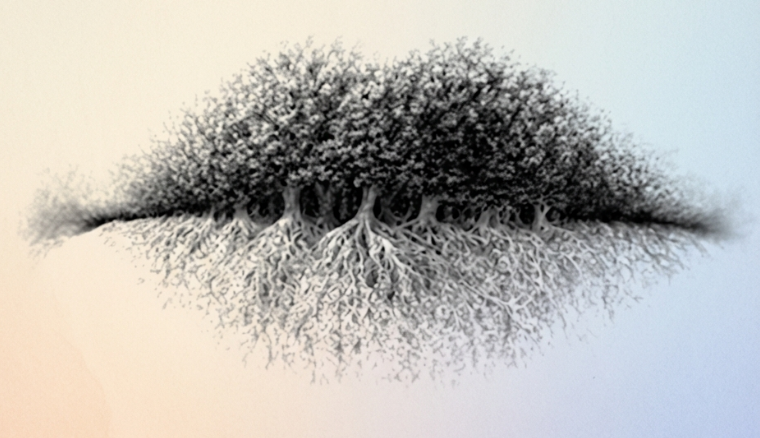
At first glance, the image appears simple and familiar. Many people look at it and assume they understand what they are seeing right away. Yet when you slow down and notice what your eyes focus on first, the picture may reveal something interesting about how your mind processes information.
Some viewers immediately notice a pair of lips. Others focus on the outline of trees rising upward. A smaller number of people identify the roots hidden deeper within the design. None of these observations are incorrect. The intriguing part lies in the speed with which your brain chooses one element over the others.
This type of visual puzzle is not a formal psychological test. It does not diagnose personality traits or predict behavior with scientific accuracy. Instead, it serves as a playful way to explore how perception and personal tendencies sometimes intersect.
Human brains process enormous amounts of visual information every second. In order to keep up with this constant stream, the mind filters details and highlights what seems most relevant. Past experiences, mood, environment, and attention patterns all influence what stands out first.
Optical illusions capture attention for this very reason. They demonstrate that two people can observe the same image while noticing completely different details. Each viewer interprets the visual signals according to their own mental patterns.
Internet culture has offered several well-known examples of this phenomenon. Debates about the color of a dress or the shade of a sneaker once spread across social media. Millions of viewers examined identical photos, yet their conclusions varied widely.
These differences do not mean that one person is correct while another is mistaken. Instead, they illustrate how perception works. The brain builds meaning from the information it receives, and that process is shaped by individual perspective.
Images that contain multiple interpretations encourage people to trust their first instinct. When you look at a picture like this, your attention naturally settles on the feature that feels most prominent.
If the first shape you recognized was the lips, your perception may lean toward balance and clarity. Rounded shapes and smooth outlines often attract the attention of people who value harmony in their environment. Individuals who notice these forms first are sometimes described as calm, practical, and steady during everyday challenges.
People with this tendency often communicate in clear, straightforward ways. Friends and family members may rely on them when situations become stressful. Their presence can bring reassurance during moments that feel uncertain.
However, maintaining that sense of stability for others sometimes leads these individuals to overlook their own needs. Remembering to create space for personal rest and reflection can help maintain balance.
If your eyes moved immediately toward the trees, your attention may naturally focus outward. Vertical shapes that rise above the surrounding image often attract people who are energetic and socially aware.
Individuals who see the trees first frequently enjoy interaction, discussion, and collaboration. They notice the environment around them quickly and may feel energized when connecting with others. Curiosity and expressiveness often accompany this pattern of observation.
Those who respond strongly to bold shapes may also appreciate new experiences and creative opportunities. They tend to adapt easily to dynamic situations and enjoy exploring ideas with friends or colleagues.
Another possibility involves noticing the roots hidden within the design before anything else. Roots require a closer look, which means your attention may lean toward deeper layers of meaning.
People who identify these subtle elements often value reflection and thoughtful conversation. They may enjoy examining ideas carefully rather than reacting quickly. Hidden details capture their curiosity, and they often seek understanding beneath the surface of everyday situations.
This pattern of perception can reflect patience and analytical thinking. Conversations with such individuals often move beyond quick conclusions and explore broader context.
It is important to remember that no single interpretation defines a personality. Visual perception can shift depending on mood, lighting, or even how long someone studies an image.
These playful exercises serve as reminders of how diverse human perception can be. A single picture can inspire several viewpoints, each shaped by individual attention patterns.
In daily life, similar differences appear during conversations, creative projects, and problem-solving situations. One person might focus on practical details, another on relationships, and another on underlying patterns.
Observing how people interpret the same information offers a glimpse into the complexity of human thinking. It shows that perception is not fixed. It evolves through experience, environment, and curiosity.
A simple image can become an invitation to pause and reflect on how our minds work. In that moment, we recognize that everyone brings a unique perspective to the world around them.
And sometimes, a picture that looks ordinary at first glance turns out to reveal something fascinating about the way we see.