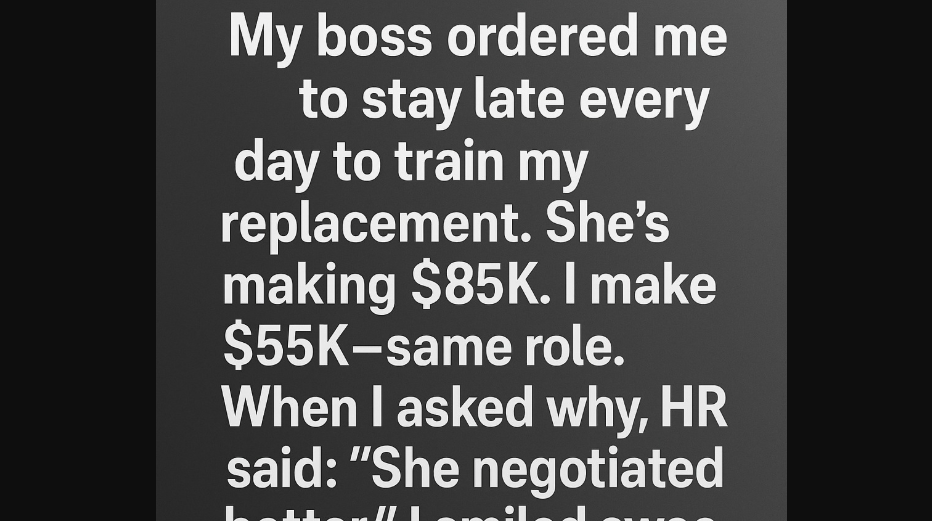
The first sign that something felt unusual came during a quiet afternoon at work. My boss called me into his office and asked if I could stay late throughout the week. The explanation sounded simple: a new employee would be joining the team, and I would help train her before transitioning out of the role.
At first, the request sounded routine. Training new staff members often falls on experienced employees, and I had helped onboard several colleagues in the past.
Still, something about the conversation felt different.
The tone carried a strange sense of urgency, and my boss avoided eye contact while explaining the plan. He emphasized how important it was that the transition go smoothly and how much he appreciated my cooperation.
I agreed, although a quiet sense of curiosity stayed with me.
Later that day, during a brief conversation with the Human Resources department, the situation became clearer.
And far more surprising.
A Number That Changed Everything
While discussing paperwork related to the transition, someone in HR casually mentioned the salary associated with the role moving forward.
The number they mentioned stopped me in my tracks.
Eighty-five thousand dollars.
For a moment I thought I had misunderstood. I asked politely if that figure referred to the position I had been holding for years.
The representative confirmed it without hesitation.
My salary had been fifty-five thousand dollars.
The same job, the same responsibilities, and a difference that suddenly felt impossible to ignore.
I asked how that difference could exist.
The HR representative offered a short response that felt surprisingly casual.
“She negotiated better.”
A Different Kind of Decision
The answer could have led to a long argument. Many people might have reacted immediately with frustration or anger.
Instead, something else happened.
The moment carried a strange sense of clarity.
Rather than pushing back right away, I smiled and said that I would happily continue helping with the transition.
The HR representative nodded and moved on with the conversation, seemingly unaware of the shift taking place in my mind.
That evening I stayed at my desk long after most of the office had gone home.
I began reviewing every responsibility I had handled over the years.
The list grew quickly.
Two Very Different Lists
The next morning, two neatly organized stacks of documents sat on my desk.
Each page represented work I had performed during my time in the role.
The first stack contained the tasks listed in my official job description. These were the duties the company had formally assigned to the position.
The second stack told a much larger story.
Those pages listed everything I had taken on voluntarily over the years—projects, emergency fixes, technical support, vendor negotiations, and internal conflicts that required immediate solutions.
Tasks that had slowly become part of my daily routine.
Tasks that had never appeared in the official description of the job.
When my boss walked into the office that morning, he stopped in place the moment he saw the two labeled stacks.
One stack read: “Official Job Duties.”
The other read: “Tasks Performed Voluntarily.”
Beginning the Training
My replacement arrived later that morning.
She seemed friendly, enthusiastic, and ready to begin learning the role she had accepted. I welcomed her and started explaining the structure of the position.
From the beginning, I focused entirely on the responsibilities listed in the official description.
I walked her through the systems she would use each day. I explained the reports she would prepare and the processes the department expected her to follow.
When questions arose about more complicated situations, I offered a consistent response.
“You may want to check with management on that,” I said calmly. “That responsibility was never formally assigned to me.”
The room grew noticeably quieter each time I repeated that sentence.
Behind us, my boss remained unusually silent.
The Invisible Work Revealed
Throughout the day, my replacement asked thoughtful questions.
How were vendor disputes handled?
What steps should she follow when software errors disrupted the workflow?
Who managed the emergency escalations that sometimes appeared without warning?
Each of these situations had once landed directly on my desk.
Each time the same response followed.
“That process was never formally assigned to this position.”
Slowly, the full picture became visible.
My boss shifted uncomfortably in the background as the conversation continued.
Responsibilities that had quietly accumulated over years were returning to his attention one by one.
A Conversation With My Replacement
By the second day, my replacement began to understand the situation more clearly.
During a break in the afternoon, she admitted something that surprised me.
She had accepted the position believing the responsibilities matched the description she had received during the hiring process.
The salary made sense within that context.
However, the long list of additional tasks revealed that the role had grown far beyond its original scope.
She did not appear angry or defensive.
Instead, she thanked me for explaining everything honestly.
Transparency helped her prepare for what the position might require moving forward.
A Different Atmosphere in the Office
Meanwhile, the mood in the hallway changed noticeably.
My boss spent much of the day making quiet phone calls and stepping in and out of meetings.
Every advanced task that returned to his desk created another conversation.
For the first time in years, the full scope of the workload became visible to management.
The comment from HR—“she negotiated better”—no longer carried the same sting.
It had revealed something far more important.
Understanding personal value begins with recognizing the work that often goes unnoticed.
The Final Day
By the final day of training, every item listed in the official job description had been explained thoroughly.
My replacement felt confident about the responsibilities she had accepted.
Before leaving the office that afternoon, I placed a single envelope on my boss’s desk.
Inside was a resignation letter.
The letter explained that my time with the company had been valuable and that I appreciated the experience I had gained.
The resignation would take effect immediately.
My replacement wished me well and thanked me again for helping her understand the role honestly.
My boss looked at the stacks of responsibilities that now required attention and remained silent for a long moment.
Moving Forward With Confidence
Walking out of the building that day felt different from any other departure I had experienced.
The weight of unrecognized work had lifted.
Two weeks later, I accepted a new position at another company.
This time, the conversation about responsibilities and salary looked very different.
I approached the negotiation with confidence and clarity about the value of my experience.
Because once someone truly understands their worth, future opportunities become easier to evaluate.
Recognizing that value changes every professional decision that follows.