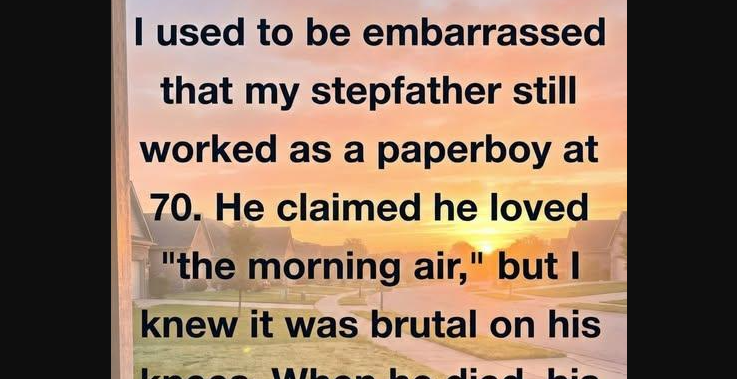
For as long as I can remember, Patrick followed the same routine every morning.
He woke before sunrise. The kitchen light flickered on while the rest of the neighborhood still slept. Coffee brewed quietly while he folded newspapers into tight bundles with practiced hands. By the time the sky began turning pale gray, he was already heading out the door with his old bicycle and a canvas bag slung over his shoulder.
Whenever I asked why he kept doing it, his answer never changed.
“The route’s my responsibility.”
To me, it looked like a simple paper route. A small habit that filled his retirement years with purpose. I assumed he enjoyed the quiet mornings, the rhythm of riding through empty streets while the town slowly woke up.
Patrick was not a man who explained much. He spoke in short sentences and calm tones. He rarely talked about the past. Over time, I stopped asking questions.
Then, six months ago, everything changed.
It happened on a Sunday morning, during the largest delivery of the week. The Sunday edition was thick, filled with advertisements and long features that made each bundle heavier than usual.
Patrick was halfway through the route on Maple Street when he collapsed.
A neighbor later told me what happened. Patrick had stopped beside the curb to adjust his stack of papers. One hand rested on the bundles while the other pressed against his chest. The heart attack came quickly. By the time someone called for help, he was already gone.
The funeral reflected the kind of man he had been.
Quiet. Simple. Respectful.
Neighbors came to pay their respects. A few of my mother’s friends stood near the back of the chapel. I recognized many of the faces from the neighborhood. People who had received their newspapers from Patrick for years.
During the service, I noticed someone unfamiliar standing near the door.
He wore a dark suit that looked new and carefully pressed. His posture felt formal compared to the casual presence of the others in the room. He did not look like someone from the neighborhood.
After the service ended, he walked directly toward me.
“Mr. Hayes?” he asked politely, extending his hand. “Martin O’Connell.”
I shook his hand, unsure where I had seen him before.
“I was Patrick’s manager at the Town Herald,” he continued.
I nodded slowly. “Thank you for coming. He took the route very seriously.”
Martin hesitated for a moment before speaking again. He lowered his voice slightly.
“Alistair… there’s something you should know.”
My stomach tightened.
“Patrick never actually worked for the Town Herald,” he said.
I stared at him, confused.
“That can’t be right,” I replied. “He left every morning. He collected a check every week.”
Martin nodded.
“Yes. The checks were expense allowances. I signed them myself.”
The words did not make sense.
“The paper route… was a cover,” he continued. “It had been for twenty years.”
He reached into his jacket pocket and placed a heavy card in my hand.
There was no company name printed on it. No logo. No address. Only a phone number and two initials.
C.B.
“Patrick asked me to give you this after the funeral,” Martin said.
“For what?” I asked.
“In case you ever wanted to know who he really was.”
That night, I drove home feeling as though I had stepped into someone else’s story. The house felt empty without Patrick’s quiet presence.
My mother had passed away years earlier. Patrick had been the only other person living there. Now the silence carried questions I had never considered asking.
The next morning, I picked up the phone and dialed the number on the card.
A calm voice answered.
“C.B.”
“My name is Alistair Hayes,” I said carefully. “My stepfather was Patrick Hayes.”
There was a pause on the line.
Then the voice softened.
“Please come in,” the person said. “He was well respected here.”
The office was located in a plain building downtown. From the outside, it looked like any other administrative office. Nothing about it suggested anything unusual.
Inside, security procedures were extensive. Identification was checked. I was escorted through several doors before reaching a conference room.
A woman named Catherine greeted me.
She spoke clearly and directly.
Patrick, she explained, had spent decades working in government intelligence operations focused on financial investigations. His specialty involved tracking hidden money movements across international networks.
He had the rare ability to follow complicated financial trails that others overlooked.
Within their organization, they had a nickname for him.
The Ghost Finder.
The paper route had been a perfect disguise. Delivering newspapers placed him on the streets early in the morning, allowing him to observe patterns, routines, and locations without attracting attention.
Some of the houses on his route were not ordinary customers.
They were contacts.
Certain deliveries occasionally carried more than newspapers. Hidden messages, coded information, and encrypted storage devices sometimes traveled quietly inside the bundles.
The routine that had seemed so ordinary to me had served a far more complex purpose.
Catherine explained that two years earlier, Patrick helped investigators dismantle a large international financial crime network.
His breakthrough began with a single transaction that appeared slightly unusual.
He noticed it while reviewing financial data connected to a routine contact. That small detail led investigators toward a chain of shell companies and hidden transfers that eventually exposed the entire operation.
I sat there quietly as she described the work he had done.
For years, I had believed Patrick spent his mornings delivering newspapers to quiet streets.
The truth revealed a life far more complicated than I had ever imagined.
And somehow, he had carried that secret with the same calm patience he showed every morning when he left the house before sunrise.