Sunlight poured through tall windows, warming the wooden floors and casting soft shadows between the shelves. The air carried that familiar scent of paper and ink, a comforting mixture that made every shift feel calm and protected from the outside world. It was the kind of place where time slowed down, where conversations stayed soft, and where stories lived quietly on every shelf.
That sense of peace stayed constant—until one afternoon.
The door opened gently, and a teenage girl stepped inside. There was something about her presence that felt different. Her hoodie was pulled low over her face, and her backpack hung heavily from her shoulders. She moved carefully, almost as if she hoped not to be noticed.
Still, something in the way she hesitated made me pay attention.
She wandered toward the paperback section and stood there longer than most customers usually did. Her hands hovered over the books, trembling slightly as she scanned the titles. She kept glancing around, not with curiosity, but with unease.
Then I saw what happened.
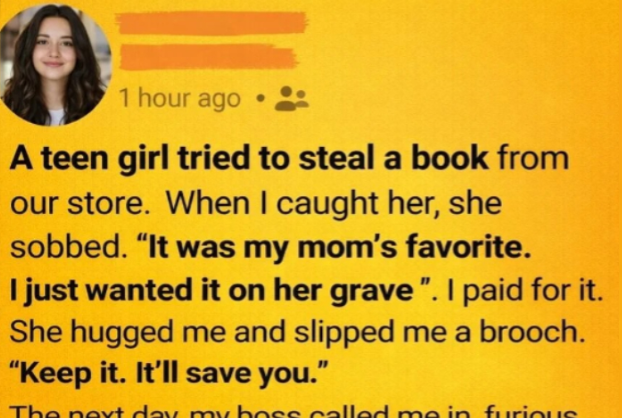
Slowly, deliberately, she slipped a worn paperback into her bag.
The movement was careful, practiced, and quiet.
I walked toward her, unsure of what I would say. Store policy was clear about situations like this, though something about her made me hesitate. When she noticed me approaching, she didn’t run.
She froze.
And then, unexpectedly, she began to cry.
Her composure broke completely as tears filled her eyes. Through uneven breaths, she explained why she had taken the book. It had been her mother’s favorite story. When her mother was still alive, she used to read it aloud every night.
Her voice shook as she spoke about losing her the year before.
She wasn’t taking the book for herself. She wanted to place that exact story on her mother’s grave, as a way of saying goodbye in a language she understood.
In that moment, rules and policies felt distant.
I walked quietly to the register, purchased the book with my own money, and returned to her. When I handed it to her, she looked surprised, then relieved. She hugged me tightly, holding onto the book as if it carried something far beyond paper and ink.
Before she left, she placed something small into my hand.
It was a silver flower brooch with a blue stone in the center.
“It’s lucky,” she said softly. “My mom said it would save you.”
Before I could respond, she stepped out of the store and disappeared into the street.
The next day, everything changed.
My manager called me into his office and showed me the security footage. He explained that I had violated store policy. There was no room for discussion. By the end of the conversation, I no longer had a job.
The bookstore, the place that had felt like a safe corner of the world, was no longer mine.
Days passed quietly after that. I carried the brooch with me, unsure why I kept it, though I felt reluctant to let it go.
A week later, I wore it to a job interview.
It was an opportunity I didn’t expect to receive, and I walked into the building with little confidence. During the interview, the woman across the desk suddenly paused mid-conversation.
Her eyes fixed on the brooch.
She asked where it had come from.
When I told her the story, she listened carefully, then stood up and asked me to follow her. She led me down a hallway and into another office.
Inside was the owner of the company.
The moment he saw the brooch, his expression changed. He recognized it immediately. It had belonged to his late wife, something their daughter had lost years earlier.
What began as a small act of kindness inside a bookstore had unexpectedly connected me to a family searching for something they thought was gone forever.
That single moment, which had cost me my job, opened a door I never anticipated.
It reminded me that actions guided by compassion may not always bring immediate reward. Sometimes they lead through uncertainty, through loss, and through unexpected change.
Yet, in ways that cannot be predicted, they also create connections that shape the future.
Walking out of that office later that day, I understood something I had never fully realized before.
Kindness has a way of returning.
Not always quickly. Not always in the same form.
But when it does, it carries a meaning far greater than the moment it began.