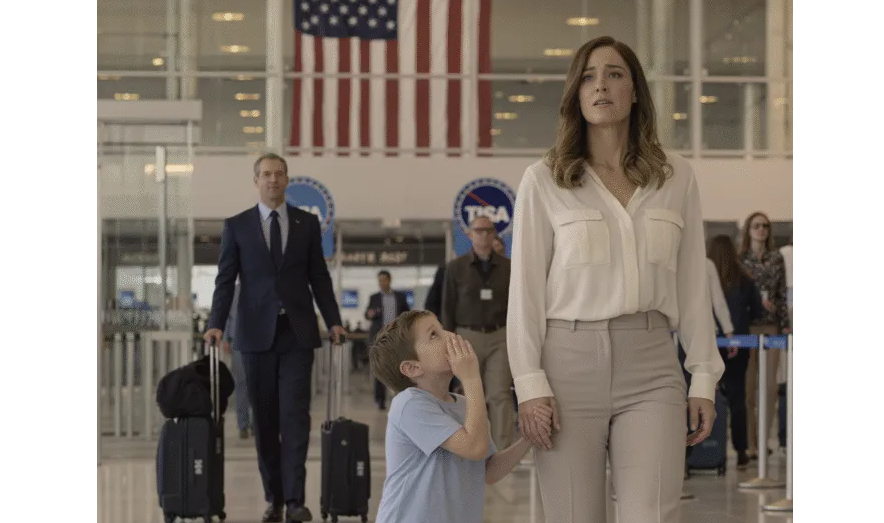
The airport terminal carried the layered scent of coffee, disinfectant, and something harder to describe—restlessness that seemed to linger in the air.
That was the first thing I noticed as we stood near the security checkpoint at Hartsfield–Jackson, watching people move quickly past us with rolling suitcases and distracted expressions. Some held half-finished drinks, others checked their phones as they walked. The fluorescent lights above us felt too bright, casting everything in sharp, unforgiving detail. A television mounted near the ceiling played a muted report about traffic on I-85 and an approaching storm system, its sound blending into the background noise of announcements and footsteps.
It should have felt routine.
Another Thursday evening. Another trip for work.
Yet something inside me felt off, though I couldn’t explain why. I was tired in a way that had nothing to do with sleep. It was the kind of exhaustion that builds quietly over time, the result of carrying responsibilities without pause, without anyone asking if you needed a moment to rest.
My husband, Quasi, stood beside me, composed as always. His gray suit was pressed with precision, his shoes polished to a mirror shine, his leather briefcase resting comfortably at his side. He carried himself with ease, as though everything in life followed a clear and controlled plan. The cologne I had given him for his birthday still lingered faintly, familiar and comforting in a distant way.
To anyone watching, we likely appeared as a family that had everything in order.
A successful man, a supportive wife, and a child standing close between them.
Our son Kenzo held my hand, his small fingers slightly damp against my palm. At six years old, he was usually full of quiet curiosity, always observing the world around him. He wore his favorite Hawks hoodie, and his sneakers lit up each time he shifted his feet. His dinosaur backpack hung unevenly on his shoulder, filled with small treasures he carried everywhere.
That evening, something about him felt different.
He stood too still, his gaze moving carefully from one detail to another, as if he were searching for something. There was a tension in his posture that didn’t belong to a child.
“This meeting in Chicago is important,” Quasi said, pulling me into a brief embrace. His tone was warm, practiced, steady. “Three days, and I’ll be back.”
I nodded, offering the same calm response I always gave. “We’ll be fine.”
Kenzo’s grip tightened.
Quasi crouched down in front of him, placing his hands gently on his shoulders. “Take care of Mama for me,” he said.
Kenzo nodded, though he didn’t speak. His eyes stayed fixed on his father’s face, and something about that look unsettled me more than I could explain.
Quasi kissed his forehead, then my cheek, and turned toward the security line. Within moments, he disappeared into the steady flow of travelers moving toward their gates.
I watched until I could no longer see him. Only then did I realize I had been holding my breath.
“Let’s go home,” I said softly.
We walked toward the parking area, our footsteps echoing faintly against the polished floor. Shops were closing for the night, and announcements flickered across the departure boards overhead. People hurried past us, focused on catching their flights.
Kenzo slowed down.
“You okay?” I asked.
He didn’t answer.
Near the exit doors, he stopped abruptly.
“Mama.”
His voice made me turn immediately.
“What is it?”
He looked up at me, fear clear in his expression. “We can’t go home.”
I knelt in front of him, trying to stay calm. “Why would you say that?”
“Something bad is going to happen,” he said, his voice trembling.
I held him closer, speaking gently. “You’re safe. Everything is okay.”
He shook his head. “You have to believe me.”
There was something in the way he said it that made me pause.
I asked him to explain.
His words came quietly, almost as if he was afraid someone else might hear. He described what he had overheard that morning—his father speaking on the phone, saying something about needing to be far away, about something happening while we were asleep.
At first, I wanted to dismiss it. To explain it away as a misunderstanding.
But memories began to surface. Small details I had ignored before. Conversations that didn’t fully make sense at the time.
I stood slowly, my thoughts racing.
“I believe you,” I said.
Relief spread across his face instantly.
We left the airport and drove, taking a longer route than usual. When we reached our neighborhood, I stopped a short distance away, keeping the car hidden from view.
Our house looked unchanged. Quiet. Still.
We waited.
After a few minutes, a dark van appeared, moving slowly down the street. It stopped near our home. Two men stepped out and approached the door with purpose. One of them used a key.
They entered.
A moment later, I noticed smoke.
Then flames.
The realization hit all at once.
We had been meant to be inside.
Kenzo held onto me as we watched from a distance, the glow of the fire reflecting in the night. Sirens approached, and the van disappeared as quickly as it had arrived.
My phone vibrated. A message from Quasi appeared on the screen, simple and calm.
I stared at it, then at the house.
And in that moment, everything became clear.
If I had ignored my son’s fear, we would have been there.
Asleep.
And as the fire spread, one thought settled heavily in my mind—this was not the end of it.