The short version is the one I tell when someone at a bar looks at me like I must be making it up. They cut down my trees for a better view, so I closed the only road that led to their front doors. That is the story in one line. People usually stop whatever they are doing when I say it. They stare at me for a second, waiting for the punch line. There isn’t one. I never tell it as a joke.
The longer version began on a Tuesday so ordinary that remembering it still feels strange. The sky was bright, the air carried that late-September warmth that lingers after summer starts loosening its grip, and I was at my desk eating a turkey sandwich while reading emails about a permit application. Nothing important. Nothing dramatic. Then my sister Mara called.
Mara never calls during work hours. She sends texts. She leaves voice notes that trail off before she reaches the point. She sends random photos of things she thinks I should see. A call from her at two in the afternoon meant something had gone very wrong. I picked up with half a bite of sandwich still in my mouth and said, “Hey, what’s up?”
All I heard at first was wind and the sound of her breathing, fast and tight, like she had crossed the yard in a hurry.
“You need to come home,” she said. “Right now.”
There is a tone people use when they are trying hard not to sound afraid. They keep their voice level. They speak carefully. That control tells you more than panic ever could. That was the tone Mara had.
“What happened?”
“Come home, Eli.”
I left without even shutting my laptop properly. I told my manager there was a family problem and I would explain later. Then I grabbed my keys and drove faster than I should have on the county road, hands locked on the wheel, radio silent, not letting myself fully picture what waited for me.
Pine Hollow Road branches off the highway and curves east through low hills. I have driven it thousands of times. I grew up at the end of it. I left for a while. I came back when my father got sick. After he died, I stayed. Sometimes land keeps hold of you in a way that feels natural and permanent.
I knew something was wrong before I rounded the final bend. A place feels different when something old has been removed from it. You may not see it at once. You feel it first, the way you notice when furniture has been moved in a dark room. The proportions change. The light lands somewhere new. Something in the shape of the world no longer fits.
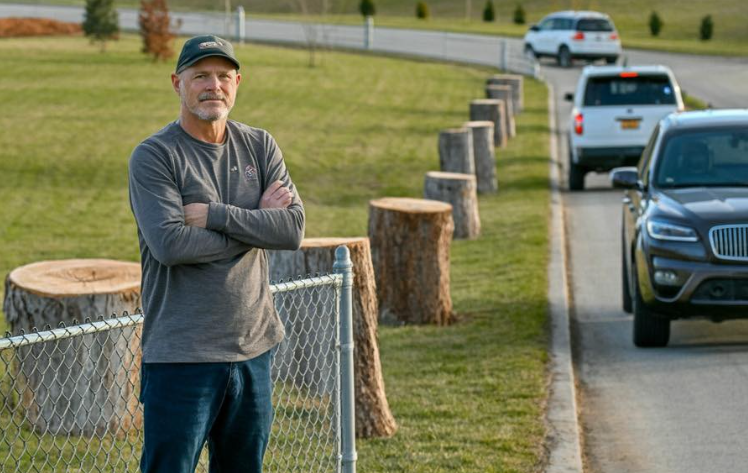
The six sycamores along the eastern edge of my property were gone.
Not split by lightning. Not rotten and fallen. Gone. Cleanly cut. Six stumps in a straight line where six trees had stood for longer than I had been alive. They were big trees, the kind that had spent decades thickening into themselves until they carried a kind of presence. My father planted three of them when I was little. The other three were already there when we arrived, older than us, rooted deep in that ground. Together they formed a green wall along the edge of the yard. They gave shade in August. They gave privacy all year. From upstairs windows, I had always looked east and seen sycamore leaves.
Now I looked east and saw open sky and the glass-faced houses of Cedar Ridge Estates staring down from the hill.
Mara stood near the fence line with her arms folded, her jaw tight.
“I tried to stop them,” she said.
I looked at her. “What do you mean you tried to stop them?”
She had been home when the trucks arrived that morning. Two trucks. Company logo on the doors. Men in hard hats, orange shirts, chainsaws, a chipper. She walked out and asked what they were doing. One of them told her they were following a work order. She asked whose work order. He said Cedar Ridge Estates HOA.
Cedar Ridge sits on the ridge east of my land. It went in about five years earlier, complete with a stone entrance sign, a decorative fountain, oversized houses, oversized windows, and the sort of homeowners’ association that sends formal reminders about appearance and standards. My family’s property had been there decades before Cedar Ridge existed. We were not part of their development. We were not under their authority. We were not included in their plans.
There was a business card tucked under my windshield wiper. Summit Tree and Land Management.
I called the number standing right there in my front yard. A man answered with the upbeat tone of somebody handling routine business. I gave him my name, told him where I was standing, and asked him to explain why six trees on my property had been cut down. I could hear him shuffling papers while he checked the file. Then he said the HOA president had approved boundary clearing along the south overlook because the trees were obstructing the community view corridor.
View corridor.
As if my trees were a paperwork issue. As if forty years of growth could be reduced to a phrase from a planning memo.
I told him plainly that the land was mine, the trees were mine, and Cedar Ridge had no business touching anything on that side of the boundary. He went quiet. When he spoke again, his voice had changed. He said he may have been given incorrect survey information and suggested I contact the HOA. That careful shift in tone told me he understood what had happened and what it could cost him.
I thanked him, ended the call, and stood among the stumps.
The cuts were smooth and professional. The rings showed clearly on every trunk. On the largest stump I counted more than forty. More than forty years of growth in that one spot. More than forty years pulling water from that soil, filtering the air, casting shade across the yard on hot afternoons when the porch was the only comfortable place to sit.
I remembered my father teaching me how to plant properly. Angle the shovel first. Loosen the soil in a circle. Set the root ball lower than feels necessary because the ground settles. Press the soil firm, not hard. Water slowly so it sinks in. He was exact about every step. The trees he planted were still standing when he died. That had always mattered to me. It still does, even now.
Mara said what both of us already knew. “They did it for the view.”
She was right.
The ridge faces west. My sycamores had blocked Cedar Ridge’s sunsets, that long gold light that falls across the valley in autumn and winter and makes expensive homes feel even more valuable. From their decks and patios and kitchen windows, those six trees stood between them and the perfect image they thought they had paid for. By noon that day, the trees were gone and the view was wide open.
I got back in my car and drove up to Cedar Ridge.
I was angry, though not in the loud way people imagine. My anger had already gone cold and sharp. I was thinking clearly. I was thinking about facts, boundaries, documents, proof. I drove through the stone gate, past the trimmed lawns and the broad sheets of back-facing glass, until I found the house with the decorative fountain in front. Every HOA bulletin I had ever seen carried the same signature at the bottom.
Gordon Hale.
He answered the door in golf clothes, visor still on, with the expression of a man mildly annoyed to find someone on his porch.
“Yes?”
“Your contractors cut down six trees on my land this morning,” I said.
He looked at me with complete calm. No apology. No uncertainty.
“We cleared the view corridor,” he said. “Those trees were affecting property value for twenty-seven homeowners.”
“The trees were on my property.”
“Our survey says otherwise.”
“Your survey is wrong.”
He gave me a polished smile, the kind practiced by people who mistake confidence for authority. “Then I suggest you get your own survey.”
I looked past him through the wall of glass at the view beyond. My yard. My land. My house roof in the distance. The valley stretched open under a clean sky.
“You mean a view,” I said.
He did not correct me.
“You don’t live up here,” he added, with that careful edge people use when they want to sound superior without saying it outright. “You wouldn’t understand what we’re dealing with.”
I looked at him, then at the open horizon behind him.
“You’re right,” I said. “I don’t live up there.”
Then I left.
What Gordon Hale either did not know or did not care to find out was this: Pine Hollow Road, the only paved road in or out of Cedar Ridge Estates, crosses my property for six-tenths of a mile before it reaches the county-maintained road below. Back in 1989, when the ridge above was still scrub and deer paths, a developer wanted access. My grandfather did not sell the strip of land. He granted an easement.
That distinction meant everything to him.
A sale changes ownership. An easement gives passage while the land remains yours. He had the agreement drafted carefully by a county attorney and kept copies of every document. I learned that habit from him. The file was in the hallway cabinet between the tax records and the original survey from 1967.
I pulled it out and read it again at my kitchen table.
Non-exclusive right of passage for residential access only. Subject to maintenance compliance and continued use within scope of original grant. Modification of the easement corridor or adjacent landowner’s parcel requires written consent.
Modification.
Like showing up with chainsaws and a chipper and removing forty-year boundary trees without permission.
I called my attorney, Denise Alvarez. She practices property law in the county seat and treats language the way a surgeon treats a blade. Precise. Controlled. Reliable. She told me to start from the beginning. I did. She listened all the way through.
When I finished, she said, “If the trees were on your parcel, that is trespass. It may also qualify as timber theft under state law depending on valuation. Using the easement corridor to alter your land without consent is a scope violation. They have the right to pass through. They do not have the right to improve their view by cutting your trees.”
“Can we suspend the easement?”
“We can seek suspension pending resolution,” she said. “It is conditional. If they violated the conditions, you can enforce that.”
The hardware store was still open. I bought orange survey posts, chain, a padlock, and two laminated signs. Early the next morning, before sunrise, I drove the posts into the ground where Pine Hollow Road entered my property. I stretched the chain between them and locked it in place.
On the signs I printed:
PRIVATE PROPERTY
EASEMENT UNDER REVIEW
NO ACCESS PENDING LEGAL RESOLUTION
Then I went inside, made coffee, and waited.
My phone rang at 7:02. I let it ring. By 7:15, three SUVs had stopped at the chain. By 7:30, Gordon Hale was on my porch.
“You cannot do this,” he said through the screen door.
“It’s my land,” I said.
“You are trapping people in their homes.”
That word came up many times that day, so I want to be accurate about it. Nobody was trapped. The paved route was closed. There was another way out, about six miles longer over gravel roads. Inconvenient, yes. Impossible, no. I had confirmed that before I put the posts in place.
“Emergency vehicles have keyed access,” I told him. “I arranged that with the county clerk yesterday.”
Denise had already filed notice. She had done her work thoroughly, which is why I trust her.
Gordon tried every argument he had. Right of way. Public necessity. Emergency access. Each one ran into the language of the easement and the legal position Denise had built around it. I handed him a copy of the agreement through the screen.
“Our attorney will contact yours,” I said.
He stood there holding the paper, staring at it.
“You’re making enemies over trees,” he said.
“You made enemies over a view,” I said.
Then he left.
By midmorning, the residents of Cedar Ridge were turning on each other. I know this because an older resident named Helen, who had never been impressed by Gordon, forwarded screenshots of their neighborhood group chat to Mara all day. The first question people asked was whether the road closure was legal. The second was who had ordered the trees cut. The third, which mattered most, was why the neighborhood had never voted on it.
That was when more of the truth surfaced. Gordon had not taken the project to the full community. He had labeled it routine maintenance. A few homeowners with the largest windows wanted a cleaner sunset line. Other residents had not even been told.
The sheriff’s deputy who came that afternoon did not arrest anyone. He reviewed the easement, checked the filed notice, and told Gordon it was a civil matter. He advised him to speak with counsel.
A week passed. Deliveries took the gravel route. Commutes grew longer. Residents grew louder. Then the county survey came back. Cedar Ridge had paid the required deposit under protest, and the county surveyor walked the lines, set the stakes, and produced a report that confirmed exactly what I had known from the start.
Every stump was on my land.
Not near the boundary. Not arguably over it. Well within my parcel.
When Denise called with the report, her voice carried that dry disbelief lawyers reserve for cases where the other side makes itself look foolish.
“Their surveyor estimated,” she said.
“On a clearing job?”
“On a clearing job involving mature trees on someone else’s property,” she said.
That afternoon she filed the amended claim: trespass, timber theft, loss of property value, injunctive relief, compensatory damages. The filing went to the court, Cedar Ridge’s attorney, and the HOA’s insurance carrier.
By the end of the day, the insurance carrier had apparently spoken to Gordon, because his attorney reached out and asked what resolution would require.
The meeting happened at my kitchen table. Gordon showed up without the visor and without the practiced smile. He looked worn down, like a man who had been explaining himself all week and no longer believed his own version of events. His attorney sat beside him. Denise sat beside me.
Our terms were already in writing.
Cedar Ridge would pay for twelve mature sycamores, not six, including installation and soil remediation. They would compensate for loss of value during the absence of the trees. They would pay damages under the timber trespass statute.
Gordon stared at the number for a long time.
“And the road?” he asked.
I had already decided how I would answer.
“When the first tree goes into the ground,” I said.
His attorney leaned over and said something quietly. Gordon gave a stiff nod. It was the look of a man agreeing to terms he hated because the alternative was worse.
Three months later, on a gray morning in November, twelve mature sycamores arrived on flatbed trucks.
I worked with the arborist to choose them. I wanted trees with substance, trees that had already moved past their fragile early years. I asked for twelve because replacing six with six would have felt too neat, too thin, too easy. Restoration was never going to bring back what had been taken. It could only create something strong enough to stand in that place going forward.
And yes, I knew what twelve sycamores would eventually do to the view from Cedar Ridge.
The crane lowered them one by one into the prepared holes. The arborist checked root balls, depth, soil, orientation. The crew packed the earth the way my father taught me long ago: firm, not hard. By late afternoon, a new row of sycamores stood along the eastern edge of my property. They had not formed a wall yet. They still looked like individual trees. Even so, they had already begun becoming something larger than themselves.
When the last one was set, I walked to the gate with my key. I unlocked the padlock, dropped the chain, and carried it back to the shed.
Cars came down slowly at first. The residents of Cedar Ridge were using the paved road again after three months, and many of them drove as if they had learned something about speed, boundaries, and consequences. Helen waved from her sedan. A few others nodded. Most passed quietly.
Gordon drove by without turning his head.
The new sycamores looked slightly uncertain in the November air, the way transplanted trees often do. They were adjusting. They were settling. The arborist told me they would establish well by spring. In five years they would begin to hold the land properly. In fifteen they would have presence. In forty, if left alone, they would become what the old trees had once been.
Cedar Ridge still has its view. Evening light still pours across the valley. In autumn, the hills still glow. It is beautiful, because that light is always beautiful here. Now it comes through twelve sycamores planted in a row. It is framed. Filtered. Alive.
Since all of this happened, I have thought less about the legal paperwork and more about the assumption beneath it. Gordon ordered that clearing because he believed the landscape below him existed for the benefit of the people above him. He believed anything standing between them and a better view was an obstacle waiting to be removed.
My grandfather understood another principle. If someone needed something from your land, then your position mattered. The road to the ridge went through him first. He made sure that fact stayed on paper. My father understood that planting something with care can outlast you. I learned both lessons later than I should have.
The original six trees are gone. That loss remains real. I do not dress it up as a clean victory or pretend replacement erases what happened. Those exact trunks, that shade, that history, those years, they are gone. Still, twelve new trees are rooted there now, drawing from the same soil, taking in the same water, leaning toward the same light. They are not my father’s trees. They are something new on the same ground, and maybe that is the most honest form restoration can take.
The easement agreement is back in the hallway cabinet now, filed where it always belonged. In the same folder sit the settlement papers, the county survey, the trespass documentation, and a photo Mara took on planting day: twelve sycamores in a line, a crane behind them, the sky gray overhead.
I do not tell this story often. When I do, I usually keep it simple. They cut down my trees, so I shut down their road. That is the part people remember. Some hear justice in it. Some hear escalation. I hear something else. I hear a lesson about knowing what is yours, knowing what it is worth, and refusing to let somebody take it without consequence.
In the evenings, I still stand on my porch and look east. The view is different now. Young trees stand where old ones once stood. Light moves through them in a new way, and it will keep changing as they grow. The ridge is still there. Cedar Ridge is still there. The stone gate, the fountain, the glass, the filtered sunset.
I drink my coffee, look at the new sycamores, and think about the ones that are gone.
Then I go inside.