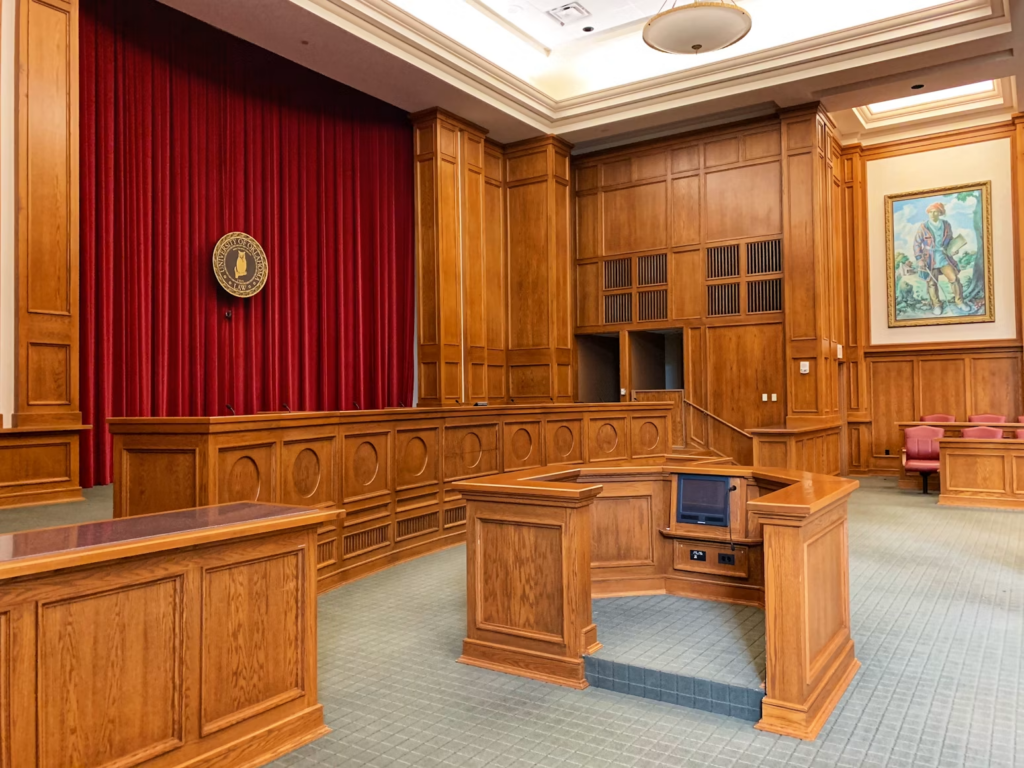
The courtroom carried the scent of old wood polish, damp wool, and the particular odor of institutional routine.
I sat at the plaintiff’s table with my hands folded over a blank yellow legal pad.
I listened to the steady ticking of the clock above the judge’s empty bench.
Outside, November rain struck the tall courthouse windows and cast long gray shadows across the varnished mahogany.
The weather matched the occasion.
Across the center aisle my younger sister Nicole sat at the defense table.
She appeared as though she were attending a charity event.
The setting was a legal proceeding.
She wore a tailored cream suit that exceeded the value of my first two vehicles.
Her blond hair fell in perfect waves.
She touched the corners of her dry eyes with a monogrammed tissue and performed the part of the wronged sister for anyone who chose to accept the performance.
Beside her sat her husband Chris Irving.
His manner centered on his golf handicap and the lease on his Porsche.
He leaned back in the leather chair with practiced ease.
He met my gaze across the aisle and allowed a small smirk to form at the corner of his mouth.
“Your little real estate game ends here, Tracy.”
I did not blink.
I did not scowl.
I directed my attention to the gallery behind them.
My parents Richard and Susan Manning sat upright in the second row.
They had not come to observe justice.
They had come to witness what they viewed as a necessary correction.
In the Manning family an unspoken order had existed since before I finished middle school.
Nicole held the position of the favored child.
She was cheerful and agreeable.
She had married a man they found acceptable.
She supplied grandchildren and a suburban image they could mention at the country club.
I occupied the position of the one who created difficulty.
I remained unmarried and independent.
I worked long hours and declined to follow their schedule.
My presence outside their expectations made them uneasy.
Any achievement on my part received the label of chance.
Any boundary I set received the label of moodiness, bitterness, or instability.
Because I occupied that position they supported the proceeding in this courtroom.
In their reasoning a single woman without children had no legitimate claim to a mountain house while a family with the proper structure had to arrange rental accommodations for holidays.
The property in question was 48 Hollow Pine Road.
It was a custom cedar-beam house on the edge of a glacial lake in the North Carolina mountains.
I had acquired it through eight years of extended work hours, disciplined investing, and a refusal to apologize for any of it.
It served as my retreat.
It was the location where my family’s repeated dismissals could not reach me.
They were attempting to claim it through the court.
The Family Pattern That Shaped the Lawsuit
The pattern had formed early.
Nicole received praise for every social success.
I received questions about when I would settle down.
Nicole’s marriage received celebration.
My career milestones received polite nods followed by inquiries about grandchildren.
When I purchased the mountain house they described it as an impulsive purchase made by someone who lacked proper priorities.
They never asked how I had funded it.
They assumed I had stretched my resources to make a statement.
They did not know that I had been acquiring properties quietly for years.
They did not know the scale of what I had built while they focused on appearances.
The Judge Enters and the Document Is Presented
“All rise.”
Judge Elena Brown entered and took her seat.
She reviewed the docket and nodded to Nicole’s attorney.
“We are here for the civil matter of Irving v. Manning. Mr. Bell, you may proceed.”
Nicole’s attorney Mr. Arthur Bell stood.
He presented a polished appearance.
He carried sympathy as though it were an accessory he had selected for the occasion.
He cleared his throat and approached the bench with a manila folder.
“Your Honor, this is a difficult family situation in which my clients seek to uphold a promise made by someone whose judgment has proven unreliable. Christopher and Nicole Irving request that the court recognize a signed agreement. The defendant Tracy Manning agreed to transfer the deed to 48 Hollow Pine Road because of concerns about her ability to manage the property.”
He withdrew a white sheet of embossed letterhead from the folder.
It was my letterhead.
“I present Plaintiff’s Exhibit A. A binding agreement with Ms. Manning’s signature that transfers the Hollow Pine property to the Irving family.”
The bailiff carried the document to the judge.
I looked across the aisle.
Nicole had set the tissue aside.
She looked directly at me.
Her expression held anticipation.
Her smile conveyed the thought she did not need to speak aloud.
Finally. Your house is mine.
I kept my hands folded on the legal pad and allowed her the moment.
Judge Brown adjusted her glasses.
She placed the sheet on her desk.
The rain continued against the windows.
I watched her eyes move across the text.
Her expression began with the expected neutrality of routine proceedings.
As she reached the lower portion of the page her eyebrows drew together.
A slight tension appeared at the corners of her mouth.
The signature did not hold her attention.
The header on the letterhead did.
Judge Brown lowered the document and looked directly at me.
The routine quality had left her expression.
Sharp attention had replaced it.
“Miss Manning,” she said. “I am examining this address. 48 Hollow Pine Road. This property belongs to your real estate holdings, correct?”
The room became completely still.
Chris’s smirk remained in place for a moment before it froze.
The muscles in his jaw tightened in a way that altered his appearance.
“I observe corporate letterhead here under a holding company name. How many properties do you currently hold, Miss Manning?”
Behind me in the gallery my mother produced a sound.
It was not a sigh.
It was a sharp intake of breath as though something had struck her.
I did not turn.
I kept my eyes on Nicole.
Nicole’s lips parted.
Color left her face so quickly I thought she might lose consciousness.
Her hands gripped the edge of the defense table until the knuckles showed white.
For thirty-two years my family had maintained the belief that I was a struggling and resentful woman who lived alone.
They had assumed the mountain house was a single acquisition I had managed with difficulty.
They had constructed a story in which I occupied the position of the lesser member of the family.
They had no knowledge that I had built a portfolio while they attended to social standing.
“Twelve, Your Honor,” I answered.
My voice remained even in the room.
Mr. Bell rose from his chair.
The legs scraped against the floor.
“Objection, Your Honor! The defendant’s overall financial position holds no relevance to this specific agreement—”
“Overruled, Mr. Bell. Sit down.” Judge Brown did not look at him. Her attention remained on me. “Twelve properties, Miss Manning?”
“Yes, Your Honor.” I allowed my gaze to move briefly to Chris. A drop of moisture had formed on his forehead. “They range from commercial buildings in the financial district to residential developments. The total value reaches eighteen million dollars. All are fully owned. Hollow Pine Road serves as my personal retreat.”
The silence that followed carried weight.
Eighteen million dollars.
I could sense the reaction moving through the room.
I did not display satisfaction.
I did not smile.
I remained seated and allowed the information to settle.
The Forensic Evidence and the Video
Mr. Bell attempted to regain control of the narrative.
“Your Honor, the defendant’s financial position does not change the existence of the signed agreement. Wealth does not cancel a contract.”
I turned to the man beside me.
My attorney Mr. Arthur Sterling sat with the composed patience of someone who had waited for the appropriate moment.
He had remained silent during the initial portion of the hearing while Mr. Bell presented his case.
I gave Sterling a small nod.
He rose without haste.
He buttoned his jacket.
He reached into his briefcase and released the clasps.
The sound carried through the quiet room.
“You are correct, Mr. Bell,” Sterling said. “Wealth does not cancel a contract. A criminal act does.”
Sterling carried a thick folder with red markings to the bailiff.
“Your Honor, we do not deny that the document Mr. Bell submitted exists. We question its source. We question the decision to present it in this courtroom.”
Judge Brown opened the folder.
“Inside this folder is a forensic handwriting analysis prepared by Dr. Aris Thorne, an expert who regularly testifies for federal matters. He compared the signature on Exhibit A to forty-two samples of my client’s handwriting. His determination is clear. The signature is not genuine. The attempt was not skillful.”
“Objection!” Mr. Bell rose again. “This is unexpected. We received no prior notice of this expert!”
“You received no prior notice,” Judge Brown said, “because the document was submitted only minutes ago. Overruled.”
Nicole turned toward her husband.
Her eyes had widened.
They moved between confusion and the beginning of alarm.
“Chris?” she said in a voice that carried to the front row. “What is he describing? You stated she signed it.”
Chris did not respond.
He stared at Sterling with the fixed expression of someone who had encountered an obstacle with no passage around it.
“Furthermore, Your Honor,” Sterling said as he turned toward the defense table, “the forged signature represents only one part of the issue. We will demonstrate how the letterhead was obtained.”
Sterling returned to our table and pressed a key on his laptop.
The screen on the courtroom wall came to life.
For months I had noticed signs of increased interest from my family.
Nicole had mentioned a desire for a vacation property.
Chris had asked detailed questions about the security system at the mountain house during one Thanksgiving gathering.
Because I understood the individuals involved I had installed additional cameras at Hollow Pine six months earlier.
The image on the screen showed clear video from the upper corner of my home office at the mountain house.
The timestamp read September fourteenth, three months after the date Nicole had claimed we reached an agreement.
A person entered the darkened room through a forced door while holding a flashlight.
Christopher Irving appeared in a black jacket and baseball cap.
He looked over his shoulder as he moved.
A sound of surprise came from the gallery.
My mother placed both hands over her mouth.
My father rose partway from his seat.
His face had taken on a deep color.
On the screen Chris approached my desk.
He searched the drawers until he located the leather folder that held my corporate letterhead.
He removed three blank sheets, folded them, placed them inside his jacket, and left the room.
Sterling paused the video on a clear frame that showed Chris’s face as he turned toward the door.
“This recording was made on private property that belongs entirely to my client,” Sterling said. “It shows Christopher Irving entering the Hollow Pine residence without permission to take the letterhead he later used to create the forged signature.”
Chris’s Reaction and the Judge’s Ruling
Chris rose from his chair so quickly that it fell backward and struck the floor with a sound that echoed through the space.
“That recording is illegal!” he shouted. His finger pointed toward me with a shaking hand. “She arranged this! This is not permitted! You cannot record someone without agreement!”
“There is no expectation of privacy when someone commits a crime inside a home they entered without permission, Mr. Irving,” Sterling replied with the same steady tone he had maintained throughout.
Nicole rose from her seat.
The cream suit and composed appearance had lost their effect.
She looked at her husband with an expression that moved from confusion to alarm to growing anger.
He had not only misled me.
He had misled her.
His actions had placed her in the position of co-plaintiff in a matter that involved criminal conduct.
“Chris,” Nicole said in a low voice. “You created the document. You entered her house.”
“Be quiet, Nicole!” Chris turned toward her with the urgency of someone who had no remaining options. “I acted for both of us. You continued to express dissatisfaction with her having a better house than ours!”
“Mr. Bell.” Judge Brown’s voice did not increase in volume. It cut through the room with precision. Every person became still. “I recommend that you bring your client under control before his position worsens.”
The expression on Judge Brown’s face indicated that the recommendation had arrived too late to change the outcome.
The Arrest and the Immediate Aftermath
The gavel struck the bench.
The sound carried through the high ceiling.
“Mr. Bell,” Judge Brown said while holding the forged document, “you have presented false evidence in this court. You have attempted to use the legal process to take property that does not belong to your clients. We will address your conduct with the appropriate board. Remain in the area.”
Mr. Bell appeared unsteady.
He stepped back from his client and raised his hands.
“Your Honor, I had no knowledge that the document was not genuine. My clients provided every assurance—”
“We will determine whether the board accepts that position, Counselor.”
Judge Brown directed her attention to Chris Irving.
“This civil matter is concluded. The situation does not end here.”
She leaned forward.
Her robe cast a shadow over the defense table.
“Christopher Irving. You have committed perjury in this courtroom. You have presented forged evidence. Clear video shows you entering a residence without permission. I am holding you in direct contempt. Bailiff, take Mr. Irving into custody now. I am instructing the clerk to send the complete record to the District Attorney. I expect charges for forgery, perjury, and unauthorized entry to be filed today.”
Two bailiffs moved without delay.
They took Chris by both arms and lifted him from the defense table before he could fully register the change.
“Wait! No! This cannot happen!”
One bailiff directed him over the table.
The sound of handcuffs closing over his watch carried through the quiet room.
“Chris!”
Nicole’s voice carried raw emotion.
It did not resemble the polished tone she had used when she entered the room.
She reached toward her husband.
An officer stepped between them.
Nicole turned toward the gallery.
Tears had marked her face.
“Mom! Dad! Do something! Make them stop!”
Richard and Susan Manning remained in place.
They sat in the second row with pale faces and parted lips.
They watched the man they had presented as an example of success for ten years being escorted from the courtroom in restraints.
My father appeared unwell.
My mother wept without sound.
The image they had maintained for thirty years had broken in public view.
They had no means to intervene.
The account they had accepted for three decades had ended in open court.
I rose from my seat.
I fastened the button on my blazer.
I collected my legal pad and placed it in my briefcase.
I stepped from behind the table and walked toward Nicole.
She remained at the defense table with her hands over her face and her shoulders moving.
She looked up when she heard my approach.
Her expression contained multiple elements at once.
Fear, anger, defeat, and a form of recognition she had not previously permitted.
I stopped in front of her.
“You wanted my house, Nicole,” I said. “You may now have access to his cell.”
I turned and walked up the center aisle.
I passed the gallery.
I passed my mother and father without directing my attention toward them.
I owed them neither anger nor pity.
I pushed through the heavy doors and entered the cool air of the courthouse hallway that had been washed by rain.
For the first time in thirty-two years I drew a breath that carried a quality other than defense.
The Months That Followed
Six months later the difference in circumstances was clear.
Chris Irving did not manage the criminal process well.
Faced with the video and the forensic report his attorney recommended a plea.
He stood in a different courtroom in an orange jumpsuit and entered a guilty plea to two counts of forgery to limit the sentence.
The civil action I filed against him for attempted fraud resulted in the court restricting his remaining assets to cover legal expenses.
The Porsche was taken back.
The country club membership ended.
Nicole’s previous life ended with his.
With his income gone and accounts reduced by legal costs she sold their house at a loss.
The coordinated family images were replaced by the reality of living in her parents’ lower level with two dogs and reliance on the individuals who had taught her that reliance belonged to others.
Hundreds of miles away the morning mist lifted from the lake at 48 Hollow Pine Road.
I sat on the cedar porch in a wide chair with a wool blanket across my lap and coffee in my hand.
The water below reflected the green of the pines.
The quiet of the mountain no longer carried a sense of removal.
It carried the result of sustained effort.
Beside my coffee rested a stack of legal documents.
They represented the final steps on a commercial building acquisition in the city center.
I reviewed the projections and signed the final page.
Property number thirteen.
My phone vibrated against the arm of the chair.
My mother’s name appeared on the screen.
I played the voicemail.
Her voice came through uneven and without its usual tone.
It carried genuine distress.
It did not carry the tone of command.
“Tracy, please answer. Nicole’s attorney requires a retainer and your father’s pension remains unavailable. We have no immediate funds. You have resources. Please. We are a family. Please return my call.”
The message ended.
Silence returned to the lake.
I held the phone for a moment and observed whether any response formed within me.
Guilt, anger, pity, or the familiar sense of obligation presented as connection.
None appeared.
I placed the phone face down on the table and lifted my coffee.
One Year Later
One year after the courtroom proceeding I stood on the glass-railed balcony of my penthouse and looked out over the city at night.
The air carried a cool edge and the scent of rain.
Below, lights moved through the streets.
I held a portion of that skyline.
Property fourteen stood a few blocks away with its structure still rising.
I held a glass of wine in one hand and my phone in the other.
A notification appeared.
Another voicemail from a blocked number.
Susan Manning.
I played the message and listened to the first few seconds.
The same uneven tone and appeal to connection appeared.
I deleted the message.
I stood looking over the city and observed whether guilt appeared.
The response that some expect when someone steps away from family.
The remaining effect of earlier experiences.
The rise of anger.
The sense of superiority toward individuals who did not meet expectations.
None appeared.
I experienced a steady calm.
The Mannings had become individuals I no longer knew.
They represented an investment that had cost more than it returned.
I opened the settings on my phone and removed the blocked messages folder.
I removed their presence from my digital life as completely as they had once attempted to remove me from my own life.
I stepped back into the warmth of the penthouse.
The space held quiet and deliberate arrangement.
Art I had selected hung on the walls.
Lighting existed without apology.
The steady pattern of a life constructed on my own terms continued.
No raised voices.
No manipulation.
No gatherings that reduced my sense of self.
Only calm.
I walked to the kitchen counter, took a sip of wine, and allowed myself the private recognition of standing in a space no one else had constructed for me.
My family had described my silence across thirty-two years as a problem.
They described my choice not to participate in their patterns as stubbornness.
When they learned of my holdings in the courtroom they described the situation as concealment.
Standing in my penthouse and looking over a city in which I had acquired fourteen buildings I recognized the element they had never understood.
My silence had never functioned as a barrier intended to exclude others out of fear.
It had functioned as the operation of a secure space.
It protected what held value in the quiet and patient manner required until the individuals who wished to take it arrived and encountered what they had not measured accurately.