The $29 Water Bill: Why Ada Holloway Left Her Brick House to the Neighbor Instead of Her Only Son
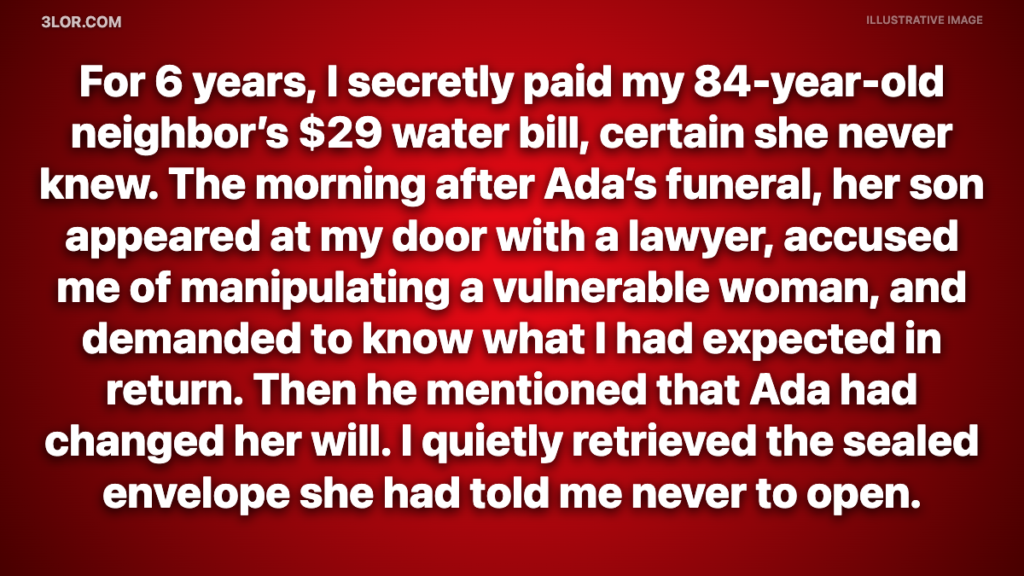
For six years, I quietly paid the water bill for the house next door, certain Ada Holloway never knew.
Her son discovered the truth the morning after her funeral.
Philip arrived on my front porch flanked by an attorney, holding an old utility statement like a criminal indictment.
“Mrs. Mercer?” the attorney said, extending a business card. “I’m Nathan Price. May we step inside?”
“You may stand on the porch,” I replied, keeping the screen door between us.
Ada had been eighty-four when she died. She had lived in the faded brick colonial beside mine since 1972. After her husband passed away in 2009, the flower beds surrendered to weeds, the cedar front steps began to sag, and the amber light beside her entryway stopped coming on at dusk.
In April of 2019, I walked over to return an errant piece of mail and found a bright orange municipal disconnection notice taped to her front door.
I peeled it off before she could see it, called the county water authority, and used their automated portal to wipe out the balance. Every month after that, I logged in on the first and covered it.
It was rarely more than $29.
Ada was fiercely proud. If I had handed her a twenty-dollar bill directly, she would have closed her door in my face. Worse, she would have felt the sting of charity every time we crossed paths by the curb. She had already lost her husband, her driving privileges, and most of her lifelong friends. I saw no reason to take her dignity, too.
Philip thrust the paper toward me. “I found this in my mother’s desk drawer yesterday.”
My name was written across the top margin in Ada’s spidery cursive. Directly beneath it, she had added a note in faded pencil:
Helen has paid this since 2019. She will deny doing anything special. Do not embarrass her by arguing.
My chest tightened. For six years, I had thought my secret was buried in a municipal database.
Philip sneered. “Three days before the service, her estate attorney notified me that Mom executed a completely revised will. Don’t stand there and play innocent.”
Mr. Price opened a thick manila folder. “Mrs. Mercer, we are evaluating whether Mrs. Holloway was subjected to undue influence during her final months. Systematic financial interventions made on behalf of an isolated senior citizen are legally scrutinized.”
“I kept her plumbing running,” I said evenly.
“You manufactured a dependency,” Philip snapped.
I looked at him—the expensive tailored coat, the polished shoes, the cold certainty in his eyes.
“When did you last speak with your mother, Philip?”
“That has zero bearing on this situation.”
“June 18,” I said. “Her eighty-fourth birthday. You called at 7:12 in the evening and hung up at 7:16. I was sitting at her kitchen table helping her peel apples. And when she took a fall in February, did you know?”
Philip hesitated. “No.”
“She lay on the cold linoleum for forty minutes before I brought her mail in,” I continued. “She begged me not to dial your number because she knew you would use the ambulance ride to force her into assisted living.”
“She was eighty-four years old!”
“That was her age, Philip. Not an excuse to treat her like real estate awaiting liquidation.”
The Envelope on the Porch
Mr. Price shifted his weight, clearing his throat. “Mrs. Mercer, we are simply attempting to establish the timeline.”
“Then you should read the file she prepared for you.”
I stepped back into my hallway and retrieved a heavy legal envelope Ada had handed me the previous autumn. Across the front, she had written with a black felt marker:
For the attorney Philip retains when he contests my estate.
Philip stared at the handwriting, his jaw tightening. “So the two of you conspired.”
“No,” I replied, passing the envelope through the door. “Ada knew you better than you think. I simply held the mail.”
Mr. Price broke the seal, adjusted his wire-rimmed glasses, and began scanning the top document. Within thirty seconds, his professional posture went rigid.
“Philip,” the attorney said, his tone dropping several degrees. “Did you maintain power of attorney over your mother’s banking accounts?”
Philip frowned. “What does that have to do with Helen?”
“Answer the question, please.”
“Mom had hip replacement surgery in 2020,” Philip muttered. “She granted me temporary signatory authority to cover her medical deductibles and household utilities.”
“This formal revocation dated August 2021 states that authority was terminated immediately upon her discovering unauthorized transfers.”
Mr. Price flipped past the revocation to three months of audited bank records.
“The highlighted disbursements total $18,600,” Price read aloud. “Every dollar was wired directly from your mother’s primary savings into Northline Renovations—an entity registered to you.”
“Those were private loans,” Philip said defensively. “She was my mother. We didn’t need commercial paperwork.”
“Did she authorize those withdrawals before you initiated them?”
“She knew my contracting business was bleeding cash during the shutdowns!”
“Philip,” Price said, his voice hard. “Did she give prior written or verbal consent?”
Philip looked down at his leather loafers, refusing to answer.
He had marched onto my porch prepared to weaponize a $29 water bill into a claim of elder manipulation. Instead, his own attorney was staring at indisputable evidence of family embezzlement.
The Mother’s Final Letter
Mr. Price pulled the final document from the envelope—a folded piece of stationery written in Ada’s hand, addressed directly to her son.
He handed it to Philip.
My dear Philip,
If you are reading this on Helen’s porch, you have already convinced yourself that a stranger turned me against you. No one did.
I altered my estate because you began appraising my life as a property portfolio before I was even in the ground. You inquired about the resale value of this house more often than you asked about my heart. You called the money you took a loan, yet you never asked for permission before taking it.
When I confronted you, you told me I was losing my mental sharpness. I was not losing my mind, Philip. I understood that my son was panicked about his business, but I also understood that love does not give a child the right to steal from his mother.
I did not remove you because I stopped loving you. I did it because dignity is the only thing an old woman has left to protect. Do not spend your life defending what you took. Spend it becoming a man who wouldn’t take it in the first place.
Love, Mom.
Philip’s hands shook so violently the edges of the stationery fluttered.
“She knew?” he whispered, his voice cracking down the middle.
“She knew since August of 2021,” Price answered quietly.
Philip stood on my porch, hollowed out, staring at the blue painted shutters of the house where he had grown up. The anger was completely gone, replaced by the sickening realization of what he had thrown away.
Without another word, he turned and walked down the steps, followed by his attorney.
The Deed and the $65,000
Two weeks later, Ada’s probate counsel, Celia Warren, summoned me to her office downtown.
“Mrs. Mercer, Ada’s primary residence has been deeded directly to you.”
The air left my lungs. “No. I cannot take that house. That belongs to her family.”
“You need to read the instructions she left before you refuse,” Mrs. Warren said, sliding a sealed letter across the conference table.
I took the key, drove home, and unlocked Ada’s front door.
The house smelled of sweet lavender sachet and old paper. Her reading glasses rested on the side table beside an unfinished crossword puzzle. On the kitchen counter sat an envelope with my name on it:
Dear Helen,
You truly believed I never noticed who kept the water running.
During that cold winter, I called the municipal desk because I assumed my late husband had left an old escrow balance behind. They wouldn’t disclose the payer’s name, but I didn’t need them to. There was only one neighbor stubborn enough to look after me for six years and proud enough never to take credit for it.
True kindness is never loud, Helen. It is noticing when a porch light stays dark. It is watching the front curtains. It is checking in without making an old woman feel like a charity case.
Philip loved me, but he spent so much time protecting what I owned that he forgot about who I was. You allowed me to remain Ada.
I am leaving you the house because you understood why these walls mattered. Alongside the deed, I established a dedicated maintenance fund of $65,000 to cover property taxes, a new roof, and insurance.
If you are willing, do not let this house become another empty asset. Turn it into an address where people who feel invisible can be seen. Let the lonely drink coffee. Let the children read after school. Open the curtains, keep the porch light burning, and please save my roses.
Love, Ada.
I sat at her worn wooden table and let the tears come.
When I stepped outside, Philip was sitting on the bottom step of my porch, waiting. He had driven three hours back to the neighborhood.
“I instructed Mr. Price to withdraw the probate contest,” Philip said quietly, staring at the grass. “And I executed a binding promissory note to return the $18,600 to the estate fund.”
“That is the right place to begin,” I told him.
He looked up, his eyes red-rimmed. “I knew the square footage. I knew the lot value. But I didn’t even know she was terrified of thunderstorms. I forgot the woman living inside the walls.”
Ada’s Porch
Over the next seven months, we transformed the old brick colonial into a sanctuary for the neighborhood.
Philip made good on his word. Every weekend, he drove down to help. He repaid the $18,600, which went directly toward rewiring the aging breaker panel and replacing the sagging front steps. Neighbors brought paint, bookshelves, and armchairs.
By autumn, a hand-carved cedar sign hung beside the mailbox: ADA’S PORCH.
It became exactly what she envisioned: a quiet refuge where local seniors gathered for coffee without having to admit they were isolated, and where neighborhood kids found a warm desk to do their homework.
Exactly one year after the funeral, a woman in her forties arrived holding an aged photograph showing Ada beside a seven-year-old girl in a knit sweater.
Her name was Caroline Bennett.
During a bitter separation decades earlier, Ada had taken legal guardianship of Caroline—the daughter of a former student—for eight years while Philip had been away working commercial transport ships. When the girl was eventually relocated by relatives to the Pacific Northwest, Ada’s husband had hidden their correspondence, leaving both women believing the other had walked away.
Only in her final months had Ada tracked Caroline down, leaving behind a bundle of archived letters and instructing Mrs. Warren to invite her into the family circle once the legal dust had cleared.
Caroline didn’t come looking for real estate. She stepped into Ada’s Porch, embraced Philip across decades of silence, and joined the board of the foundation.
Five years later, Mrs. Warren delivered a cedar box Ada had earmarked for the center’s anniversary. Inside were dozens of handwritten index cards documenting the small, invisible heartbeats of our street:
Mrs. Palmer—prefers peppermint tea. Bring her a tin on her birthday.
Mr. Bailey—too proud to say he is hungry. Invite him to dinner casually.
Philip—never stop leaving the door open for him.
Helen—remind her that receiving kindness is not a debt.
A person’s life is not measured by the equity left behind in a county ledger. It is measured by the people they refused to let slip into the shadows.
Every evening at dusk, when the amber porch light clicks on across the drive, the house next door is alive with voices, steaming coffee, and shared laughter.
It all started with an orange disconnection notice and twenty-nine dollars. Ada didn’t leave behind a house; she left behind an address for grace. And her light has never gone out since.
Note: This narrative is an original work of dramatic fiction produced for storytelling and editorial purposes. Names, characters, businesses, and incidents are products of the author’s imagination.