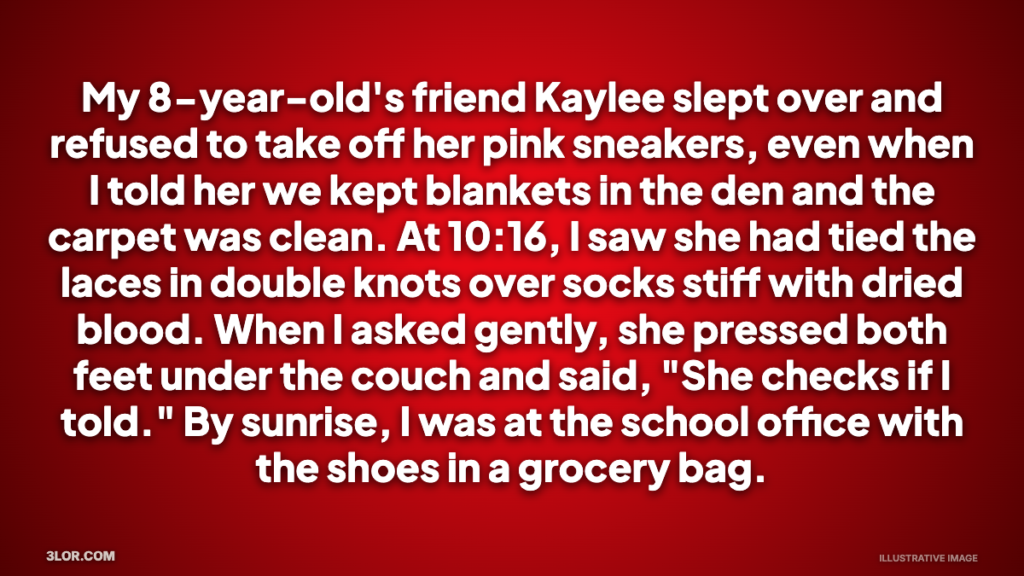
“I need you here now, not after lunch.”
The nurse — Mrs. Delgado, silver cross at her throat — didn’t look at me when she said it. She was looking at the grocery bag on Mrs. Fox’s desk, at the pink sneakers with the double-knotted laces, and her face had gone very still.
7:31. Mrs. Fox took Kaylee into the little room behind the nurse’s office — the one with the cot and the curtain — and shut that door too. I sat in the front office with my hands around a paper cup of water I didn’t drink, listening to the school wake up around me. Buses. Bells. Somebody’s laugh in the hallway.
Mia was in Mrs. Pruitt’s class by then, doing morning work, unaware that her best friend was behind a curtain showing a nurse what her stepmother had done.
At 8:05, a woman in a navy blazer arrived with a badge I only half saw. Caseworker. She didn’t introduce herself beyond her first name — Priya — and went straight into Mrs. Fox’s office, where my photos were now spread across the desk next to Tasha’s note.
“Kaylee is dramatic about shoes. Please don’t encourage attention-seeking.”
Priya read it twice. Then she looked up at me. “You did the right thing bringing her in,” she said. “Most people talk themselves out of it.”
I thought about those two hours the night before. Kaylee Whitman was not my child. I’d used it like a shield.
8:40. They called Greg.
He came through the front doors at 9:15 in a work shirt with his name stitched over the pocket, and the first thing he said — before anyone told him anything — was, “Is she okay?”
Mrs. Fox took him into her office. I wasn’t in the room. But the walls in that part of the building are thin, and I heard his voice rise, and then break, and then go quiet for a long time.
When he came out, his eyes found mine across the office, and he crossed the room like a man walking to his own sentencing.
“You saw the socks,” he said.
I nodded.
“I saw them too.” His voice was raw. “Two weeks ago. In the laundry. I asked Tasha and she said —” He stopped. “She said Kaylee was clumsy. That she trips on the playground. And I wanted —” He put his hands over his face. “God. I wanted it to be true.”
That was the moment I understood the ugliest thing about that whole night. It wasn’t Tasha’s note, or the double knots, or even the blood. It was that everyone around that little girl had been given a chance to see, and every one of us had found a reason to look away. Him for two weeks. Me for two hours.
“You don’t get to do that,” I said quietly. “She’s eight, Greg. She doesn’t get to be the one who tells. That’s our job.”
He didn’t argue. To his credit — the only credit I’ll give him — he didn’t argue.
9:40. A police officer arrived, a woman with her hair in a tight braid. She took my phone and scrolled through the photos — the socks, the laces, the note, the stove clock reading 11:03 — and she bagged Tasha’s note in a clear envelope like it was already evidence. Because it was.
“What happens now?” I asked Priya.
“Tasha will be contacted by law enforcement today,” she said carefully. “Kaylee won’t be going home to that house tonight.”
“Where will she go?”
“Her maternal grandmother is in Dalton. We’re reaching out now.”
I thought of Kaylee holding the grocery bag on her lap in my car at 6:52 that morning, not speaking once. I thought of the stuffed llama.
“Can I see her?” I asked. “Before —”
Mrs. Fox shook her head gently. “Let the professionals finish, honey. You did your part. You did it exactly right.”
At 11:15, they walked Kaylee out through the side door — not the front, where the buses were — with Mrs. Fox on one side and Priya on the other. She was wearing loaner socks from the nurse’s drawer, white ones, and sneakers from the lost and found that were two sizes too big. She looked small and tired and — I will remember this as long as I live — relieved. Like a child who had been holding her breath for months and finally exhaled.
She saw me. She lifted one hand, just a little.
I lifted mine back.
Three weeks later, my phone rang at 5:40 on a Friday. Same time as before. But this time Greg’s voice on the other end sounded like it belonged to a different man.
“Kaylee keeps asking about Mia,” he said. “Would — could she come over? Just for the evening? Her grandmother says it’s okay. I’ll stay. I’ll be right there in the living room.”
“Of course,” I said.
She came through my front door at 6:15 with her backpack and her stuffed llama and her pink sneakers — new laces, I noticed. Single knots.
Mia screamed and tackled her with a hug. They painted nails. They made popcorn. At 8:30, I told the girls to get pajamas on.
And Kaylee — my brave, skinny, big-eyed Kaylee — sat down on my hallway floor, untied her sneakers, pulled them off, and lined them up neatly by the wall.
She looked up at me and smiled. A real one.
“Carpet’s clean,” she said.
I had to turn around and pretend to check the popcorn, because I was crying too hard to let her see.
If a child ever trusts you with the truth, be the adult who acts. Tell me in the comments.
This piece is inspired by stories from the everyday lives of our readers and written by a professional writer. Any resemblance to actual names or locations is purely coincidental. All images are for illustration purposes only.