I bought my daughter a vintage wedding dress at a thrift store for $85, and it changed the life of a man I thought I knew.
My daughter Emily is getting married in April. She’s a kindergarten teacher, her fiancé Josh is an electrician, and between the two of them and me, there isn’t much room for a $2,000 dress.
Emily never complained. She’s not that kind of girl.
One Saturday in October, we stopped at the Goodwill on Route 30 just to look. Hanging at the very end of the rack, in a plastic bag that had gone cloudy, was an ivory lace dress with long sleeves and tiny pearl buttons down the back.
Emily tried it on. She came out of the fitting room with her hand over her mouth.
It fit like it had been made for her. The tag said $85.
Mrs. Patel’s Phone Call
The hem needed taking up two inches, so I brought it to Mrs. Patel, who has done alterations on Main Street for as long as I can remember.
Two days later, she called. Her voice was strange.
“You need to come in,” she said. “I found something in the dress.”
When I got there, she laid the dress on her worktable and turned back the lining of the bodice.
Someone had hand-stitched a tiny pocket there, right over the heart. The stitches were small and careful, done by someone who knew what they were doing.
Inside was a folded piece of paper, soft and yellow. The ink was faded, but I could still read every word.
“Margaret, I know your mother will never let you choose me. I’m a mechanic’s son with nothing to offer but this. If you ever change your mind, I’ll be at the train depot the first Saturday of every December. I’ll wait as long as it takes. Walter.”
It was dated November 1978.
The Man Across the Street
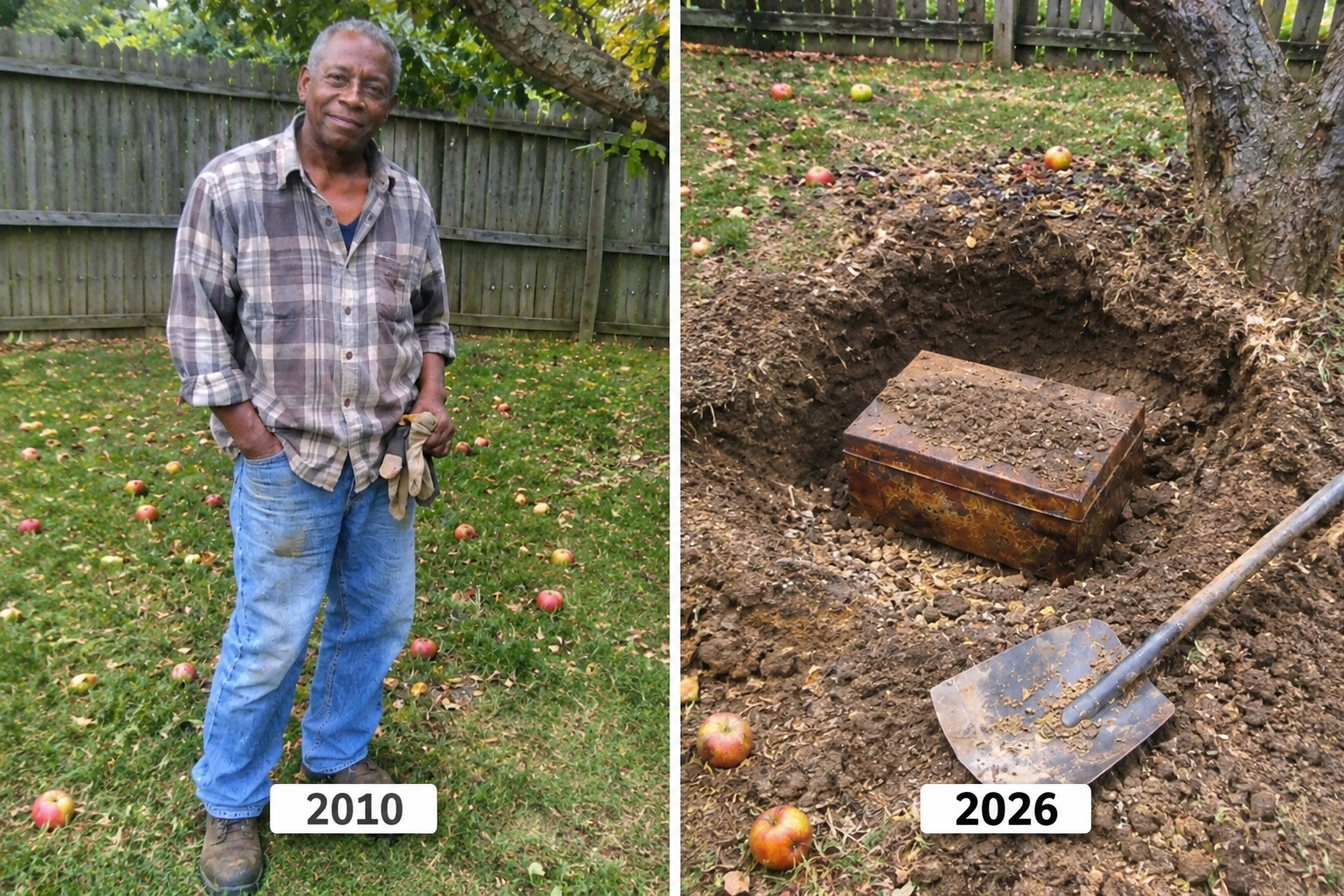
I have lived on Linden Avenue for 20 years. Across the street from me lives Walter Brennan.
Walter is 86. He has never married. He drove a tow truck for 40 years and still fixes every lawnmower in the neighborhood for free.
When it snows, every driveway on our street is shoveled before 6 a.m., and nobody ever sees him do it. Everyone knows it’s Walter.
He’s kind, but he’s private. In 20 years, I’ve never been inside his house.
And every year, on the first Saturday of December, I watch him leave at dawn in a gray wool coat he wears no other day of the year. He comes home in the afternoon. Always alone.
I used to think he visited a grave.
I stood in Mrs. Patel’s shop with the note in my hand and felt my whole chest go tight.
Finding Margaret
I didn’t tell Walter. Not yet. If I was wrong, I didn’t want to break the heart of an 86-year-old man for nothing.
I went back to the Goodwill and asked the manager if there was any way to know who had donated the dress. She looked at me like I was crazy.
But when I showed her the note, she went into the back office for twenty minutes.
It had come in with a whole estate of clothing in September. Donated by a woman named Carol Hughes, who was clearing out her mother’s house after moving her into assisted living.
Her mother’s name was Margaret.
It took me a week to work up the courage to call Carol. When I read her the note over the phone, she was quiet for a long time.
“My grandmother made that dress,” she finally said. “For my mom’s wedding. My mom married my father in December 1978. She always said it was a good marriage. He was a good man.”
She paused.
“But every December, she’d get quiet. Sad. We never knew why. My grandmother must have found that note while she was sewing the dress, and hidden it instead of giving it to her.”
“Is your mom still…” I didn’t know how to finish.
“She’s 84. Her body’s tired, but her mind is sharp as a tack. Dad passed eleven years ago.” Another pause. “Does this Walter still live near the depot?”
“Four minutes from it,” I said.
The Conversation on Walter’s Porch
I knocked on Walter’s door that evening. For the first time in 20 years, he invited me in.
I set the note on his kitchen table.
He didn’t say anything. He just picked it up with both hands, very carefully, like it might crumble. His lips moved as he read it.
When he got to the end, he took off his glasses and pressed his fingers against his eyes.
“I thought she read it,” he said hoarsely. “I thought she read it and chose him. I never blamed her.”
“She never saw it, Walter.”
He looked up at me.
“Her mother sewed it into her wedding dress,” I said. “Margaret never knew.”
I’ve never seen a grown man cry like that. Quietly, with his whole body, like 48 years were coming out at once.
“Every first Saturday of December,” he whispered. “I sat on that bench at the depot. I told myself it was habit. I told myself I’d stop next year.”
The First Saturday of December
The old train depot is a coffee shop now. It still has the original wooden benches and the big clock over the door.
On the first Saturday of December, Walter left his house at dawn in his gray wool coat, exactly like every year.
But this year, I drove behind him. And Carol drove behind me, with her mother in the passenger seat.
Walter sat down on his bench by the window. Carol wheeled her mother through the door.
Margaret was small and silver-haired, wearing pearl earrings and a red scarf. She stopped her wheelchair three feet from the bench and looked at him for a long, long time.
“You’re late, Walter Brennan,” she said finally, her voice shaking. “About 48 years late.”
He stood up so fast his knees cracked.
“No, ma’am,” he said. “I’ve been right here every year. You’re the one who’s late.”
And then she laughed, and cried, and held out both her hands, and he took them.
Carol and I went outside so they could have the bench to themselves. We stood in the cold and cried like two idiots.
The Wedding
Emily is still wearing the dress in April. Margaret insisted.
“That dress has been waiting a long time to see a happy ending,” she said. “Let it finally see one.”
There will be two guests at Emily’s wedding that nobody else will understand.
An 86-year-old man in a gray wool coat, and an 84-year-old woman in pearl earrings, holding hands in the third row.
The note is back in its tiny pocket over the heart. Mrs. Patel sewed it back in herself.
This story is a work of fiction. Names, characters, and events are products of the author’s imagination. Any resemblance to actual persons, living or dead, is purely coincidental.