“I’m simply asking why someone has been withdrawing my money while wearing my coat and using my identification.”
Across the line, my daughter’s breathing turned shallow and ragged. Behind her voice, I could hear the faint hum of a dishwasher—the brand-new stainless-steel model that had been installed alongside her custom walnut cabinets three weeks ago.
“Mom, please,” Karen whispered, her voice cracking. “You don’t understand what Brian is dealing with right now. His commercial bridge loan fell through. The contractor put a lien on the house. If we didn’t get liquidity by Friday, the bank was going to start foreclosure proceedings.”
“So you sent Diane to my branch?” I asked, keeping my voice flat. “You took my passport from my bedroom safe, handed her my winter coat, and sent her to impersonate an eighty-year-old woman?”
“We were going to put it back!” Karen cried out, the words tumbling over each other. “Brian’s commission check clears on the twenty-eighth! It was sixty-one thousand dollars, Mom—you don’t even touch that money! It just sits in your passbook account! You wouldn’t have even noticed it was gone for three weeks if you hadn’t walked in today!”
Mr. Okafor, sitting across the mahogany desk, didn’t move a muscle. His pen remained poised over the yellow incident log, recording every word coming through the speakerphone. By the glass door, Brittany had her hand pressed over her mouth.
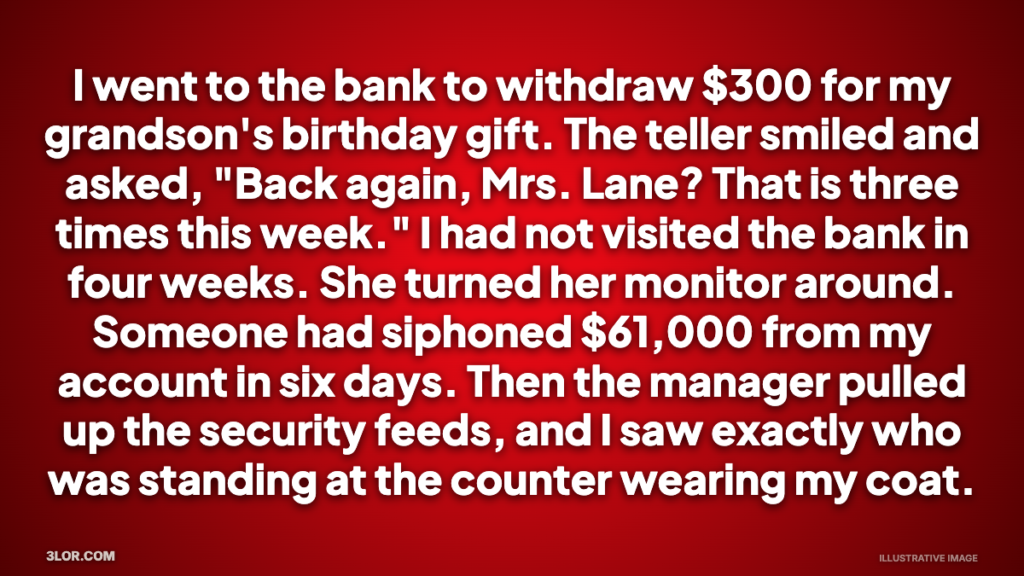
“I noticed,” I said. “Because I came in to withdraw three hundred dollars for my grandson’s birthday.”
Suddenly, the line rustled. A man’s voice—tight, aggressive, and dripping with panic—snatched the phone away from Karen.
“Eleanor, listen to me,” Brian barked through the speaker. “You need to take a breath and think about what you’re doing. You’re eighty years old. Your house is paid off. You get your late husband’s pension and Social Security. What do you need sixty grand sitting in a checking account for? If you file a police report, you’re going to destroy your daughter’s marriage, ruin my broker’s license, and put your grandson through hell. Don’t be vindictive.”
I stared at the frozen security frame on Mr. Okafor’s monitor. Diane, wearing my green wool coat with the fur collar, holding my life savings in a leather tote bag.
“Brian,” I said quietly. “You didn’t ask to borrow it. You used your emergency house key to rob me.”
“I’ll write you a promissory note tonight!” he snapped. “Just tell the manager it was a family misunderstanding and walk out of there!”
I reached across the desk, pressed the disconnect button on the speakerphone, and severed the call.
The silence in Mr. Okafor’s office was absolute.
“Mrs. Lane,” Mr. Okafor said, his voice steady and professional. “How would you like to proceed?”
“Call the financial crimes unit,” I told him. “And print out three copies of every camera angle you have from Monday through Wednesday.”
The Warrant
Detective Marcus Vance from the county sheriff’s financial crimes division arrived at the branch thirty-five minutes later.
He didn’t waste time. He reviewed the high-definition lobby footage, comparing Diane’s forged signature on the three withdrawal slips against the original signature card I had signed in blue ink in 1971. Under magnification, the forgery was obvious—Diane’s hand was heavier, rushing the loops on the E and the L.
By four o’clock that afternoon, two patrol cruisers and an unmarked detective sedan pulled into Brian and Karen’s driveway in the suburbs.
They didn’t have to force the door. Diane opened it herself, holding a coffee mug in the middle of that brand-new kitchen.
My green wool coat was hanging neatly on the brass hook in the front entryway. Inside the right interior pocket, Detective Vance recovered my missing passport, my original Social Security card, and $24,500 in unspent cashiers’ checks made out to Brian’s remodeling contractor.
Diane broke down within ten minutes. Sitting at the white quartz island, she gave a full recorded statement admitting that Brian had orchestrated the entire scheme, promising her that her son would go to prison for fraud if she didn’t impersonate me at the teller window.
Brian was arrested in his home office before five o’clock, handcuffed in front of the neighbors while deputies boxed up his business ledgers and laptop.
The Aftermath
Because the branch had failed to run secondary photo verification for cash-equivalent withdrawals exceeding ten thousand dollars, the bank’s fraud insurance division completed its audit in eleven days. Every single dollar of the $61,000—plus accrued interest—was wired back into my account.
The following morning, I hired a master locksmith to replace every deadbolt on my house with commercial keypad locks.
Three days before Brian’s preliminary hearing, Karen stood on my front porch in the pouring rain for twenty minutes, knocking on the glass and begging me through the closed door to drop the felony charges so Brian could take a plea deal.
I didn’t open the door.
I sat in my living room armchair, wearing my freshly dry-cleaned green wool coat, drinking hot tea while the rain washed down the driveway.
People often confuse an elderly woman’s quiet life with weakness. They assume that because you don’t raise your voice, you won’t fight back.
Brian and Karen learned the hard way that forty years of patience doesn’t make you soft. It just makes you certain of what you’re worth.
Editorial Note: This narrative piece was developed with AI assistance to explore family trust, personal boundaries, and financial accountability. Names and identifying details have been altered for privacy.