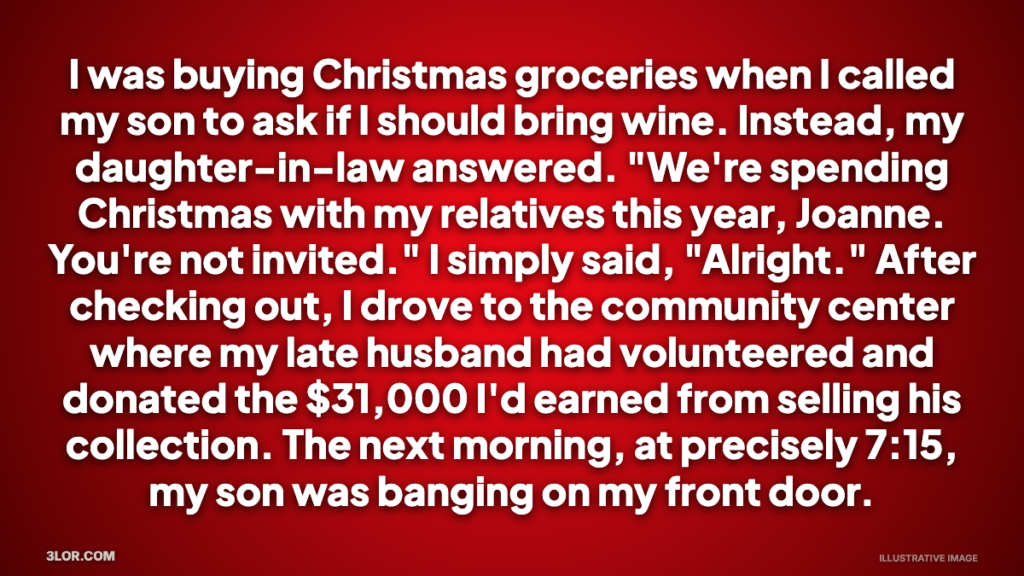
He stared at me through the three-inch gap of the security chain as though I had just told him I had burned the deed to my house in the fireplace.
“Every dollar,” I repeated quietly, keeping my hand resting on the edge of the oak door. “I wrote the check to Westdale yesterday afternoon.”
Adam’s breath came out in sharp white clouds in the December air. He lowered his phone, his face blotchy red from the wind—and from something that had nothing to do with the temperature. “Mom, have you lost your mind? Renee and I are supposed to put an offer in on the house on Elmwood Avenue right after the holidays! We were counting on that auction money for the down payment!”
I didn’t unhook the chain. I didn’t invite him into the warm hallway. I simply looked at my thirty-six-year-old son standing on my porch in his fleece jacket and realized how long it had been since he had asked me how I was doing without his father.
“You never asked me for the money, Adam,” I said evenly. “Last summer, when I mentioned the auction had brought in thirty-one thousand dollars, you said it would make a decent down payment. I agreed that it would. That was the entire conversation.”
“Because we assumed you were going to help us!” he snapped, running a hand through his hair. “Renee’s parents are already giving us eight thousand toward closing costs. That’s why we’re spending Christmas with her family—her mom has been stressed about the financing, and Renee didn’t want things to feel awkward at the table!”
There it was. Plain, unvarnished, and sitting right between us on the front porch.
I wasn’t uninvited because Renee’s mother had a rough year. I was uninvited because Renee’s parents were writing an eight-thousand-dollar check, and my son and his wife had already mentally spent my thirty-one thousand dollars before bothering to save me a chair at their dining table.
What Walter Would Have Said
“Your father spent thirty years driving across three states on his weekends to hunt down old hockey programs and signed pucks,” I told him, my voice steady despite the cold draft creeping under the door. “He cataloged every single piece by hand in those binders so that when he was gone, it would mean something. And for the last six years of his life, he spent four mornings a week at Westdale hauling boxes of canned goods and fixing furnaces for families who didn’t have enough heat to get through January.”
Adam looked down at the welcome mat, his jaw tight. “Dad would have wanted his grandkids to have a bigger backyard, Mom.”
“Your father would have wanted his wife not to find out she was uninvited to Christmas while standing in the spice aisle at Kroger,” I replied calmly. “And he would have been proud to know that his collection just kept nine families in Hamilton from losing their apartments this winter.”
Adam’s phone buzzed in his hand. He glanced down at the screen—a text from Renee, judging by the quick flare of irritation across his forehead—then looked back up at me, softening his tone just enough to try a different angle.
“Look, Mom… it’s a nonprofit,” he said, leaning closer to the doorframe. “Clare knows you. Everybody down there loved Dad. If you call her right now and explain that you wrote the check while you were upset, they’ll void it. Nobody deposits a thirty-one-thousand-dollar check before nine in the morning. Just ask for it back, come over on Christmas Day—I’ll talk to Renee right now—and we can sit down and figure out the house numbers together.”
For half a second, I stood completely still. It wasn’t anger I felt. It was a quiet, settled clarity that felt almost like relief.
“I didn’t write that check because I was upset, Adam,” I said. “I wrote it because I finally realized that to you and Renee, I’m only family when my checkbook is open. And for the record, I already signed the bank transfer release yesterday at four o’clock. The funds cleared before Clare posted that photograph.”
Christmas Morning at Westdale
Adam stood on my porch for another ten seconds, waiting for me to blink, waiting for me to apologize the way I had spent most of his adult life doing whenever Renee felt slighted or plans changed at the last minute.
When I didn’t move, he slipped his phone back into his pocket, muttered something under his breath, and walked briskly back down my front steps toward his idling SUV.
Four days later, on Christmas morning, I didn’t sit alone in an empty living room staring at wrapped presents no one came to open.
At eight o’clock sharp, I tied on one of Walter’s old canvas volunteer aprons at the Westdale Community Resource Center and spent the morning packing hot turkey dinners, sorting warm coats, and handing out wrapped board games to parents who actually looked me in the eye and said thank you. Around noon, Clare brought out a thermos of spiced cider and pinned a small laminated tag next to the brass plaque by the front entrance: The Walter & Joanne Miller Emergency Housing Fund.
My phone buzzed once in my apron pocket at 2:30 p.m.—a short text from Adam with a blurry photo of Lily and Noah opening stockings in front of Renee’s parents’ fireplace. Merry Christmas, Mom, it read. Hope you had a nice day.
I smiled, tucked my phone back away, and went back to ladling mashed potatoes onto warm plates. For the first time in three years, Christmas didn’t feel lonely at all.
Editorial Note: This story is a work of fiction inspired by real-life family dynamics. All names, locations, and details have been created for storytelling purposes.