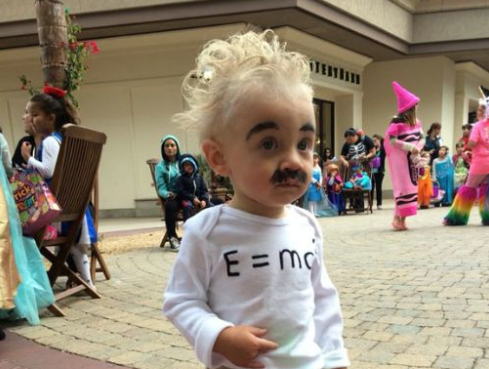
So the theme was “Iconic Characters.” You know—superheroes, princesses, cartoon mascots. I figured my son would go full Spider-Man like half his class, maybe Batman if he was feeling edgy.
But nope.
He looked me dead in the eye, spoon still in his cereal, and said, “I want to be Albert Einstein.”
I blinked. “You sure you don’t mean Iron Man?”
He shook his head. “Nope. The guy with the hair and the mustache. E equals m c square.”
He didn’t even pronounce it right—but he knew it. And he meant it.
So we got to work. I dug out an old white long-sleeve shirt and wrote the equation across it with fabric marker. We puffed up his curls with mousse and a little hairspray (okay, a lot), and I used eyeliner to draw on some big ol’ brows and a mustache. He looked in the mirror and gave me the most serious nod. Like he was about to go change the laws of physics at snack time.
The second we walked into the school courtyard, I felt eyes on us. Kids were running around in glitter capes and tiaras… and there was my boy, looking like a pocket-sized Nobel Prize winner.
A few kids pointed and laughed—not mean, just confused. One girl asked if he was a grandpa. One boy asked if he was supposed to be the Monopoly guy. My son didn’t flinch.
He just adjusted his mustache and said, “I’m Albert Einstein. He’s one of the smartest people ever. He made people think different.”
That’s when I felt a small wave of pride surge inside me. He wasn’t just dressed as some random character. No, my son, at just eight years old, had chosen someone who changed the world, someone whose name was synonymous with intelligence and groundbreaking ideas. He wasn’t just playing dress-up; he was embodying a piece of history.
As we walked further into the courtyard, I overheard a group of teachers talking. One of them, Ms. Lawson, who always seemed to be a little too caught up in the latest trends, was glancing at my son with a raised eyebrow. “Isn’t it a little… out there for a kid his age to dress as Einstein? I mean, shouldn’t he be something more, you know, fun?”
I felt a little defensive, but my son didn’t seem to notice or care. He was already off with his classmates, confidently explaining Einstein’s famous equation to a curious group of kids who had gathered around him. He might have mixed up a couple of the words, but they were hanging on his every word, fascinated by his enthusiasm.
A few hours later, I returned to pick him up, and I found myself walking over to his teacher, Mrs. Turner. She had a gentle smile but looked a little perplexed.
“He’s something else, isn’t he?” she said. “Your son was, by far, the most unique choice for the theme. I’ve never seen a kid so passionately explain science to his peers before. It was impressive. I honestly didn’t think kids that age even knew about Einstein, much less understood his contributions. He may have confused a few things, but his enthusiasm was contagious.”
I nodded, both proud and a little concerned. “It’s like he has a whole different view on things, you know? He’s always been curious, but this… this is something new.”
“Well, don’t worry,” she reassured me with a chuckle. “It’s rare to see a child with such a strong sense of curiosity. You’ve got a budding scientist on your hands.”
I laughed, but something about her words stuck with me. A budding scientist. I didn’t know if I should be worried about how different his interests were or if I should be encouraging him to dive deeper into this curiosity. Was I doing enough to foster his growth, or was I just letting him explore without a plan?
That evening, we sat at the dinner table, and I asked him about his day. His eyes lit up as he started recounting the events, from teaching his classmates about Einstein’s theory of relativity to drawing diagrams of space-time curvature with a napkin and a pen. He was glowing with excitement, and for the first time, I realized how much he had taken ownership of his learning. He wasn’t doing this because I pushed him; he was doing it because he wanted to.
The next morning, as I was preparing breakfast, I heard my son humming a tune in the other room. When I walked in, I found him on the computer, Googling everything he could about Einstein. He even found a video of Einstein explaining his theory.
“Mom,” he said with the same determination in his voice, “did you know that Einstein didn’t just figure out the theory of relativity? He also worked on the quantum theory of light and was a pacifist. He didn’t like wars.”
I felt a lump form in my throat. My son, who was supposed to be just a kid enjoying superheroes and cartoons, was absorbing all this information. And not only was he absorbing it—he was processing it.
Later that day, I made a call. I had to figure out if this fascination with Einstein could go somewhere, if it was just a phase, or if it was the start of something deeper. I reached out to a local science center, asking about any educational programs for kids interested in science. They suggested a couple of weekend workshops and after-school classes that were available for curious minds like my son’s. One was about space exploration, and another one focused on famous scientists and their discoveries.
When I told my son about it, his face lit up. “Can I sign up for both?” he asked eagerly.
I agreed, but I still had some doubts. Was I pushing him too hard? Was I allowing him to be a kid, or was I fostering some kind of academic obsession too early?
Weeks went by, and my son continued to amaze me with his thirst for knowledge. He would come home with books on Albert Einstein, quantum physics, and even space exploration. At night, he’d fall asleep with a small stack of books by his bed, his little glasses perched on his nose as he nodded off to sleep. His room started to look more like a mini science lab than a kid’s bedroom.
But then came the twist. One afternoon, I picked him up from his science workshop, and he was unusually quiet. When I asked him what happened, he looked up at me with wide eyes and said, “Mom, I don’t think I’m supposed to be there.”
I frowned. “What do you mean?”
“The other kids, they weren’t really interested in the stuff we were doing. They were talking about video games and sports, and I was talking about Einstein’s theory of light. They thought I was weird.”
A pang of guilt hit me. I knew my son was different, but I never thought it would make him feel alone or out of place. Was I forcing him into a mold that he wasn’t ready for?
Over the next few weeks, I had a lot of conversations with him, helping him navigate the challenges of fitting in, of finding his place in the world. I realized that, in my excitement to nurture his curiosity, I might have overlooked the importance of balance—helping him explore his passions while still allowing him to enjoy the things that most kids his age loved, too. And so, we found a middle ground. We decided together that he could spend some time learning about the things he loved, but he would also get involved in other activities, like joining the school soccer team and playing board games with his friends.
Then, one day, there was a twist I wasn’t expecting. A few months later, at the end of the school year, my son’s teacher pulled me aside after class.
“He’s such a bright kid,” Mrs. Turner said. “And he has a way of explaining things that makes others want to listen. I’ve seen him spark interest in science with some of the other kids. He even helped one of his classmates understand how to use math to solve a problem in a way that no one else could explain. It was like watching a young Einstein in action.”
I smiled, feeling a sense of pride wash over me. My son had found a way to blend his love for science with his desire to fit in. He had learned how to share his passions without alienating himself, how to bridge the gap between what excited him and what excited the other kids. And in doing so, he had become an inspiration to others.
The karmic twist? That same student who had been confused about my son’s interests, the one who had made fun of him at the beginning of the year, had approached him a few weeks later. “Hey,” he said sheepishly, “can you explain that thing about Einstein again? I think I finally get it now.”
It was a moment of full-circle redemption. My son had done it—not by changing who he was, but by being true to himself. And in doing so, he had created connections, even with those who didn’t understand him at first.
The lesson? Stay true to your passions, even when they make you feel different. Sometimes, being different isn’t a barrier—it’s a bridge that can help others see things in a whole new light.
So if you’ve ever felt out of place or misunderstood, remember this: your uniqueness is your strength. Share it with the world, and you’ll be amazed at the connections you can build.
And if this story resonated with you, don’t forget to like and share it. Let’s spread the message that embracing who we are is the key to making a difference in the world!