When my 68-year-old father had a massive stroke while riding his Harley, I never expected the emergency room to feel so cold—so indifferent.
As they rushed him in, unconscious and bleeding, I overheard a doctor mutter under his breath, “Another organ donor who thought he was invincible.”
He had no idea I was standing right there.
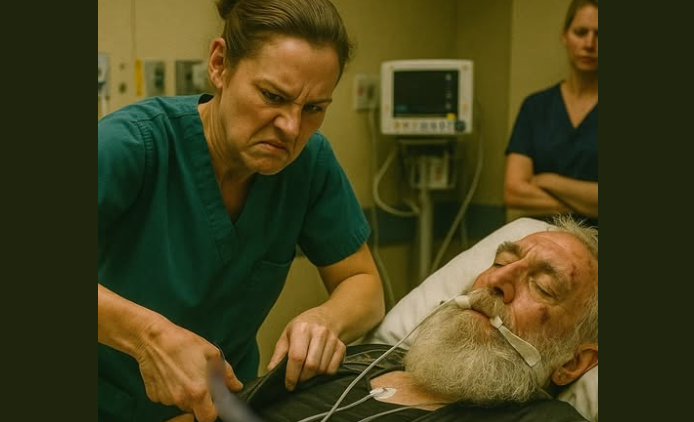
My father lay still, leather vest soaked in blood, silver hair tangled, tattoos faded but visible—each one telling a story. The nurses exchanged glances—judging the grease-stained denim, the military patches, the scent of engine oil.
To them, he wasn’t a patient. He was a stereotype.
Then one of them pulled a folded photo from his vest pocket: me, in a graduation cap and gown.
Their expressions shifted. Surprise, then discomfort.
But the damage had already been done. They saw a washed-up biker, not the man who had built an entire life around serving others.
What they didn’t know?
He was a decorated combat medic. A single father who raised me alone. A volunteer who read bedtime stories to kids battling cancer. A founder of a nonprofit that raised millions for veterans with PTSD.
But none of that mattered in those first moments. They wrote him off before reading his chart.
That night, I sat by his ICU bed, surrounded by machines that breathed for the strongest man I’ve ever known.
I made two silent promises: he would get the care he deserved—and when he woke up, they’d regret how they treated him.
I had no idea those promises would uncover more than I expected…
Or that I’d have to confront the parts of him I never fully understood.
The next morning, I returned to the hospital wearing a suit and a mission. But before I could say a word, he surprised me.
Still unable to speak, he shoved a notepad toward me.
Scrawled across it, in shaky letters:
“CHECK ON KATIE.”
“Who’s Katie?” I asked, confused.
He wrote: “NEW GIRL. CANCER WARD. SCARED. PROMISED I’D BE THERE.”
Even on the edge of death, his first thought was of a frightened child.
That was who he really was.
The stroke had come from trauma. He’d laid the bike down to avoid hitting a reckless driver. And the helmet I’d begged him to wear? It probably saved his life.
Later, the neurologist, Dr. Mercer, gave his update: swelling, no clear outcome, and—he noted almost dismissively—traces of cannabis in his system.
“It’s prescribed,” I said firmly.
“For combat-related PTSD. You’d know that… if anyone had bothered to read his chart.”
When I told him who my father really was—a veteran, a hospital volunteer, and the father of a malpractice attorney—Mercer’s tone changed.
He didn’t need to know I hadn’t practiced in years.
I asked Nurse Patel about Katie.
When I mentioned my dad’s work with pediatric patients, something shifted in her eyes. “That’s… surprising.”
“People are rarely what they seem,” I said. “Just like I’m sure you’re more than your name tag.”
She nodded. “He’ll get the respect he’s earned.”
That evening, I sat beside him and thought about everything he’d done. How he raised me alone after Mom died. How he always showed up, even when I asked him to park down the block because I was embarrassed of the bike.
He never took it personally. He just loved me. Quietly. Fiercely.
Now it was my turn to return the favor.
I called Children’s Memorial. The moment I said “Road Dog,” the woman on the other end lit up.
When I told her what happened, she offered to gather cards and messages from the kids.
Then I called Jake Martinez—Dad’s best friend, co-founder of the Veterans Motorcycle Association.
“I’ve got a plan,” I said.
Without missing a beat, Jake replied: “Whatever you need. You’re definitely his kid.”
By afternoon, things started to change. A respiratory therapist chatted while adjusting a monitor. A nurse tucked his blanket with unexpected gentleness.
Then the front desk called.
A delivery had arrived. Big one.
It was Katie.
Seven years old, wrapped in a headscarf, bald from chemo. She was holding a stuffed dog.
“Grandpa Road promised he’d be here,” she said. “He never breaks promises.”
She handed me the toy.
“This is Brave. He gave it to me. But I think he needs it more right now.”
With permission, I wheeled her into his room. She told him about the other kids. The cards. The messages. He gave her a weak thumbs-up.
When she left, she placed Brave beside him.
A small gesture. A giant message.
Outside, the staff stood silent. Watching.
That night, they treated him like a human being.
They explained every procedure. Called him by name. Tucked Brave back under his arm when he slipped.
His room is now full of light—cards, drawings, color, love.
I curled up beside him in the chair. Tired, proud, ready.
Phase one: complete.
They finally see him.
Phase two begins tomorrow.