Andrey, a young chef with serious talent and even bigger ambitions, had always dreamed of freedom. He wanted to create, to innovate, to break the mold. But working in a top-tier restaurant—with its high salary, renowned name, and patrons who’d spend a fortune on dinner—felt more like a trap than a dream.
“The menu’s too out there,” he kept hearing whenever he pitched a new idea. The owners didn’t care about his vision or his drive to bring something fresh to the table. Andrey felt like a part in a machine stuck in cruise control. For others, that was enough. But not for him. He didn’t want to reheat tradition. He wanted to shake things up.
After yet another standoff with management, he knew he’d had enough. If the work no longer brought joy, what was the point? The path ahead was uncertain, but it felt right.
The idea for a mobile kitchen struck unexpectedly. One day, walking through a city fair full of sound, laughter, and the clatter of food being made, he saw a row of vibrant food trucks. They were bustling, open, alive. No stiff rules. No “you can’t do that.” Just pure energy and creativity.
“That’s it,” Andrey thought.
He hadn’t felt that inspired in a long time. Food trucks offered freedom, low startup costs, and best of all—immediate feedback from customers. It was exactly what he needed.
A month later, he bought a van. Calling it a wreck would’ve been generous. The body was rusted, the doors screeched, and the interior was falling apart. But Andrey saw possibility.
He dove in with excitement. Painted it a bold orange to grab attention. Slapped on a name he dreamed up over coffee with friends: “Taste on Wheels.” A friend designed a quick logo that now stood proudly on the doors.
“The color says it all,” Andrey explained. “I want this to feel like something different. Something joyful.”
The van became his outlet, the kitchen his lab.
The toughest part was the menu. Andrey didn’t want to sell the same tired street food. He needed something bold.
After sleepless nights and tons of trial runs, his signature dishes were ready:
Duck tacos with Eastern spices. Light Asian soups made fresh on the spot. Homemade desserts that stirred nostalgia—like eclairs filled with condensed milk cream. Every dish was crafted with care. Andrey wasn’t just cooking; he was telling stories.
“Food should be a memory,” he said. “Something that makes you come back.”
But the first days were rough. On opening day near the city park, the van’s generator died. He scrambled to find an electrician.
On day two, the weather turned bitter. Hardly anyone came. Andrey stood alone in the van, bundled in a jacket, wondering if he’d made a mistake leaving a secure job.
Then came day three.
An elderly couple approached. They browsed the menu, ordered tacos, and ate quietly. Then the woman looked up, smiled, and said:
“That’s the best meal we’ve had in years.”
Those words hit deep. They made it all worth it.
Soon after, Andrey noticed a man who came every day. An older gentleman with sharp features and an upright posture. He never ordered. Just sat at a nearby table, watched, and left after an hour or two.
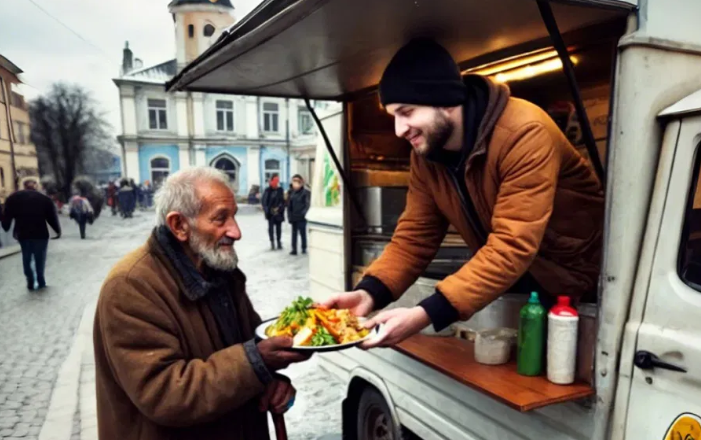
Andrey figured he was just a passerby—until the fourth day, when something pulled at his heart. He walked over with a plate of tacos and set it in front of the man.
“Please,” Andrey said gently. “Try it.”
The man looked up, surprised, a bit embarrassed.
“I… I can’t pay,” he murmured.
Andrey smiled. “It’s on me. Just taste it.”
The man hesitated, then picked up his fork. One bite. Then he froze.
“Incredible,” he whispered.
That was the beginning. His name was Mikhail Arkadyevich. In the ’80s, he had been the head chef at a legendary restaurant. Andrey knew the name—once the gold standard for elite dining. Mikhail had written the menu, cooked for dignitaries, run the kitchen.
But the world changed. The restaurant closed. Jobs vanished. Mikhail lost everything—his position, his home, his path back.
“Time doesn’t wait,” he said, almost apologetically. “Especially when you’re older.”
Andrey listened. It was hard to reconcile this man with the life he described.
“I just like watching people eat,” Mikhail said. “Reminds me of when I had a place in the world.”
Andrey thought for a moment. He remembered his own struggles, trying to figure out what made him happy.
“Mikhail Arkadyevich,” he said finally, “would you work with me?”
The man blinked, stunned. “I… I’m not sure I can.”
“Come on,” Andrey said with a grin. “I need someone who knows real cooking.”
Mikhail paused, then nodded. “I’ll think about it.” A few days later, he said yes.
From day one, their bond was clear. Mikhail brought more than experience—he brought soul. He showed Andrey that real cooking wasn’t just about flavor, but feeling. Even the way he chopped onions or trimmed meat became a master class.
“Cook with heart,” he’d say. “The food knows if you don’t.”
Andrey soaked up every word. He wanted more than skill—he wanted meaning.
Mikhail shared stories: how he wowed ministers with duck in orange glaze, saved a banquet with emergency truffles, designed menus that became events.
“Food isn’t just ingredients,” he’d say, seasoning broth. “It’s emotion. Memory.”
The two began to experiment. First small things—soups in edible bread bowls. That one took off instantly. Then more daring: new pie fillings, surprise spice blends, deconstructed salads in jars.
Every customer reaction was fuel. A smile, a compliment—it lit something in Andrey.
One evening, an older couple lingered by the van, unsure. Mikhail saw it first.
“Wait,” he said, stopping Andrey. He stepped out with two bowls of soup and set them down.
“It’s on us. Enjoy.”
They hesitated, then thanked him and ate slowly. Andrey watched, feeling like he was witnessing something real.
“We should do this more,” he said.
So they did. Once a week at first, then more. Free meals for retirees, students, struggling parents. Little by little, they built more than a customer base. They built a community.
Word spread. First from person to person. Then online. Local papers caught wind. Soon, everyone was talking about “Taste on Wheels”—not just the food, but the heart behind it.
One quiet evening, with the van closed and tea in hand, Mikhail looked at the sky and said:
“You brought me back to life, Andrey.”
Andrey sat beside him. “You reminded me not to quit.”
They weren’t just coworkers. Mikhail had become a mentor. A friend. Family.
Their next goal? Expand. More vans. More cities. More people fed.
But they’d never forget how it all started.
With one bowl of soup. And the choice to care.