Sarah exhaled slowly. She was looking at her son, Noah, who was sleeping in his crib. Tears rolled down her eyes. How could a mother accept that her son would never walk?
Noah’s spinal muscular atrophy diagnosis shattered Sarah’s and her husband’s life. When he was born, Noah looked like the healthiest boy ever. He even moved his tiny legs, but those movements stopped completely over time and doctors told them they would never return.
“Sarah, have you slept for at least an hour?” her husband Michael asked her with a dose of concern in his voice.
“I couldn’t,” Sarah answered. “I just can’t stop looking at Noah. Who knows, maybe he’ll move his legs and I won’t be there to see it.”
Then, they heard barking coming from the living room. It was Max, the tiny golden retriever Sarah took home from the shelter that day.
Just like her boy, this golden retriever was a fragile puppy — the tiniest in the litter — and the vets believed he wouldn’t make it. But somehow, Max thrived and ended up at the shelter. When Sarah learned his story, she knew he belonged with them.
“What do you think, Michael, should we let the dog in? Let’s see how he reacts to Noah.”
Michael was hesitant at first, but he agreed and opened the nursery’s door.
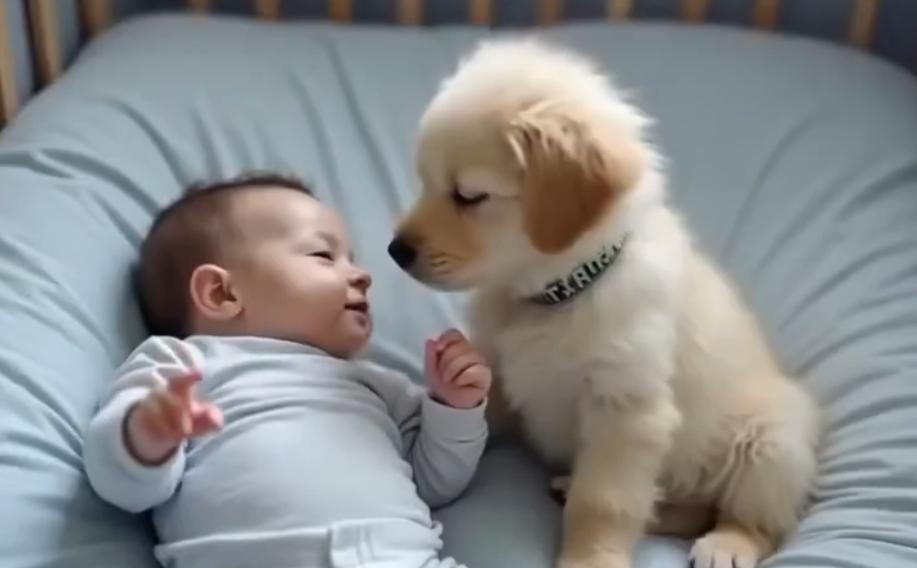
When Max entered Noah’s room, he went straight to the crib and started sniffing the baby. Next, he lay beside him and started pressing his nuzzle to Noah’s skin.
“Oh, this is so beautiful,” Sarah said, not assuming that Max would give them the hope they had prayed for ever since Noah’s diagnosis.
At one moment, Max made a movement and Noah’s arm twitched. They haven’t noticed such movement in months.
Sarah and Michael looked straight at each other’s eyes. “Michael, did you see that?” Sarah yelled.
“Yes, I did,” Michael answered, barely able to utter anything.
To their surprise, Noah made a few more movements, but only after Max did them first. It looked as the boy was mirroring the dog’s movements.
The following morning, Sarah and Michael went to see Noah’s neurologist, Dr. Hammond. They explained what they had witnessed, but Dr. Hammond said that Noah’s movements were just random spasms and that there was no evidence of any kind that animal therapy ever helped patients like Noah. But his parents knew better than that. They were certain Max was doing something to trigger their son’s reactions.
After nights of researching cases like Noah, every fibre of Sarah’s being craved a miracle. She contacted a number of doctors and specialists, and one of them, Dr. Evelyn Carter, answered back.
Dr. Carter had been researching animal-assisted therapy on people with spinal muscular atrophy. She believed there was something Max could sense about Noah and that the baby’s movements weren’t just random spasms.
She watched closely, her expert eyes following Max’s movements as he pressed against Noah’s lower spine and legs, then her expression shifted from calm to shock.
“It’s not random. It’s a response,” she said. “I think he’s detecting nerve activity.”
“Are you suggesting Noah’s paralysis might not be permanent?” Sarah asked.
Dr. Carter paused. “Max is targeting pressure points Noah can sense but we can’t. Let’s demand more tests. Maybe the diagnosis isn’t right.”
At that moment, Dr. Hammond entered the room. “This is nonsense. Dogs don’t diagnose nerve damage,” she said nervously.
But despite her words, Sarah and Michael knew there was still hope for their boy all thanks to the golden retriever they decided to welcome into their lives and home.