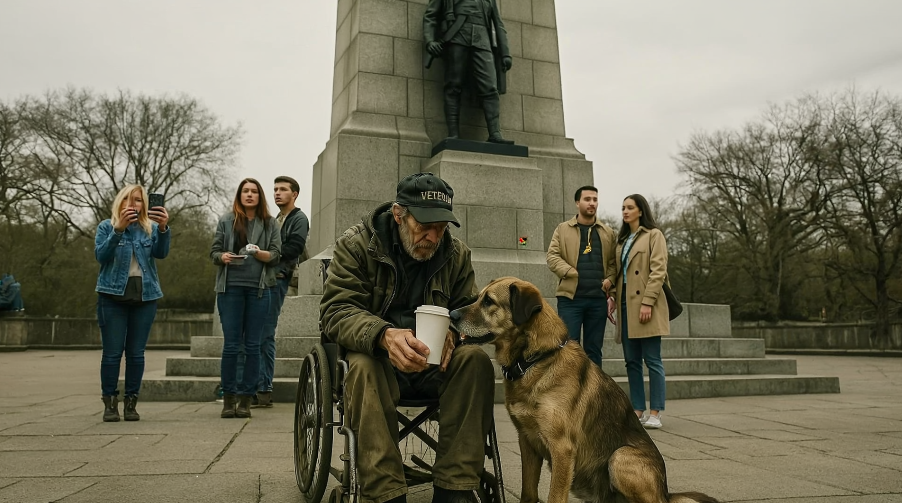
People were posing for selfies in front of the statue. Smiling. Peace signs. One couple argued quietly, like the granite soldier might overhear. But I only saw him.
The man in the wheelchair, hunched like the weight of that monument was pressing down on his shoulders. His jacket was torn at the cuff. The cap on his head said VETERAN, nothing more. Like a label he didn’t ask for. And next to him—this weathered dog, drinking from a paper cup he held out like it was china. No leash. No commands. Only trust.
I stood there longer than I intended, holding my coffee like an idiot. Watching them. He never looked up. Never asked for change. He simply fed his dog first.
It hit me sideways. This was supposed to be a place of honor. Granite and names and speeches once a year. Yet here was a man who’d actually served… forgotten at its base.
A woman walked by, dropped a dollar into his lap without pausing. The bill stuck to his pant leg. He didn’t move. The dog did—turned and looked at me as if it knew I was observing.
That’s when I finally stepped forward. Said, “Sir… do you require anything?”
He nodded once. Barely. Then he cleared his throat, voice cracked and low, and said, “A name. For him.”
I blinked. “For your dog?”
He gave the smallest smile, as if it pained him to do so. “He’s been with me a long time. Saved me more times than I can count. But I never gave him a name. Didn’t think I had the right.”
I crouched down slowly, allowing the dog to sniff my hand. He was old, muzzle gray, but eyes sharp. Gentle. Loyal.
“Why now?” I asked. “Why do you want to name him today?”
The man looked toward the monument. “Today was the day I lost my squad. All of them. Same time. Same sandstorm. We never even said goodbye. But this dog… he was the only thing that made it out of that desert with me. I think he deserves more than silence.”
I didn’t know what to say. I looked at the memorial again, but it felt cold now. Hollow. As if it didn’t reach the people it was built for.
“I’m Michael,” I offered. “Perhaps… perhaps I can help.”
The man nodded again. “My name’s Roy.”
Roy had the kind of voice that sounded like it had told too many stories and grown weary of hearing itself. Still, there was something solid about it. As if, when he spoke, it held significance.
He reached into a beat-up canvas bag and pulled out a photo, yellowed and curled at the edges. It showed five men standing beside a Humvee, all grinning, arms slung around each other’s shoulders. “These were my brothers,” he said. “The last good day we had.”
The dog sat beside him as if he already knew the names. As if he remembered the laughter before the screams.
“He’s always been there?” I asked.
Roy nodded. “Found him on patrol. He was half-starved, barely moving. Took him in when I shouldn’t have. But he stayed with me. Even through the fire.”
There was a long pause. Tourists continued walking by, taking photos, oblivious. Some glanced at Roy, but quickly looked away. As if guilt burned faster than compassion.
“Tell me about the fire,” I said, gently.
Roy looked at me for a long time. Then, with a sigh, he began to speak.
It was the kind of story that twisted your stomach. His unit had been ambushed. The vehicle caught fire. Roy had tried to pull his friends out, but the flames had consumed them faster than he could move. He was burned in the attempt. That’s when the dog—who’d been hiding under the vehicle—bit through Roy’s vest strap and dragged him away.
“He shouldn’t be alive,” Roy said. “Neither should I. But here we are.”
I looked at the dog again. He tilted his head as if he understood the weight of that story.
“I think,” I said, “he already has a name.”
Roy raised an eyebrow.
“Honor,” I said. “He’s your Honor. He carries their memory, doesn’t he?”
Roy’s eyes welled up, but he blinked hard and looked away. “That’s a good name,” he said quietly. “Honor.”
I reached into my pocket and pulled out the sandwich I hadn’t touched. Broke off half, offered it to Roy, then knelt and gave the rest to Honor. They both accepted it as if it were a feast.
I thought that would be the end of it. A moment shared. A quiet gesture. But Roy looked at me and asked, “Do you have somewhere to be?”
“Not really,” I said. “Why?”
“Want to walk with us?” He gestured to the wheels beneath him. “Well. Roll, I suppose.”
So I walked. He rolled. Honor padded beside us. And Roy talked.
He didn’t talk like someone unburdening himself. More like someone planting pieces of himself along the way, like seeds in case he didn’t make it back.
He told me about growing up in Georgia. About wanting to be a mechanic before the war pulled him in. About the letters he used to write to a girl named Samantha who stopped writing back after his third tour.
“I don’t blame her,” he said. “War changes you. Sometimes into someone who no longer belongs anywhere.”
I didn’t argue. I simply listened. That seemed to be what he needed most.
We ended up at a small park behind the library. Quiet. Shady. Roy parked his chair near a bench, and I sat down. Honor flopped into the grass as if he’d earned it.
“Do you have family?” Roy asked.
“Only a brother in Chicago. We don’t talk much.”
Roy nodded slowly. “It’s curious how we spend so much time trying to survive and then forget how to live.”
That resonated with me more than I expected. Perhaps because it felt true.
I offered to buy him lunch, but he declined. Said he had all he needed. But I noticed his shoes were falling apart. The soles looked like they’d traversed a few lifetimes.
So I made an excuse to step away and called a friend who ran a local shelter. Told her about Roy. Told her about Honor. She said she’d meet us there in half an hour.
When I got back, Roy was rubbing Honor’s ears and staring off into the trees.
“You don’t have to remain,” he said. “I’m accustomed to people drifting away.”
“Well,” I replied, “perhaps it’s time someone remained.”
When the shelter van pulled up, Roy tensed. “I’m not going to a home,” he said firmly. “I’m not leaving him.”
“You’re not,” I said. “They’ve got a room at the back. It’s private. Pet-friendly. And there’s hot food. Give it one night. For Honor.”
Roy didn’t answer immediately. Then he looked at the dog. “Do you trust them?” he asked him. The dog licked his hand.
“That’s a yes,” I said.
He sighed. “Alright. One night.”
That night turned into a week.
A week turned into a month.
I visited every other day. Sometimes we conversed. Sometimes we simply sat in silence. But the silence didn’t feel heavy anymore. Only quiet.
Roy started helping around the shelter. Fixing things. Talking to the other vets. Honor became everyone’s therapy dog.
One afternoon, I brought him a new jacket. A simple item. But I had it embroidered on the inside: “For the man who gave Honor his name.”
He ran a hand over the letters, said nothing. He simply patted my shoulder and smiled.
Three months later, Roy passed in his sleep. Heart failure, they said. Peaceful. Honor was curled at his side the entire time.
They asked me what should be done with the dog.
I didn’t hesitate. “He comes with me.”
Honor lives with me now. He still enjoys sitting by the war memorial on Sundays. I allow him. Perhaps he’s remembering. Or perhaps he’s hoping someone else will notice.
Sometimes people stop to pet him. They ask his name.
And I always say, “This is Honor. He belonged to a hero.”
People smile, nod politely. They don’t always comprehend.
But that’s fine.
Because Honor does.
And me? I understand more now than I ever did before.
We don’t choose who we save or who saves us. But sometimes, if we’re fortunate, we choose to give someone their name back. Or give them one to carry with pride.
So the next time you walk by someone sitting quiet and forgotten, do not simply keep walking.
You never know whose story you’re passing.