It was past seven on a chilly autumn evening when she arrived.
The restaurant, Maison du Jardin, was nestled in the heart of the city, glowing with golden chandeliers and the soft tinkle of piano notes in the air. Inside, every table was dressed in white linen and flickering candlelight. Wealthy couples sipped imported wine. Laughter came in measured tones. It was a place where businessmen sealed deals over truffle risotto, and socialites captured their meals on gold-trimmed iPhones.
Then came the click of soft, practical shoes.
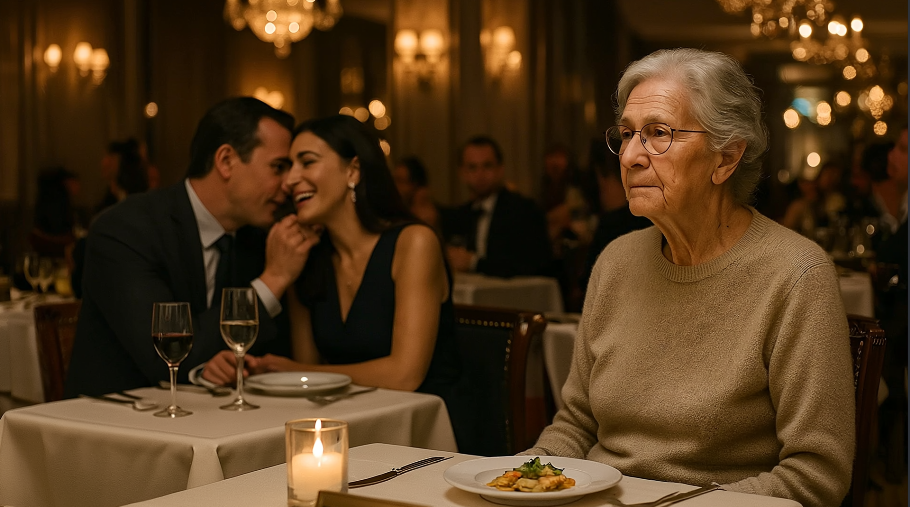
Eliza stepped through the door wearing a timeworn wool sweater, a long gray skirt, and a pair of well-used orthopedic shoes. Her hair was neatly pinned, her eyes sharp behind wire-rimmed glasses. She stood at the entrance quietly, unnoticed at first—until the maître d’ turned.
He was tall, polished, with a rehearsed smile that flickered when he saw her.
“Good evening,” Eliza said with gentle dignity. “I have a reservation. Under the name Eliza.”
The maître d’ hesitated, as if waiting for her to realize her mistake. His brow furrowed ever so slightly. Then, with a half-nod, he checked the book.
“Ah… yes. Eliza. Party of one?”
“Correct,” she said. “I called this morning.”
He sighed. “Tonight we’re offering a fixed tasting menu only. No substitutions. It’s… quite rich.”
“I’m aware,” she replied calmly. “I’m looking forward to it.”
The maître d’ led her—albeit with a trace of reluctance—to a small table by the window, a little removed from the center of the room. She thanked him with a warm smile and took her seat.
But the atmosphere shifted almost instantly.
From the adjacent table came a whisper. “She must be someone’s grandmother. So sweet… but isn’t she out of place?”
“I’ll bet she can’t even pronounce ‘foie gras,’” a man murmured, barely suppressing a chuckle.
“She probably got lost,” a waiter whispered behind the bar. “Sometimes elderly folks wander into the wrong place…”
A couple requested to be moved. A group of influencers tried to angle their cameras so she wouldn’t appear in the background.
But Eliza didn’t seem to notice. She sat tall, looking around the room with a peaceful gaze, her hands folded in her lap. When the waiter approached, she ordered the full menu without hesitation—and declined the wine.
“I’m waiting for someone,” she explained, her voice soft but certain.
Time passed. The din of conversation continued, but there was a strange tension in the air. Every so often, eyes flicked toward her table. Some in amusement, others in pity.
And then it happened.
The kitchen doors swung open.
From behind the pass came a man few in the dining room had ever seen—the owner himself. Benjamin Hartwell.
He wasn’t the type who mingled with the guests. A former chef who’d worked in Paris and Tokyo, Ben preferred the back of the house. He was known for his perfectionism, for being elusive, almost mythic.
But tonight, he stepped into the dining room, his apron still dusted with flour, his sleeves rolled up. His eyes scanned the room intently.
Until they landed on her.
He froze.
Time seemed to suspend.
Then, slowly, he crossed the room—ignoring every whisper, every curious glance.
He stopped beside her table. And then, to everyone’s shock, he knelt beside her.
“Eliza,” he said, his voice hoarse but filled with warmth. “You’re back.”
Eliza smiled softly. “Of course. I told you I would be.”
Ben took her hand gently in his. “Do you remember what you told me? That night—when I nearly walked away from all of this?”
Her eyes glistened. “I said, ‘Don’t let your pain decide the flavor of your food. Let your hope do that instead.’”
He laughed through the lump in his throat. “You did. And I didn’t understand it then. But now…”
Around them, the room had fallen completely silent.
Ben turned to the crowd, rising slowly. “This woman saved this restaurant.”
He looked back at her. “No—she saved me.”
And then, for the first time, the full story came out.
Fifteen years ago, Maison du Jardin was an idea—Ben’s dream after he left the culinary world behind. He had lost his wife to cancer, and in the months that followed, he spiraled into a pit of despair. The restaurant was supposed to be their joint vision. But alone, he doubted everything. He burned dishes. Snapped at staff. Considered selling the whole thing.
One night, in those early days, an elderly woman had wandered in. The place was nearly empty. Ben had yelled at a line cook and smashed a sauce pan against the wall. He was ready to throw in the towel.
But the woman—Eliza—had been seated anyway.
She ordered a bowl of soup. It was a simple leek and potato blend Ben had learned from his grandmother.
She ate it slowly, savoring each bite.
When Ben came out to apologize for the commotion, she had looked up at him and said, “Your food tastes like someone who’s trying not to feel.”
He was stunned.
Then she added, “Don’t let your pain decide the flavor of your food. Let your hope do that instead.”
She didn’t explain what she meant. She simply paid her bill and said she might return someday.
And now… she had.
Tears were running down Ben’s face by the time he finished telling the story. And Eliza sat there, serene, as if nothing had changed.
But everything had.
The couple who’d requested to be moved? They quietly slid back to their original seats.
The influencers? They put their phones down.
And the waiter who had doubted her returned with a steaming bowl of soup—on the house.
The rest of the evening unfolded like a dream. Eliza enjoyed every course with quiet delight. She chatted with the sommelier about pairings—turns out she once taught wine appreciation at a community college. She complimented the servers, even asking about their families.
At the end of the meal, she asked for Ben.
When he came out again, she stood—slowly, with his help—and reached into her pocket. She pulled out a small envelope.
“This is for your scholarship fund,” she said.
He blinked. “How did you—?”
“I read the article in The Chronicle. You’re starting a fund to train young chefs from low-income families.”
He nodded. “Yes. In honor of my wife. She used to say food should be an open door, not a locked gate.”
“Well then,” Eliza smiled, placing the envelope in his hand. “Let’s unlock more doors.”
Inside was a check for $50,000.
By the time Eliza left that evening, the staff was lined up at the door. Every one of them thanked her.
And in the weeks that followed, a framed photograph appeared in the restaurant’s foyer: Eliza, sitting at her table near the window, a small smile on her lips.
Next to the photo was a quote etched in gold: “Let your hope decide the flavor of your food.” – Eliza
People still talk about that night at Maison du Jardin. Not because of a celebrity or a viral menu item.
But because one woman, dressed in a worn sweater and orthopedic shoes, reminded a room full of people that dignity has nothing to do with appearance—and that the heart behind a dish matters as much as the ingredients.
Eliza never asked for recognition.
She returned, like she said she would.
And this time, no one missed her.