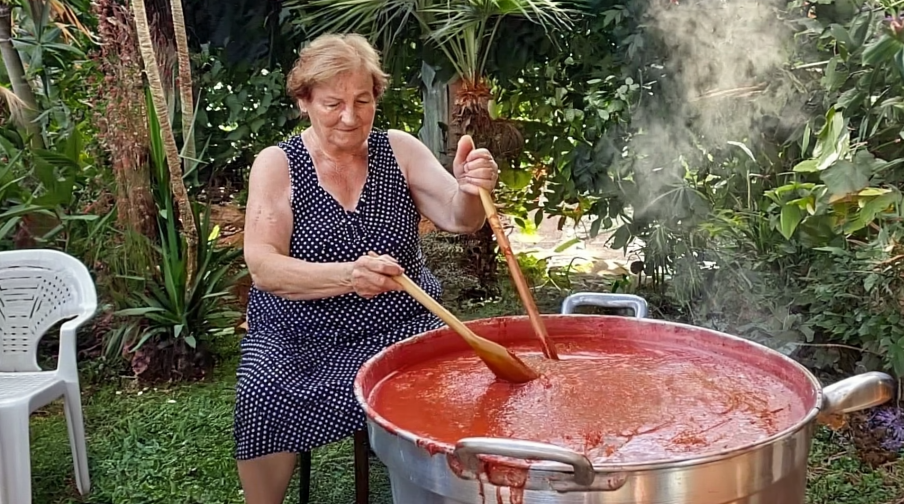
She starts the tomatoes before sunrise, same as always, stirring with that ridiculous wooden pole she’s had since the ’80s. Neighbors wave, joke about her “witch’s cauldron,” but no one complains. Until last week.
This time, a cop actually shows up. Says they got a report. “Possible illegal production.” My aunt doesn’t even flinch—she stirs slower, as if waiting for him to grow bored.
But he’s not here about permits. He points to the sauce. “Someone says this smells exactly like the paste from the San Giovanni fire. 1999.”
I freeze. I was nine. I remember that fire. A whole restaurant burned, insurance money changed hands, and no one was ever charged.
My aunt gets quiet. Then she says, too calmly, “That recipe was stolen. It belonged to my sister.”
Except—her sister’s been in Argentina since the ’90s. Claimed she couldn’t travel. Claimed she had lupus.
And now I’m standing here in the yard, next to a bubbling pot of tomato sauce that smells of buried memories and lies.
The cop looks at me like I’m supposed to confirm something, but all I can do is glance at my aunt. Her eyes are on the sauce, not on us. As if it’s telling her what to do next.
“Ma’am,” the officer says, “May I ask who taught you to make this?”
My aunt sighs, and for a second, she looks older than I’ve ever seen her. “My sister. Before she left. Before she disappeared.”
“Disappeared?” I echo. “She moved to Argentina.”
“That’s what she said,” my aunt mutters. Then she finally stops stirring. “But she didn’t move. She ran.”
Now it’s the officer’s turn to freeze. “Ran from what?”
Aunt Teresa wipes her hands on her apron and nods at me. “He should hear it too. You both should.”
She walks over to the porch, sits down slowly like the story weighs more than her bones.
“It was ’97,” she begins. “We were both working at Trattoria della Luna, the one that burned two years later. My sister—your aunt Lucia—was the star. She made the sauces, picked the herbs, charmed the customers. That tomato paste? That was hers. Not the restaurant’s. Hers. Family recipe, passed down from Nonna Alina, all the way from Calabria.”
She pauses to catch her breath, or perhaps gather courage.
“One night, Chef Marco in the pantry copying her recipe book. Word-for-word. She threatened to tell the owner. But Marco… he had friends. Real friends. The kind who handled problems with matches and gasoline.”
My stomach churns. “You think they threatened her?”
Aunt Teresa nods. “I know they did. That same night, she packed a bag and told me she was going to Milan. Said she’d be back in a week. I never saw her again. Two months later, a letter came from Argentina. No return address. ‘Don’t look for me. They’re watching.’”
“And the fire?” the officer asks.
She shrugs. “Insurance scam, most likely. But you said the paste smells the same. That means someone has her recipe.”
“Or she’s back,” I say quietly.
That idea floats in the air like ash. Nobody moves.
The officer finally says, “I’ll file this as a neighbor dispute for now. But if you hear from her—your sister—I need to know.”
He leaves with a polite nod, but the weight of his questions lingers.
That night, I can’t sleep. I keep thinking about the fire, the sauce, the strange quiet way my aunt had told that story. And something else.
A letter I found years ago in a box of Christmas ornaments. It was from Lucia, addressed to someone named Mateo. It was in Spanish, but I remember a phrase in English scrawled at the bottom: “Tell Teresa the sauce is safe.”
Back then, I thought it was some inside joke. Now, I’m not so sure.
The next morning, Aunt Teresa is back at the pot, like nothing ever happened. But there’s a tension in her jaw that wasn’t there before.
“I need to go to the city,” I tell her, tying my shoes.
She doesn’t ask why. She nods.
I head to the public records office downtown. If Lucia changed her name, got married, or owned property, something would show up. I start with immigration records. Nothing under Lucia Romano after 1997.
I try aliases. Middle names. Variations in spelling. Still nothing.
But then I check property transactions under her name in 1999. Nothing in her hometown. But one entry in 2002 in the name of Lucía Ramone. A food import business license. Based in Buenos Aires.
My hands shake as I print it.
I call the number listed. No answer. I send an email, using the only thing I can think of as a subject: “The sauce is safe.”
Hours pass. I’m halfway home when my phone buzzes.
The reply is short: “Meet me. Alone. Tomorrow. 3 PM. Train station locker #42.”
I almost drop my phone. But I don’t tell my aunt. Not yet. Not until I know.
The next day, I arrive at the train station early. Locker 42 is near the end, away from the crowds. At 2:59, a woman in a dark coat walks up, looks around, then opens the locker.
Inside is a jar.
Tomato paste. Homemade. Still warm.
She turns and sees me.
Lucia.
Her hair’s shorter, streaked with gray. But it’s her. Same sharp eyes. Same mole on her jaw. She smiles, faintly.
“You grew up.”
“You faked a disease,” I reply, stunned. “You faked your life.”
She nods. “I had to.”
“Why now?” I ask. “Why the sauce?”
“Because someone’s selling it,” she says. “Not copying it—mass producing it. Under Marco’s son’s name.”
I feel like I’ve been punched. “Marco’s son?”
“Julian. Took over a fancy Italian food chain. ‘Family-owned.’ Even claimed to have ‘rediscovered’ an old Calabrian sauce recipe.”
Lucia pulls a folder from her bag. Inside are labels, packaging samples, even a newspaper article titled “Julian Bianchi’s Secret Ingredient.”
“Recognize the font?” she asks.
I do. It’s my aunt’s handwriting. From the old recipe book.
“Why didn’t you come back?” I whisper.
“They killed a waiter who saw too much. And Marco’s people have long arms. I stayed away to keep you and Teresa safe.”
We sit in silence, the hum of trains filling the space.
“But now they’re profiting off your life,” I say.
She nods. “And I’m done hiding.”
That night, I finally tell Aunt Teresa.
She cries. Not out of anger. Relief.
“She’s alive,” she says, again and again. “After all this time.”
We decide to help her. Together.
The plan is simple. Not revenge—exposure.
Lucia sends anonymous samples of the sauce to food critics, claiming it’s made using her original recipe. Then she mails a handwritten letter to the biggest Italian food magazine, detailing the theft, the arson, and her forced disappearance.
The story explodes.
“FROM THE FLAMES TO THE TRUTH” reads one headline.
Julian tries to deny it, but the handwriting analysis, the photos, the sauce samples—it’s all too much.
Within weeks, his brand is under investigation. Sales drop. Investors pull out.
But the twist comes when one of his former employees leaks an old video—Julian reading a recipe aloud, stumbling over Italian words.
A watermark in the corner reads “1998 – Trattoria della Luna Basement.”
Marco himself had recorded it.
And behind him, barely visible in the shadows, is Lucia. Tied to a chair.
The internet goes wild.
Police reopen the case.
Julian is arrested.
Marco? He’s been dead ten years, but his sins finally surface.
Lucia is vindicated. She comes home.
The day she returns to our little town, she and Aunt Teresa stir the sauce together. Two sisters, reunited by a pot of tomatoes and years of silence finally broken.
Neighbors stop by, bringing bread, wine, and hugs. Even the officer from before shows up with a box of cannoli and an apology.
Lucia smiles and says, “Tastes even better after twenty years of waiting.”
We end up turning the backyard into a weekend cooking class. People come from all over to learn the “real” recipe. They sit on crates, eat from paper bowls, and listen to Lucia tell her story.
And the best part?
All proceeds go to a fund for restaurant workers who’ve survived workplace abuse.
Aunt Teresa says, “Karma’s real. You have to be patient.”
And she’s right.
Lucia got her life back.
Julian lost the empire he built on lies.
And I—well, I got to witness the power of truth stirred slowly over an open flame.
The lesson?
Sometimes, the recipe for justice is like making sauce—low heat, long time, and a whole lot of heart.