Every day at 4:30 a.m., Claire Dawson arrived at Maple & Grain, a cozy little bakery tucked into a Portland neighborhood that was slowly yielding to high-rise condos and overpriced cafés. At 33, Claire had become a fixture—known for her flaky croissants, cinnamon rolls that practically melted in your mouth, and a calm, caring presence that lingered even after she’d left the room.
But her most meaningful routine had nothing to do with what was on the menu.
Before the city stirred and the bakery doors opened, Claire would wrap a warm cinnamon bun, pour a cup of black coffee, and slip quietly out the side door. She walked two blocks to an old wooden bench near a faded bus stop. And there, she left the breakfast alongside a folded napkin bearing a handwritten note: “Wishing you a peaceful morning.”
That same man was there every day. Gray hair. Weathered coat. Quiet. Always sitting alone, hands resting on his lap as if he was waiting for something—or someone. He never begged. He never spoke. He never even looked directly at anyone.
Claire never asked his name. He never gave it. But every day, she left him food.
Her coworkers noticed. Some rolled their eyes.
“She’s wasting food on someone who likely doesn’t even appreciate it,” one muttered.
“She’s going to be exploited,” said another.
But Claire persisted. Not because she expected thanks. Not because she sought attention. She acted because she saw someone who appeared forgotten by the world—and she refused to join in that neglect.
When new owners took over the bakery, Claire was called into an employee review.
“Your dedication is remarkable,” the manager said carefully. “However, some customers mentioned feeling… uncomfortable seeing a homeless man near our establishment. Perhaps consider donating to a shelter instead?”
Claire nodded politely. She changed nothing—except to arrive 15 minutes earlier so no one would observe her leaving.
She believed her act of kindness went unnoticed. Until one morning, a new cashier whispered to a customer, “She’s been feeding that man for years. Every single day.”
The customer glanced over and replied, audible to Claire:
“Poor girl. Believes she’s making a difference.”
Claire didn’t respond. She continued folding dough, continued rolling pastry—because it was never about what others thought. It was about acknowledging someone too many people ignored.
“You’re too soft-hearted,” her mother once told her. “You give too much.”
But Claire did not believe kindness was a finite resource. It was something that multiplied with generous distribution.
Her fiancé, Ben, understood that. A children’s librarian, he admired how Claire always prioritized kindness. “You don’t only bake for people,” he told her once, “you truly see them.”
As their spring wedding approached, Claire ordered their cake from the bakery she cherished and invited all her coworkers. Ben playfully teased her about inviting half the city, but in truth, he admired her more for it.
Two days before the ceremony, a letter arrived. Hand-delivered. No return address. Inside was a single sentence in neat handwriting:
“Tomorrow I will come—not for cake, but to repay a kindness.”
Claire read it again. Something about the handwriting felt familiar—but she couldn’t place it.
On her wedding day, Claire stood in the bridal room, peeking out the window at the growing crowd. She saw her coworkers, her parents, Ben’s nieces in matching dresses.
And then— There he was.
Standing awkwardly at the church entrance. Wearing a worn but freshly pressed suit. Shoes scuffed, but clean. His silver hair was combed back. For the first time, Claire could see his face clearly.
He was the man from the bench.
The whispers started immediately:
“Is he lost?”
“Who invited the homeless man?”
“Is he here for a handout at a wedding?”
Claire didn’t wait.
Without considering the carefully timed entrance or the wedding photographer waiting inside, she lifted the skirt of her white dress and walked out the church doors.
Gasps followed her. But she did not care.
She walked straight to him, tears already forming.
“I didn’t expect you to come,” she said softly.
“I wasn’t sure I should,” he replied.
“I’m glad you did.”
He held out a small object—a neatly folded cloth napkin, hand-stitched at the edges.
“This belonged to my daughter. She embroidered it when she was little. I… I thought you might like it.”
Claire accepted it like a priceless gift. “Would you come inside?” she asked.
He hesitated.
“Walk me down the aisle?” she added.
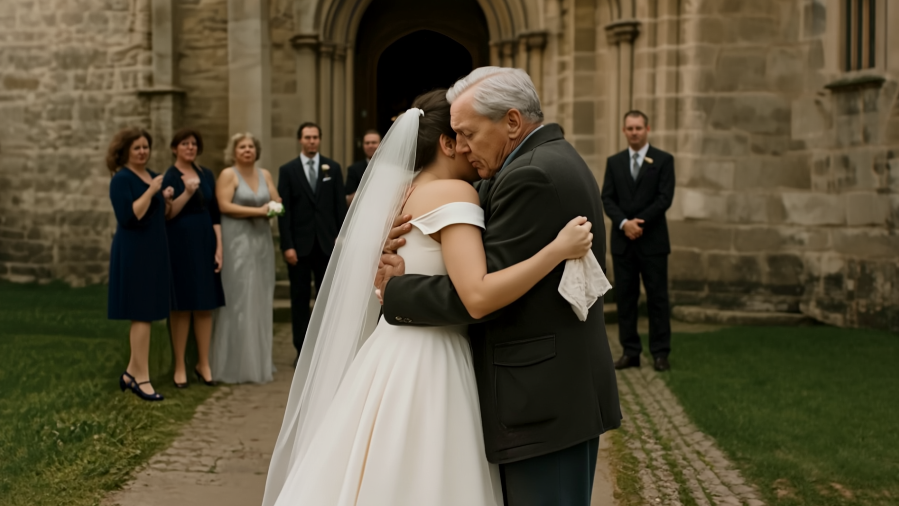
The man’s eyes welled with tears. He nodded.
When they entered the church together, guests fell silent. Claire smiled, her arm linked with the man everyone had ignored for years. And Ben, standing at the altar, smiled back—no confusion, no surprise. Only understanding.
The ceremony was short and full of laughter and promises. Claire kept the embroidered napkin in her bouquet.
After the ceremony, during the reception, many guests approached the elderly man to offer greetings or apologies. Some asked questions. Some simply expressed gratitude.
He didn’t stay long.
Before leaving, he approached Claire and Ben with a small envelope.
“I don’t have much,” he said. “But this is something.”
Inside was a faded photograph of a small bakery—its awning worn, its windows foggy with flour. On the back, a note: “My wife and I once owned a place like yours. She baked. I did dishes. We served our neighbors until we couldn’t anymore. Thank you for reminding me what kindness tastes like.”
Claire framed the photo and placed it above the counter at Maple & Grain.
She never saw the man again.
But each month, Claire began receiving envelopes from different addresses—no return name, only a postcard. Each one featured a photo of a bakery, a coffee shop, or a similar establishment.
“Breakfast shared is hope restored.”
Inspired by the experience, Claire and Ben used some of their wedding funds to start a new program: The Morning Shelf—a wooden rack outside Maple & Grain where anyone could take a pastry and coffee, no questions asked.
No signup. No line. No judgment.
Simply food. Pure kindness.
Within months, others in the neighborhood began adding to the shelf. A flower shop started leaving bouquets. A bookstore added gently used novels. Someone left winter gloves.
Claire never advertised the initiative. But it grew.
And one morning, when the rack was empty and she felt discouraged, a woman in worn clothes stopped by and left behind a handwritten sign:
“Please don’t stop. You saved my week.”
Claire didn’t cry often. But she did that day.
Years passed.
Maple & Grain became a fixture in the community not only for its pastries but for the quiet dignity it extended to everyone. Volunteers came and went. The Morning Shelf remained.
Claire and Ben had children, who learned to write notes for the strangers who stopped by.
“Have a beautiful day.”
“You are loved.”
“Thank you for existing.”
Sometimes, the most extraordinary transformations begin not with a grand gesture, but with a cinnamon roll and a napkin.
The man from the bench never returned. But his presence echoed in every act of kindness that followed.
This story is inspired by real lives and experiences, crafted by a professional writer. Any resemblance to actual names or locations is purely coincidental.
The author and publisher disclaim responsibility for the accuracy of events or character portrayals. This narrative is provided “as is,” and any opinions expressed belong to the characters, not the author or publisher.