Former President Donald Trump has once again captured global attention, this time for his pivotal role in securing a historic peace agreement between Israel and Hamas, as well as for his vocal response to TIME Magazine’s portrayal of him on its latest cover.
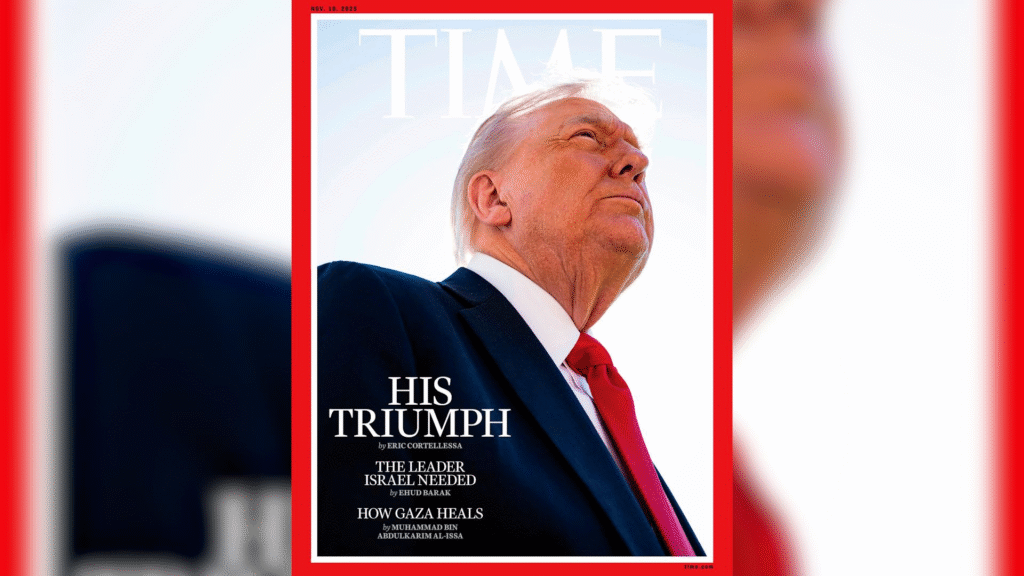
The October 2025 issue of TIME Magazine highlighted what it described as Trump’s “Breakthrough,” applauding his efforts in brokering a Gaza ceasefire that earned widespread bipartisan support and international acclaim. However, the cover image selected to accompany the feature sparked immediate debate, overshadowing what many viewed as one of Trump’s most significant accomplishments.
A Landmark Peace Agreement
At 79, Trump has devoted much of the past year to international diplomacy. Working alongside trusted advisers Jared Kushner and envoy Steve Witkoff, he engaged in months of discreet negotiations with leaders from Israel, Egypt, Qatar, and Turkey. Their collective efforts culminated in a comprehensive accord that ended hostilities, freed hundreds of Palestinian prisoners, and established a tentative but hopeful foundation for regional peace.
“I’ve always excelled at this,” Trump told the BBC during a Cairo summit celebrating the agreement. “I have a talent for resolving conflicts and fostering peace.”
For many, this deal marked a defining chapter in Trump’s post-presidency, showcasing his ability to act as a pragmatic dealmaker on the world stage, distinct from his polarizing political persona.
Yet, the unveiling of TIME’s cover shifted the spotlight in an unexpected direction.
The Cover That Ignited a Firestorm
The cover featured Trump in his signature navy suit and red tie, framed against a vivid sky and captured from a low angle—a striking, dynamic composition to most viewers. For Trump, however, the angle and lighting struck a different chord, prompting an immediate reaction.
“TIME Magazine published a decent article about my work, but the cover photo might be the least flattering I’ve ever seen,” he posted on Truth Social. “They altered my hair, making it look like some strange halo or crown floating above my head. It’s bizarre!”
While his tone carried a hint of humor, Trump made clear he viewed the image as a misrepresentation. “I’ve never been a fan of low-angle shots,” he continued. “This is an awful photo, and it deserves to be called out. What’s their intention here?”
A Complex Relationship with TIME
Trump’s history with TIME Magazine is a blend of prominence and friction. Since his first appearance on its cover in 1989, he has been featured multiple times and named Person of the Year twice. Yet, his relationship with the publication has often been marked by public disputes.
In 2015, he openly criticized TIME for bypassing him as Person of the Year, and he later dismissed its 100 Most Influential People list as insignificant. Despite these tensions, Trump recognizes the cultural weight of a TIME cover—a marker of influence that resonates deeply in political circles.
This backdrop explains his swift response to the image. For Trump, appearance is intertwined with identity. The low-angle photograph, with its stark lighting against a bright sky, appeared to diminish the iconic sweep of his blond hair—a feature that has long defined his public image and fueled endless speculation.
The Ongoing Fascination with Trump’s Hair
Few figures have faced as much public curiosity about their hair as Donald Trump. Over the years, comedians, talk show hosts, and media outlets have speculated about everything from intricate styling techniques to possible cosmetic procedures.
Dr. Gary Linkov, a cosmetic surgeon, once suggested Trump may have undergone multiple treatments, though Trump has consistently dismissed such claims. “It’s my hair,” he has stated repeatedly. “No toupee. It’s real.”
For his supporters, these discussions are mere distractions from his tangible achievements in diplomacy and leadership. Yet, Trump’s decision to publicly address the TIME cover underscores his keen understanding of media dynamics: in today’s world, perception often shapes reality.
The Substance Behind the Image
Beyond the cover controversy, TIME’s feature offered a detailed account of the peace process, highlighting months of tireless negotiations, late-night discussions, and strategic diplomacy led by Trump’s team. Their work ultimately brought two longstanding adversaries to the negotiating table.
The article also explored the broader significance of the agreement. Experts noted that a sustained ceasefire could represent a transformative moment for the Middle East, cementing Trump’s legacy as a global leader during his post-presidency.
Even those skeptical of Trump’s past policies acknowledged the scale of this achievement. As one European diplomat remarked, “Regardless of one’s views on Trump, this is a feat few others could have accomplished.”
The Role of Image in Today’s Politics
The uproar over the TIME cover highlights a broader truth about modern politics: visual presentation often carries as much weight as policy substance. A single image, amplified across social media, can generate more attention than the accomplishment it represents.
Trump’s reaction to the photo reflects not only personal sensitivity but also a deep awareness of how visual storytelling influences public perception. In an era where every detail—every word, gesture, or image—can be magnified online, even minor elements hold significant power.
A Triumph Tinged with Debate
While Trump’s comments about the TIME cover sparked amusement among commentators and fueled social media chatter, those close to him see his response as emblematic of his character: confident, detail-oriented, and fiercely protective of his public image.
For his supporters, the peace agreement represents a moment of unity, showcasing Trump’s ability to bridge divides and achieve results on the global stage. For detractors, his focus on the cover photo highlights a tendency to prioritize personal image over broader accomplishments.
Ultimately, this episode encapsulates the duality that has defined Trump’s public life: a leader who commands attention for his bold actions and for the way he navigates the narratives surrounding them.
Whether defined by the peace deal or the debate over a photograph, Trump’s story remains—as it always has—impossible to overlook.