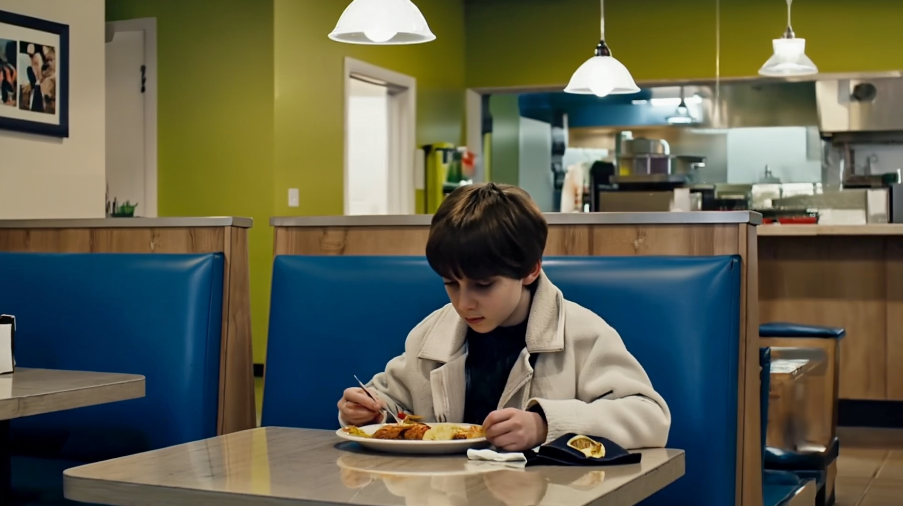
I was in the booth by the window, half-focused on my phone and a cold coffee, when I noticed the kid come in. Hood pulled tight, eyes on the floor. You could tell by the way he moved—slow and small—that he wasn’t sure he’d be allowed to stay.
He picked the last booth in the back and sat like he was invisible. No menu. No order. Waited.
Then the door chimed again, and in walked the cop. Clean uniform, serious face. For a split second, I thought perhaps he’d come to move the kid along.
But instead, he walked up to the counter, nodded toward the kid’s booth, and said, “Whatever he wants. Put it on my tab.”
Didn’t say it for attention. Didn’t even wait for a thank-you. Dropped some cash and walked out like it was nothing.
The kid ate slow. Very slow. Like every bite had to last. No phone. No noise. Only him, the plate, and a cup of water.
Then he pulled out a piece of paper. Looked like something torn from a notebook. He wrote something, folded it up, and slid it under the salt shaker.
And then he left, as quiet as he came.
Curiosity got the better of me. After he left, I walked over, picked up the note.
All it said was:
“If he ever needs help like I did, tell him I owe him my future.”
I stared at that note for a long time. I don’t know why, but it hit me harder than I expected. Perhaps it was the quiet sincerity of it, or how young the kid looked. Perhaps because it felt like the kind of moment life gives you only once in a while—quiet, unnoticed, but huge.
I asked the waitress if she knew the kid, but she shook her head. Said he looked like he hadn’t eaten in days.
The cop? I’d seen him around. He came into the diner every Thursday morning, same time, same booth. Never loud, never pushy. The kind who nodded hello and meant it.
The following week, I waited for him.
When he came in, I stopped him at the counter. I told him about the note. Showed it to him, too.
He read it. Twice. Didn’t say anything at first, folded the paper and slipped it into his wallet.
Then he said, “I’ve seen that kid before. A couple times. He hangs around the park near the high school. Keeps to himself.”
I asked if he was going to look for him, and he nodded. “I think I should.”
The next few weeks, I saw the cop less often. When he did come in, he looked a little more tired than usual, but he always smiled. I figured he was keeping an eye out for the kid.
One night, right after closing, I saw the kid again. He was across the street, near the alley behind the laundromat. Sitting on the curb, looking lost.
I grabbed a sandwich and a bottle of water from behind the counter and walked over.
He looked up when I got close, startled.
“It’s okay,” I said. “You left a note. That cop’s been trying to find you.”
He stood up fast, ready to bolt, but then hesitated.
“I’m not in trouble?” he asked.
“No,” I said. “People care, that’s all.”
He took the food but didn’t eat right away. His hands shook a little.
“My name’s Marius,” he said after a moment.
I told him mine.
He didn’t talk much, but when he did, it came out like a dam had cracked. His mom had passed away last winter. His stepdad kicked him out two weeks later. No aunts, no cousins, no one who’d take him in.
He’d been sleeping behind the community center, stealing showers when he could, and eating whatever he could scrape together. Said the night that cop bought him food was the first time he’d had a hot meal in four days.
I asked if he’d be okay talking to the cop again.
He nodded, then asked quietly, “You think he’d still want to help?”
“He hasn’t stopped looking,” I said.
I called the station the next morning. The officer—his name was Andrei—came by after sunrise. No uniform this time. Only jeans, a hoodie, and that calm, quiet way about him.
Marius stood stiff at first. But Andrei didn’t push. Sat beside him and talked like they’d known each other for years.
After that, things moved fast.
Turns out Andrei had a brother who ran a youth outreach center. They had programs, a place to sleep, and counselors. Not temporary help—but something real. Structure. Hope.
Marius moved in that same week.
The kid cleaned up quick. Got a job at a car wash. Went back to school. Andrei checked in on him often, sometimes with burgers, sometimes to talk.
They built something, those two.
Almost a year later, Marius came back to the diner. Taller. Healthier. Smiling like he had a reason to.
He wore a clean jacket and carried a manila folder under his arm.
“I got in,” he said.
“In where?”
“Trade school. Automotive tech. I start next month.”
I couldn’t stop grinning. “That’s amazing, man.”
He nodded. “I wouldn’t be here if he hadn’t bought me that dinner. Or if you hadn’t told him about the note.”
He left that folder on the table. Inside was a copy of his acceptance letter, a student ID, and a thank-you card—handwritten, full of the kind of hope you can’t fake.
I called Andrei that night. He didn’t say much. Cleared his throat and said, “Good kid.”
Three years passed.
I didn’t see Marius much, but I’d hear things. From the waitress whose nephew worked at the same garage. From Andrei, who still came by every Thursday.
Then one morning, there was a knock on my apartment door.
It was Marius.
He looked older, more confident. A man now.
“I wanted you to hear it from me,” he said. “I got my certification. Full-time mechanic. And I signed the lease for my own place.”
He handed me an envelope. Inside was a voucher for a full car service at the shop he worked at. And a little sticky note that said:
“Paying it forward. Let me know who needs help next.”
I smiled so wide it hurt.
We sat and talked for a while. He told me he was saving up to open his own garage one day. Wanted to call it “The Salt Shaker”—because of that day at the diner. Said it reminded him that one small thing can hold up something bigger.
And then he told me something else.
“You remember that cop’s brother? The one with the outreach center? He’s retiring next year. They’re looking for someone new to help manage it. Someone who knows what it’s like.”
I raised my eyebrows. “You?”
He nodded. “They offered me the job. I’m thinking about it.”
There was pride in his voice, but something softer too. Gratitude. Full-circle kind of stuff.
Before he left, he looked around and said, “You never know who’s watching. Or who needs what you’ve got to give.”
He walked out with the same quiet step he came in with years ago, but now he walked taller.
That night, I couldn’t stop thinking about the note he left behind.
“Tell him I owe him my future.”
And he meant it.
But the real twist came a few months later.
One cold evening, a teenager walked into the diner. Hood up. Same wary look. Sat in the last booth, like Marius did.
And before I could say a word, another man came in. Tall. Greasy hands. Mechanic’s jacket with “Marius” stitched on the front.
He walked right up to the counter and said, “Whatever he wants. Put it on my tab.”
Didn’t wait for thanks. Dropped a folded napkin on the table and left.
I walked over. Opened it.
It said:
“If he ever needs help like I did, tell him I’ve got him. I always will.”
Sometimes we think kindness ends with a single act. But kindness has a way of circling back.
Marius didn’t get help. He became the help.
And all it took to start it was a meal, a note, and someone who cared enough to pass it along.
If that isn’t a full circle, I don’t know what is.
One small kindness can ripple through lives for years. You never know what moment will change someone’s story.
If this touched you, share it. You might be the reason someone leaves behind their own note of hope.