The flashlight landed on another fox.
An adult male.
One of his back legs was tangled in an old section of wire fencing that had collapsed beneath the leaves.
He wasn’t fighting anymore.
He was lying on his side, breathing hard.
“Dad…”
“I see him.”
I pulled Eli behind me.
“Stay here.”
The mother fox backed away as soon as I stepped forward.
She didn’t come toward me.
She didn’t suddenly become tame.
She disappeared behind the brush.
That actually made me feel better.
Whatever was happening, she was still a wild animal.
I got close enough to see the problem.
The wire had twisted tightly around the male’s lower leg.
I wasn’t going to touch him.
I called the county wildlife rehabilitation number I’d saved years earlier after finding an injured owl.
A woman answered.
I explained where we were and sent our location.
Then we waited.
Eli kept looking between the trapped fox and the den.
“Is that their dad?”
“I don’t know.”
“But she brought us here.”
I looked toward the trees.
“I don’t know that either.”
And I meant it.
We knew what we’d seen.
A fox had repeatedly left human-scented objects near our yard.
When one disappeared, she’d returned for it.
Then we’d followed her into the woods and found another fox trapped near her kits.
Anything beyond that was our interpretation.
The wildlife volunteer arrived about forty minutes later with another rescuer.
They covered the fox, cut the wire and got him into a carrier.
His leg was injured, but there was still circulation.
One of the rescuers looked around the ground.
“People dump stuff back here?”
“Sometimes.”
She pointed toward the collapsed fence.
“Probably how this happened.”
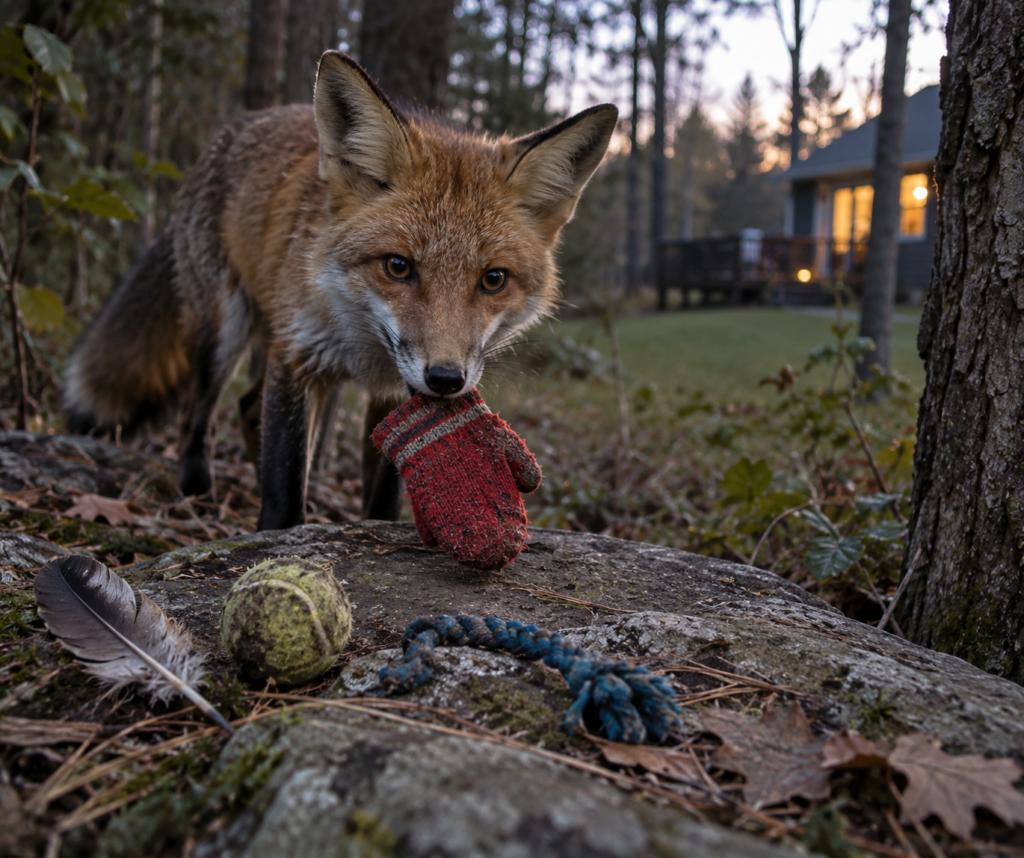
Then Eli asked about the things on our rock.
The feather.
The tennis ball.
The rope.
The mitten.
The woman smiled.
“Foxes pick up all kinds of things. Food, toys, garbage. Especially around dens.”
“So she wasn’t bringing us presents?”
“I wouldn’t call them presents.”
Eli looked disappointed.
Then she added:
“But foxes are very good at learning routines and places. If she kept coming back to the same spot, that spot meant something to her.”
That was enough for him.
The injured fox stayed with the rehabilitation center for several weeks.
We weren’t allowed to visit.
Eli asked for updates so often that eventually the woman recognized my number.
Then one afternoon she called me first.
His leg had healed well enough for release.
They planned to bring him back near where he’d been found.
We watched from far away.
The carrier opened.
For several seconds, he didn’t move.
Then he shot into the brush so fast Eli almost missed it.
There was no movie ending.
The mother didn’t appear.
The kits didn’t run out to greet him.
The woods simply swallowed him.
On the walk home, Eli was unusually quiet.
“What?”
He shrugged.
“I thought we’d see them all together.”
“Wild animals don’t care about giving us a good ending.”
He laughed.
Two nights later, there was something on the flat rock.
Eli saw it first.
A pine cone.
He ran outside.
I followed him.
There were no foxes anywhere.
He picked it up and turned it over in his hand.
“You think she left it?”
“Could’ve fallen from the tree.”
“There isn’t a pine tree here.”
I looked up.
He was right.
I still didn’t tell him it was a gift.
Because I didn’t know.
We left it on the rock anyway.
And for the rest of that summer, whenever we saw a fox at the edge of the woods, we watched from the window.
We never followed one again.
Fictional story created with the assistance of artificial intelligence during the writing process.