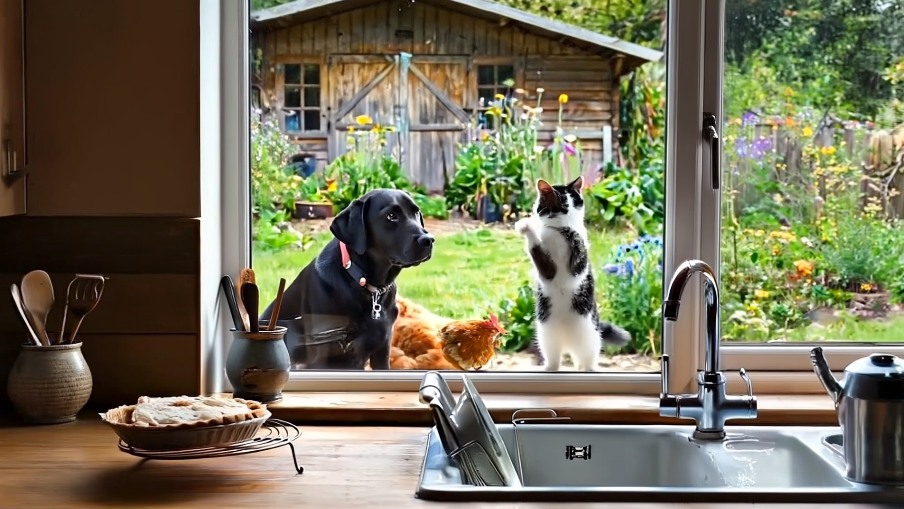
It was supposed to be one of those silly little moments. A cat, a dog, and two chickens all pressed up against my neighbor’s window like they were waiting for a dinner show.
I was driving past, saw the lineup, and couldn’t help myself—I pulled over, zoomed in, and snapped a picture. The cat had its paws up like it was begging. I laughed all the way home.
At dinner, I showed the photo to my wife and daughter. We all laughed. My daughter, who’s seven and obsessed with anything furry or feathered, begged me to take her over to meet them in real life.
So we went. Five minutes later, we were walking up the gravel path to Ms. Tilda’s front door. The animals were still there—same lineup, like they hadn’t moved. That’s when something felt… off.
The dog didn’t bark. The cat didn’t flinch. The chickens weren’t pecking the ground. They were watching something.
I knocked. Waited. Knocked again, louder this time. Nothing.
Then my daughter tugged my sleeve and said, “Daddy… look.”
She pointed through the side window, where the curtain had slipped enough. And there, through the glass—
Ms. Tilda, on the kitchen floor. Face down. One hand stretched out toward the stove.
I told my daughter to stay back. Called 911 with shaking fingers.
And as the operator answered, the dog stood up straight and started barking—like it knew help was finally coming.
The dispatcher guided me through what to do. I explained I couldn’t get inside, but Ms. Tilda wasn’t moving. Within five minutes, a sheriff’s cruiser and then an ambulance rolled up.
The paramedics pried open the door while I kept my daughter on the grass, trying to explain that everything would be okay, even though I had no idea if that was true.
A few minutes later, they rolled Ms. Tilda out on a stretcher. She had a a mask over her face, and an oxygen tank was already in use. One of the EMTs gave me a thumbs up as they loaded her into the back.
“She’s breathing. You saved her,” he said.
“No,” I replied, nodding toward the animals still huddled at the window, “they did.”
It turns out, Ms. Tilda had suffered a diabetic episode. Her blood sugar had crashed hard, and she collapsed while reaching for something sweet to stabilize it. If she’d been alone, she might’ve remained there until it was too late.
But she wasn’t alone.
Her animals had stood guard for almost two hours before I drove by. The dog—Milo—had barked himself hoarse earlier, according to a neighbor on the other side. But everyone thought he was rowdy.
The cat, Pickles, had apparently scratched at the front door until her little paws bled. And those two chickens? Turns out they weren’t only pretty decorations. One of them, Matilda, had even pecked at the side window hard enough to leave tiny cracks.
They were trying to get someone’s attention. And they did.
Ms. Tilda was kept at the hospital for three days. The doctors said it was fortunate she received help when she did. Another hour, perhaps less, and she might’ve slipped into a coma.
When she came back home, she was weak but grinning. She wore a crocheted shawl around her shoulders and insisted on giving me a fresh pie and a firm hug.
“I don’t remember much,” she said, voice raspy. “But I do remember seeing Milo pacing… and Pickles meowing. I think they knew.”
She wasn’t wrong. Milo stuck to her side like glue for weeks afterward. And when the local newspaper heard about what happened, they ran a story: “The Farmyard Watchdogs Who Saved Their Owner.”
The photo I’d snapped? It ended up on the front page.
At school, my daughter brought the newspaper in for show and tell. She told the story like it was a fairy tale.
That would’ve been the end of it. A sweet tale of animals saving the day.
But about two weeks later, something else happened.
I was coming back from the grocery store when I noticed a woman standing in front of Ms. Tilda’s gate. She looked rough—torn jacket, hollow cheeks, carrying everything she owned in one of those plastic carts.
She was watching the animals, who were now free-roaming in the front yard. Milo didn’t bark at her. Instead, he trotted over and sat beside her.
Curious, I got out of the car and approached. “Hey, are you alright?” I asked gently.
She turned. Her eyes were red, but clear. “I used to live on a farm,” she said softly. “I saw the story about this place in the paper. Thought I’d come see for myself.”
I didn’t know what to say. She didn’t ask for money or food. She simply wanted to see the animals. She knelt and whispered something to the chickens, who clucked and bobbed around her legs like they knew her.
Ms. Tilda opened the door then. She was leaning on her cane but smiling. “Come on in, dear,” she said to the woman, like they were old friends.
And that was that. The woman, whose name turned out to be Ruby, ended up staying in the little guest shed behind Ms. Tilda’s house. She started helping with chores—feeding the animals, repairing the fence, keeping Ms. Tilda company.
Ruby hadn’t had a real home in over five years.
We found out her husband had passed, and with no family left, she’d spiraled. Ended up on the streets. She wasn’t on drugs, she was lost and tired.
But those animals? They opened something in her again.
About a month after Ruby moved in, she started painting. She’d set up a little easel near the garden and paint the animals. One day, she showed me a portrait she’d done of Milo standing like a soldier at the window.
It was stunning.
I shared a photo of it online. A local café saw it and asked if they could display her work. Soon after, Ruby sold her first piece. Then another. Then a whole set of four, all featuring Ms. Tilda’s “heroes.”
She got back on her feet, slowly. Started wearing her hair down again. Smiled more. Ms. Tilda said having Ruby around gave her a new kind of peace.
“It’s like having a daughter,” she whispered to me once. “She doesn’t feel like a guest. She feels like family.”
And here’s the twist I never expected—
Six months after that first photo, Ms. Tilda called me over. She had a manila envelope in her hand.
“I rewrote my will,” she said, completely calm. “Ruby’s part of it now. So are the animals. I thought you should know.”
I didn’t ask how much or why. I didn’t need to.
Ms. Tilda had no kids of her own. And in her final years, she found someone who cared—not only about her, but about her world. About Milo. About Pickles. About the garden she loved and the chickens she called “her ladies.”
One evening, my daughter asked if we could go visit again. We brought cookies. Ruby met us at the door with flour on her face and music playing in the background.
They were baking for the church bake sale. Milo trotted out to greet us with a wagging tail, and the chickens were scratching around by the roses.
We sat in the backyard, sipping lemonade and watching the sun dip below the trees. It was peaceful in a way that’s hard to describe.
At one point, my daughter leaned over and said, “Daddy, do you think animals know when people need help?”
I nodded. “I think they know more than we give them credit for.”
And perhaps that’s the heart of this story. Sometimes, help comes in strange forms. A photo taken in passing. A dog barking at the right time. A cat who refuses to give up. Two chickens pecking like tiny warriors.
Or a woman who wandered up to a gate and found something she didn’t even know she was looking for.
In the end, it all mattered.