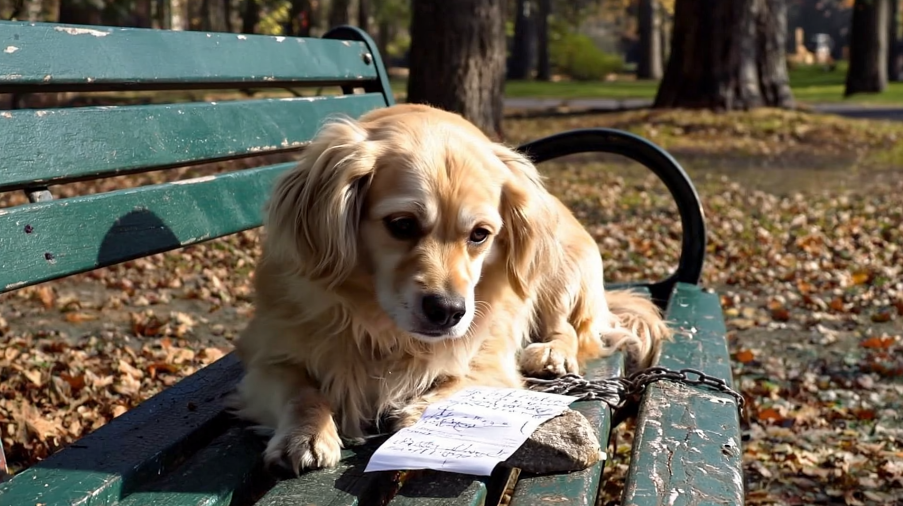
At first glance, it looked like a dog napping in the shade. Pale golden, skinny, too quiet. My partner almost walked past—until I saw the chain.
It was looped around the bench leg, as if someone wanted it to appear temporary. Beside him, a crumpled sheet of notebook paper held down with a rock.
I picked it up.
“I’m sorry. His name is Max. He’s a good boy. I lost my home. Please don’t take him to a shelter. He hates cages.”
That was it. No number. No name. Only a surrender letter written with shaking hands.
Max wouldn’t lift his head at first. He lay there, eyes dull, like he’d finally stopped hoping.
Until I opened my backpack and pulled out the sandwich I’d intended for lunch. That was when he sat up.
And that was when I saw his collar—it had a name, an address.
The address was a few blocks away. We stood there, silent, reading the scratched-up tag.
My partner, Luis, glanced at me. “What do you think?”
“I think we go,” I said. “Someone might be looking for him.”
We both knew that wasn’t true. Someone had left that note. Someone had walked away from this dog on purpose.
Still, we could not do nothing.
We walked, Max trotting beside us, a little wobbly but gaining strength with each step. He didn’t pull or bark, he stayed close as if he already knew us.
When we reached the address, it was a two-story brick house with white shutters. A neat little porch, flower pots, wind chimes. It didn’t look like the kind of place where someone would abandon a dog.
I knocked. After a moment, an older woman answered. She wore a bathrobe even though it was nearly noon, her eyes tired, like she hadn’t slept well in days.
“Hi,” I said, gently tugging Max forward. “We found this dog nearby. His tag has this address.”
She looked down at Max, and her face shifted. Her mouth opened a little, her hand flying to her chest.
“Oh,” she breathed. “Max…”
For a second, I thought she was going to cry. But then she straightened her back and frowned.
“He’s my daughter’s dog,” she said. “Or was. She’s not living here anymore.”
Luis stepped in. “We found him tied to a bench. Someone left a note. Said they’d lost their home.”
The woman didn’t say anything for a second. She stared at Max, whose tail wagged gently at the sound of her voice.
Then she sighed. “Come in.”
The living room was warm, the kind of place with mismatched blankets and dusty family photos. On the wall, I noticed a picture of a young woman holding Max as a puppy.
“That’s Rachel,” the woman said, catching my glance. “My daughter.”
“She’s the one who left him?” I asked, already regretting the question.
The woman sat slowly, like her bones were heavier than usual. “She left here a few months ago. We had a… disagreement. She was working at a diner, barely making rent. I told her she needed to get her life together, stop wasting time. One night, she packed up and left. Took Max. Said she didn’t want to live by anyone’s rules anymore.”
She looked down at her hands. “I thought she’d be back in a week.”
Luis and I exchanged a look. “She’s homeless now,” I said softly. “Or at least she was. That note—she didn’t leave him because she wanted to. She didn’t have a choice.”
The woman’s eyes welled up, but she blinked it away. “She always loved that dog more than anything. I should’ve known.”
“Do you know where she might be?” I asked. “Perhaps she’s still nearby.”
“I don’t,” the woman said. “We haven’t spoken since she left.”
She stared at Max for a long moment. He sat beside her, quiet, head resting on her knee.
Then she stood up and went into the other room. When she came back, she held out an envelope.
“It’s got her old number in it. And the name of the place she worked. I don’t know if either still works. But it’s something.”
We thanked her, promised to let her know if we found Rachel, and walked out with Max in tow.
I could tell Luis was thinking the same thing I was. This wasn’t only about a dog anymore.
We tried the number first. Disconnected.
So we drove to the diner. A squat little place with neon signs and cracked booths. Inside, a waitress in her forties stood behind the counter.
When we asked about Rachel, her eyes narrowed. “Haven’t seen her in weeks. She used to come by after her shifts to grab leftovers. I think she was staying in her car, out behind the laundromat.”
“Do you know if she still has the car?”
The woman shrugged. “Don’t think so. Cops towed it a while back. She… disappeared after that.”
That night, Max curled up on an old blanket in our living room. He didn’t cry or pace. He simply rested his head on his paws and closed his eyes like he finally felt safe again.
But I couldn’t sleep.
I kept seeing the note. “He hates cages.” It wasn’t only about Max. That note screamed of someone doing their best and still falling short.
The next day, we printed a few flyers. Nothing fancy—only a photo of Max, a description, and a note that we were looking for Rachel.
We posted them near the laundromat, the diner, and the shelter. Left a few at gas stations.
A week passed. Nothing.
Then one evening, as I was taking Max for a walk, my phone rang.
The voice on the other end was quiet. “You’re the one looking for Rachel?”
“Yes,” I said quickly. “Do you know her?”
“I might,” the woman said. “She’s been sleeping behind the church on Elm Street. I don’t know how long she’ll stay.”
I didn’t even wait. I called Luis, and we drove straight there.
Behind the small brick church, under a canopy of trees, sat a figure wrapped in a blanket. Max saw her first—his ears perked, tail wagging hard. He barked once, short and excited.
The woman stirred. Looked up.
And then she gasped.
“Max?”
She stood, her blanket falling off her shoulders, eyes wide with disbelief. Max ran to her like he’d been waiting his whole life for this exact moment.
She dropped to her knees, clutching him like he might vanish again. Tears rolled down her cheeks.
“How?” she whispered. “I thought I’d lost him forever.”
We told her everything—how we’d found him, the note, the address, her mother, the diner.
She looked ashamed when we mentioned her mom.
“I was too proud,” she admitted. “Didn’t want to go back after everything. I thought I could make it work, but then my car got towed. I didn’t have bus money. Max was barely eating. I hated myself for what I did.”
“But you didn’t leave him in a shelter,” I said. “You chose a bench. You chose hope.”
She gave a watery smile. “He’s all I had left. I thought if someone kind found him… perhaps he’d be okay.”
“He’s more than okay,” Luis said gently. “But we think you should come back with us. For now. Get cleaned up. Perhaps talk to your mom.”
She hesitated, then nodded.
It wasn’t easy. Her mother cried when she saw her—cried harder than when we’d first brought Max.
They argued that night, voices raised and tired. But by morning, they were sitting at the kitchen table drinking tea. Not best friends. But trying.
Rachel started working again. Not at the diner, but at a local pet grooming place that loved her gentle way with animals.
Max became the unofficial shop mascot.
Three months later, Rachel got a tiny studio of her own. Just big enough for her and Max.
She still visited her mom on Sundays. Sometimes they fought. Sometimes they sat in silence. But there was love there. Wounded, messy love. The kind that bends but doesn’t break.
And Max? He got a new collar. With a new tag.
It didn’t have an address.
Only one word: “Home.”
Sometimes life cracks wide open in the most unexpected places. On a bench. Behind a church. In the eyes of a dog who never gave up.
We didn’t only find a stray that day. We found a story worth saving.
Maybe we all need saving in different ways.
So what would you have done if you’d found that note?
If this story touched you, give it a like or share it with someone who needs to believe in second chances.