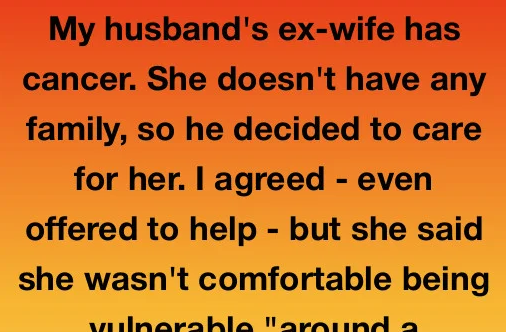
My husband’s ex-wife faced a cancer diagnosis. With no family to support her, he chose to step in and care for her. I supported his decision and even offered my assistance, but she expressed discomfort about opening up to someone she didn’t know. Respecting her wishes, I stayed away. Then, one evening, I visited the hospital unexpectedly. As I entered her room, I stopped in my tracks. There was my husband, asleep in a chair beside her, his hand gently holding hers.
A quiet stillness filled the space, like a soft mist settling in. They didn’t see me. She lay sleeping, fragile and pale beneath the hospital blanket. And he… he carried a tenderness in that moment, as if bearing the weight of years in a single touch. I knew I should leave, but I lingered, my hand resting on the doorframe. My heart wrestled with emotions—not envy, but a deep uncertainty about what I was witnessing. Was this devotion? Duty? A lingering bond? I slipped away silently.
Sleep eluded me that night. I couldn’t stop picturing him in that chair, or the calm on her face. I felt like a bystander in my own life. The next morning, over coffee, I gathered my courage and asked him.
“Do you still love her?”
He looked startled, then thoughtful. “No, not in that way. We shared a lot once. She’s alone now, and I couldn’t bear the thought of her facing this without anyone.”
His words rang true, raw and honest. Yet, a quiet unease lingered—not distrust, but a sense of something unfinished.
That weekend, I returned to the hospital. She was awake this time, her eyes meeting mine with surprise but no hostility.
“I had a feeling you’d show up,” she said warmly. “I bet you’re curious.”
“Not really,” I answered. “But I brought some soup.”
She chuckled. “You’re not at all what I pictured.”
We talked for nearly two hours—light topics like movies, food, and the sterile scent of hospital linens. As I left, she said, “Thanks for the soup… and for not prying.”
I began visiting weekly, sometimes with a meal, sometimes with a book. We weren’t close, but a connection was forming. She started using my name. Her smiles grew warmer when I arrived.
One Tuesday, I found her in tears—not gentle ones, but fierce, frustrated ones. She quickly brushed them away, but I acted like I hadn’t noticed. I sat down and rambled about a silly baking show I’d seen. Slowly, she joined the conversation.
Later, she murmured, “I’m terrified of dying. Not the act of it… but the thought that no one will carry my memory.”
Her words struck deep. I didn’t have a perfect response, but I understood her fear. “Six months ago, I didn’t know you,” I said. “Now, I’ll never forget you. You’re not invisible.”
For the first time, she let her tears fall openly in my presence.
Weeks went by. My husband continued his visits, and sometimes our paths crossed at the hospital. A quiet understanding grew among us—a delicate balance of respect and care, like a fragile thread weaving us together.
Then came an unexpected moment.
One morning, before her radiation session, she looked exhausted but sharp-eyed. “I need to tell you something,” she said. “You might not like it.”
I steadied myself.
“When I was with your husband, I knew he was unfaithful—not with you, someone before. I didn’t fight for us. I’d already stopped loving him. I just let our marriage fade.”
Her words caught me off guard.
She went on, “I always wondered if I’d tried harder, maybe things would’ve been different. When he married you, I resented you—not for anything you did, but because you got the version of him I never could. The gentle one. The one who shows up.”
My throat tightened.
She gave a wry laugh. “But now I see it wasn’t about me or you. It was just life. People evolve, or they don’t. And honestly? He’s fortunate to have you.”
I didn’t know how to respond, so I just nodded.
“I wanted to dislike you,” she admitted. “But then you came with soup.”
We both laughed, then cried. That moment reshaped everything.
After that, we found a quiet friendship—not deep, but genuine, built on something warmer than rivalry and sturdier than mere acceptance.
As her health declined, my husband struggled most. I held his hand in the waiting room when the nurse shared that the chemo wasn’t working, that she likely had only weeks left.
He wept into my shoulder. “I didn’t think it would hurt like this.”
“I know,” I whispered.
We arranged for her to move to a nearby hospice center—not our home, as she preferred her space. She accepted a favorite blanket I brought her.
One afternoon, while my husband stepped out for coffee, she pulled me close.
“Promise me something,” she said.
“Anything.”
“When I’m gone, don’t let him drown in guilt. Make sure he keeps living. He deserves it.”
I nodded, my voice caught in my throat.
She passed away three days later, peacefully in her sleep. My husband was there, holding her hand. I sat on the other side of her bed.
Her funeral was intimate—just a few former colleagues, her nurse, and us.
Afterward, we walked by a lake. My husband paused. “It feels like a chapter’s ended,” he said. “I don’t know how to begin the next one.”
I met his gaze. “We take it one step at a time.”
A week later, we found a box she’d left. Inside were old photos, a letter for him, and, unexpectedly, one for me.
With trembling hands, I opened mine.
“To the woman I never expected to respect,
Thank you for showing up when I pushed you away. For not judging. For bringing soup, laughter, and dignity to my final days.
You were never a stranger.
You reminded me that kindness doesn’t need an invitation.
Keep nudging him to live.
And you—keep shaping your story. You’re better at it than you realize.”
I wept for a long time after reading her words.
My husband never shared what her letter to him said, and I didn’t ask. But I noticed he started painting again, a passion he’d set aside for years. I think that was his way of moving forward.
One day, while tidying the guest room, I found a photo she’d tucked behind the dresser during her stay. It showed the three of us—me, her, and him—laughing over takeout. I don’t recall it being taken, but there it was: a snapshot of joy amid pain.
Life doesn’t always follow a tidy script. Sometimes, it offers small graces—a shared smile, a clasped hand, a bowl of soup.
I learned that love doesn’t need to be romantic to be profound. That forgiveness can bloom in quiet moments. And that sometimes, showing up is the greatest act of courage.
If you’re navigating something similar, may this story remind you:
Healing doesn’t always feel like triumph. Sometimes, it simply feels like peace.
If this story resonated with you, share it with someone who might need it. Perhaps they’ll be inspired to bring their own bowl of soup. ❤️