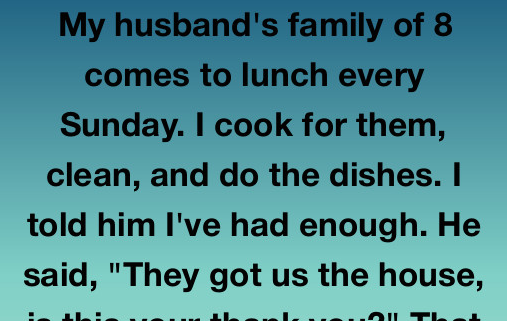
Every Sunday, my husband’s family of eight gathers at our home for lunch. I prepare their meal, tidy up, and wash the dishes. Exhausted, I confided in my husband that I couldn’t continue this way. His response was sharp: “They helped us get this house. Is this how you show gratitude?” That Sunday, I welcomed them with a warm smile and served their favorite dish, carefully portioned to feed only them—no leftovers, no seconds, and none for me.
They gathered around the table, filled with laughter and conversation, anticipating the same generous spread I’d provided for three years. I set the pot in the center, smiled, and took a seat. No apron clung to me, no sweat marked my forehead, no dishes waited for my hands. I sat still, composed, and at ease.
His mother noticed my empty plate. “You’re not eating?” she asked. With a gentle tone, I replied, “This meal is all for you. I thought you deserved the full share today.” A brief silence fell over the room. Someone laughed, assuming it was a playful jest. But as the food dwindled halfway through their seconds, and I hadn’t taken a bite, the truth settled in.
My husband glanced at me, a mix of confusion and discomfort in his eyes. “You didn’t eat?” he asked. I shrugged lightly. “I wasn’t hungry. You all come first, don’t you?”
After they left, he pulled me aside, his tone edged with frustration. “Why did you do that? It felt strange for everyone.” I met his gaze, weary but resolute. “Every Sunday, I pour myself into this. No one asks how I’m doing, offers to help, or brings anything to share. I needed to show you—and them—that I’m not here to serve endlessly.”
He didn’t respond much. He retreated to our room and shut the door. Yet something had begun to shift.
The following Sunday arrived, and I stayed in bed, watching a movie on my laptop. No early morning prep, no pots simmering on the stove. My husband walked in, puzzled. “No cooking today?” he asked. I shook my head. “Not today.”
His family arrived as usual, and I greeted them with a bright smile. “I hope you ate breakfast,” I said warmly. “There’s bread and butter in the kitchen. Feel free to help yourselves.” That was all.
They were surprised but courteous. His sister tried to lighten the mood. “What is this, a break?” she teased. I laughed softly. “Let’s say it’s a new way of doing things.”
They made do with what was available, stayed a shorter time than usual, and left with kind farewells. My husband was quiet that day, clearly wrestling with the change.
A week later, his older sister called me. Her voice was thoughtful. “I’ve been reflecting on last Sunday. We haven’t been fair to you. I’m sorry.” Her words caught me off guard. I thanked her sincerely. She offered to bring dessert next time. “Only if you feel like it,” I said. “I’m not asking for anyone to cater to me. I just want to be seen.”
Things began to evolve. The next Sunday, his sister arrived with a homemade cake. His mother brought a fresh salad. His brother volunteered to wash dishes. I hadn’t needed to ask.
My husband, though, remained distant, still grappling with the change. One evening, I sat beside him on the couch. “Are you upset with me?” I asked. He was silent for a moment.
Then he spoke. “You’ve changed things. It feels different.” I nodded. “I had to. I was fading under the weight of it all. Exhausted every week, and no one saw it—not even you.”
He leaned forward, resting his elbows on his knees. “I didn’t realize it was that heavy for you.”
“That’s the issue,” I said softly. “You never thought to ask.”
Days later, an unexpected moment arrived. His mother invited me for coffee, just the two of us. I braced myself, expecting criticism for disrupting family tradition. Instead, at a cozy café, she took my hand and shared something profound. “When I was your age, I did the same—cooked, cleaned, served every Sunday, every celebration. No one thanked me either.”
I blinked, stunned. “You did?”
She nodded, her eyes soft with memory. “I never spoke up. I thought that was a woman’s role—to give quietly. But watching you, I saw myself. I wish I’d found my voice too.”
We sat quietly, savoring our drinks. Then she said, “Thank you for showing me that respect begins with how we allow others to treat us.”
That Sunday, she brought a hearty main dish. His sister contributed sides. I prepared lemonade and joined them at the table, not as the host but as a guest. My husband sat beside me, not across, and helped pour drinks. After they left, he washed every dish.
“I understand now,” he said quietly. “I didn’t see how much I was taking you for granted.”
I said nothing, just wrapped my arms around him.
But life often tests whether change endures.
Months later, we were invited to a large family reunion at a lakehouse—cousins, aunts, uncles, all gathered. His mother asked if we’d help with one dinner. Before I could respond, my husband said, “We’ll bring drinks and dessert. Someone else can handle the cooking.”
I stared at him, amazed. He smiled and winked.
At the lakehouse, everyone contributed. One cousin grilled, another tossed a salad, and I relaxed on the dock, feet dangling in the water, holding a cold soda. His mother joined me, exhaling contentedly. “This feels good, doesn’t it?”
“Truly,” I replied.
As the sun dipped below the horizon, my husband pulled me aside. “I spoke to my dad,” he said, his voice low. “About the house.”
My heart paused. “What about it?”
He looked uneasy. “It’s not entirely ours. They covered the down payment, but the title’s still in their name. It was an investment… in case we ever parted ways.”
My chest tightened. “So it wasn’t a gift?”
He shook his head. “I didn’t know, I promise. But it explains why they felt I owed them so much.”
I sat on a log, gazing at the lake. It clarified their sense of entitlement, their subtle control. It wasn’t just generosity—it was a string attached.
He knelt beside me. “We need to make it ours. Fully. A fresh start.”
It took nearly a year. We saved diligently, tightened our budget, and refinanced. At last, we signed the papers. The house belonged to us, free and clear.
The Sunday after, we shared a quiet lunch, just us two. I made a simple pasta dish and a salad. We ate on the porch, surrounded by calm.
“It feels different now,” he said, sipping his drink.
I nodded. “It’s ours. A home, not an obligation.”
He reached for my hand across the table. “Thank you for not giving up.”
I smiled. “Thank you for stepping up.”
That evening, we strolled through the neighborhood. The air carried scents of fresh grass and jasmine. Neighbors waved, and the moment felt serene, authentic, earned.
One final moment lingers. Months later, my sister-in-law arrived early one Sunday. She knocked softly and asked to talk.
“I left my boyfriend,” she said. “Watching you stand up for yourself showed me I was accepting less than I deserved. I thought love meant giving everything to someone who doesn’t see you.”
We embraced, tears falling. Then we made pancakes together.
Sometimes, the boldest act of courage is honoring yourself. Standing up doesn’t always mean raising your voice—it’s about reshaping how others value you.
And when you do, people notice. Some push back. Some join you. The right ones grow alongside you.
A Lesson to Carry Forward
You don’t owe your peace to those who measure your worth by what you provide. Love without respect is merely control dressed as tradition.
If you’re reading this and feel you’re always the one giving, perhaps it’s time to claim a seat at your own table.
If this story resonates, share it. Someone might need the spark to stand tall. And show support if you believe every woman deserves a place at the table—not only as the one serving.