I stumbled upon a story that left me deeply moved—not for its dramatic flair, but for its raw, authentic humanity.
Dr. Oguz Basut, a skilled surgeon in Turkey, was performing a complex operation on a young woman with a tumor in her salivary glands. The procedure was intricate, with high stakes—the tumor sat dangerously close to a facial nerve, where even the slightest error could alter her life forever.
Midway through the surgery, Dr. Basut began to feel unwell. His blood pressure was plummeting. The cause? Food poisoning from the previous day, hitting him at the most critical moment. Many would have handed the scalpel to a colleague and stepped away. But Dr. Basut chose otherwise.
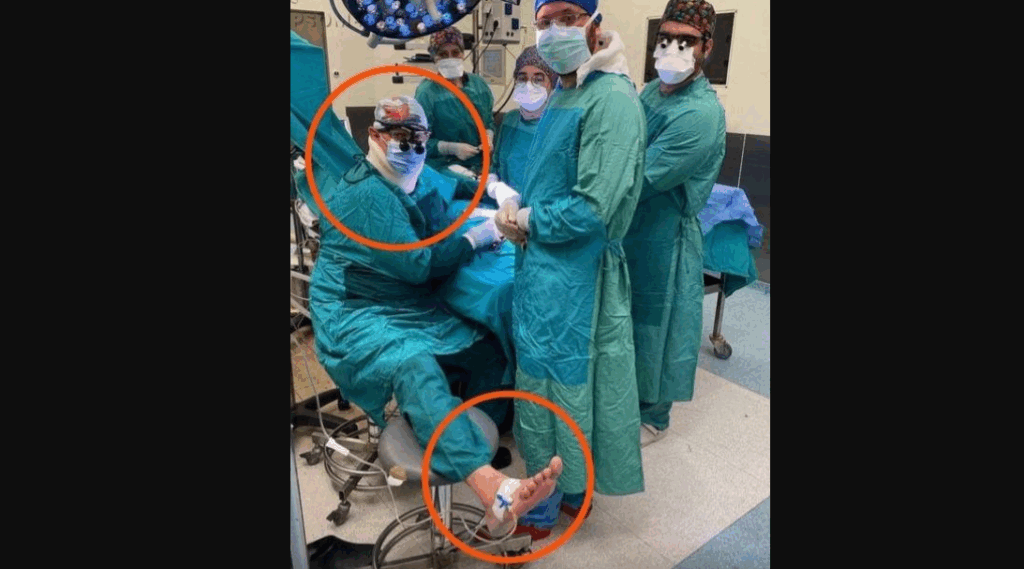
Determined to see the surgery through, he requested an IV drip be connected to his leg to stabilize his condition while he continued operating, seated but resolute. Within moments, his blood pressure began to recover, and he carried on, never wavering in his focus on the patient.
A striking image of him—sitting in the operating room, IV line in place, fully immersed in the procedure—spread rapidly across social media. The university’s director shared the photo, commending Dr. Basut for his extraordinary dedication and resolve.
What resonated most was his humble response: “I’m not a hero. I’m certain every professional would have acted similarly.”
The Immense Responsibility of a Surgeon
Surgeons bear an unparalleled burden, holding lives in their hands with every decision. Each incision, each suture, each moment carries consequences that can shape someone’s future. For this young woman, the tumor wasn’t merely a health concern—it was tied to her very identity. The salivary gland’s proximity to the facial nerve meant her ability to smile, speak, or express herself hung in the balance.
Had Dr. Basut paused the surgery, the consequences could have been devastating—potential paralysis, diminished recovery prospects, or a life forever changed. He recognized that halting wasn’t a simple delay; it risked tragedy. So, despite his body faltering, he pressed forward with unwavering commitment.
This level of responsibility is something most of us can scarcely imagine. Performing at your peak, not for personal gain, but because another’s life depends on it—this is a weight Dr. Basut carried with remarkable poise.
A Powerful Image of Devotion
The photograph of Dr. Basut has become a poignant symbol in Turkey: a surgeon, seated in the operating theater, IV drip sustaining him, yet fully focused on his patient.
It’s not a polished or staged moment. It’s unfiltered, visceral. You can sense the exhaustion in his frame, yet the unyielding determination in his gaze shines through.
Across Turkey, people lauded him. Some hailed him as the epitome of professionalism, while others expressed gratitude for his reminder that selflessness endures in a world often perceived as hurried and self-centered.
Medical colleagues, however, offered a humbling perspective. Many admitted that while they’d hope to act with similar resolve, they weren’t certain they could. It’s one thing to speak of dedication in theory; it’s another to embody it when your body is failing.
A Universal Calling
What makes Dr. Basut’s story so compelling is that it’s not entirely singular. Around the globe, countless healthcare professionals place their patients’ needs above their own.
Consider Dr. Ernest Bezarra, a surgeon in the Philippines, who completed an operation during a power outage, guided only by the glow of cell phones. Or the nurse in Italy who, during the height of the COVID-19 crisis, tested positive but chose to isolate within the hospital to continue caring for her patients.
Then there are the doctors enduring 36-hour shifts, fueled by little more than caffeine and determination, not out of choice but because the demand for care never relents.
These stories affirm that medicine is more than a career—it’s a profound calling.
The Cost of Such Devotion
As inspiring as Dr. Basut’s actions were, they prompt a sobering question: at what price?
Surgeons, like all humans, face illness, exhaustion, and burnout. Yet the culture of medicine often demands they transcend these limits. Burnout rates among healthcare workers are alarmingly high, a testament to the toll this expectation takes.
In Turkey, as in many nations, medical systems are strained. Long hours, understaffing, and relentless emergencies push doctors to their breaking points. While the public celebrated Dr. Basut’s resolve, some advocates highlighted a stark truth: no surgeon should face the choice between collapsing or abandoning a patient.
Yet Dr. Basut chose to persevere, driven by his oath to heal, protect, and do no harm.
His Humble Perspective
When asked about the incident, Dr. Basut deflected praise. “I am not a hero,” he said. “I am certain every professional would have acted similarly.”
His humility is striking. This wasn’t about accolades or recognition. It was about doing what was right in a critical moment.
But isn’t that the essence of heroism? The refusal to see oneself as exceptional, even when one’s actions are undeniably so?
The Patient’s Reality
Amid the focus on Dr. Basut, I couldn’t stop thinking about the young woman on the operating table. Imagine waking to learn your surgeon nearly collapsed while saving you, pushing past his own limits to preserve your life and identity.
For her, this isn’t a viral image. It’s the reason she can smile again, the reason her life continues without a shadow of devastation.
She’ll likely carry that gratitude forever. And so should we.
A Lesson for Us All
Beyond the medical context, this story carries a deeply human lesson. It challenges us to reflect: how far would we go for another?
Most of us aren’t surgeons, navigating life-or-death decisions daily. But we all face moments where we’re called to prioritize others—staying late to help a struggling colleague, supporting a friend through hardship, or standing by our values despite personal cost.
Dr. Basut’s story, though extreme, speaks to a universal truth: the greatest acts of service often occur quietly, without fanfare, in moments when stepping away would be entirely understandable.
The Fragile Line Between Duty and Self-Care
Yet there’s a cautionary note. As much as we admire Dr. Basut, we must acknowledge his humanity.
Doctors who push through illness risk not only their own well-being but, in rare cases, their patients’ safety. What if his condition had worsened? What if he had collapsed entirely? These questions, though uncomfortable, are essential.
The balance between duty and self-care is delicate. Our culture often glorifies sacrifice while overlooking its toll. Perhaps the deeper lesson is the need for systems that ensure no doctor must resort to an IV drip to fulfill their role.
Why This Story Captivates
This story resonates because it touches on what we cherish as humans. In a world often labeled as self-serving, Dr. Basut’s actions remind us that selflessness, devotion, and humanity endure.
It’s a testament that, despite advancing technology or shifting systems, human hands, choices, and hearts remain at the core of our shared existence.
A Final Thought
Reflecting on Dr. Basut’s words—“I’m not a hero”—I see both truth and modesty. He’s right that many professionals act with extraordinary courage daily. Yet he’s wrong to think it diminishes his own actions. In that moment, he embodied the very best of humanity.
True heroism doesn’t always arrive with grand gestures. Sometimes it’s a surgeon, IV bag at his side, hands steady, refusing to let another’s life slip away.
And perhaps the question for us is this: when life demands we show up for someone else—urgently, undeniably—will we find the strength to stay, even when every instinct urges us to turn away?