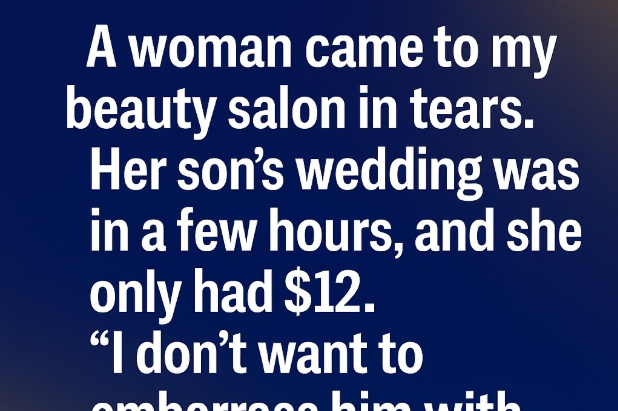
She stepped into my beauty salon trembling, her hands shaking so badly that the coins in her palm clinked softly against each other. Her eyes were swollen and red from crying, and she held exactly twelve dollars as if it were all she had left in the world. Her son’s wedding was only a few hours away.
In a quiet, broken voice, she told me she was afraid of embarrassing him. She said she did not need anything fancy. She only wanted to look “acceptable enough” to stand in the background and not draw attention.
Something about the way she spoke made the noise of the salon fade. It was not desperation alone. It was shame mixed with love, the kind that comes from a lifetime of putting everyone else first. I did not ask her many questions. I guided her to the chair, wrapped the cape around her shoulders, and told her to breathe.
Slowly, I washed her hair, styled it gently, and applied makeup that was soft, elegant, and timeless. Nothing dramatic. Nothing loud. Only care. When I finished, I handed her a mirror. She covered her mouth and cried again, this time differently.
When she reached for her money, I pushed her hand back gently and told her to keep it. I watched her leave the salon standing a little taller than when she arrived. I assumed that would be the end of it. A quiet moment of kindness on a busy day, filed away among hundreds of others. I closed the salon that evening tired but content, never expecting to think about her again.
The next morning, everything changed.
When I arrived at work, I froze before unlocking the door. A small group of people stood outside my salon, waiting. My first thought was panic. Had something gone wrong? Was there a complaint? Then I saw her.
She stood at the front of the group, no longer hunched or tearful. Her hair was styled neatly. Her posture was confident. Her eyes were bright. Beside her stood a young man in a tailored suit, smiling proudly. She introduced him and said, with a steady voice, “This is my son. This is the groom you helped me feel worthy of standing next to.”
Inside the salon, she told me what happened at the wedding. When her son saw her for the first time, he stopped walking. He looked at her and said, “Mom, you look beautiful.” She said those words stayed with her longer than any speech or photograph. For years, she had made herself invisible. She had avoided mirrors. She had believed she was meant to fade quietly behind the people she loved. Walking into my salon with twelve dollars, she had not expected generosity. She expected to blend in.
Her son stepped forward then, his voice thick with emotion. He explained that he owned a small local business and had heard his mother talk about what I did. He said, “You didn’t change how she looked. You changed how she felt about herself.” He handed me an envelope containing a handwritten letter and a proposal for free advertising for my salon through his company’s local community network. It was something I had dreamed of but never been able to afford.
I stood there stunned, holding the envelope with hands that now trembled the way his mother’s had the day before. I had done what felt natural, without expectation. And yet kindness had found its way back to me multiplied.
After they left, the salon felt unusually quiet. The chairs sat empty. The mirrors reflected a stillness that felt sacred. I sat down and let the moment settle. That experience changed how I see my work. Beauty is not about perfection or trends. It is about dignity. It is about reminding someone that they deserve to be seen, not hidden.
That woman did not walk into my salon asking for a miracle. She asked for permission to exist without shame. And in offering that freely, I received something far greater than money or promotion. I received a reminder that the smallest acts, done with sincerity, can ripple far beyond a single moment.
Sometimes compassion arrives disguised as routine. And sometimes, when given without conditions, it returns in ways that reshape your understanding of purpose, work, and the quiet power of human connection.