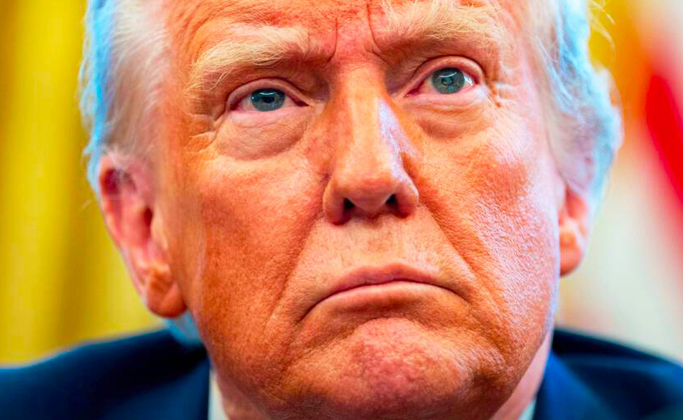
The White House released an important update regarding Donald Trump following a weekend filled with intense public discussion and widespread online speculation.
In today’s fast-moving digital environment, information travels quickly. This becomes even more noticeable when the topic involves a high-profile political figure. Over the weekend, that pattern unfolded again as a wave of claims about Trump circulated across social media platforms.
What began as a handful of isolated posts soon expanded into a widely shared narrative. The claims varied. Some raised concerns about the president’s health, while others went further, suggesting he had died or was receiving treatment at a military medical facility.
Screenshots of trending posts added momentum. Some claimed access to insider medical updates, while others pointed to perceived gaps in the president’s public schedule.
One widely circulated message suggested something was being hidden. Another went as far as claiming doctors were quietly confirming false reports. These statements spread quickly, even without verified evidence.
A Presidency Under Constant Public Attention
This situation is not new. Trump’s health has been a recurring topic of discussion for years. At 79, he remains the oldest elected president in United States history, which naturally draws attention to his physical condition.
Observers often analyze small details during public appearances. Changes in speech, movement, or visible marks have all been discussed at length online. Even minor visual details have triggered large-scale reactions.
The White House has addressed similar concerns in the past. Officials explained that discoloration on his hands was linked to aspirin use. A visible skin irritation earlier in the year was described as a reaction to prescribed treatment.
Trump has consistently responded with confidence, stating that he remains in strong health.
After a visit to Walter Reed National Military Medical Center in 2025, he told reporters that medical scans showed no issues. His physician later clarified that the imaging was precautionary.
Despite these explanations, public discussion has continued, often driven by critics and commentators who question whether full details are always shared.
The Easter Weekend That Drew Attention
The most recent wave of speculation began over Easter weekend.
Typically, presidents appear publicly or issue statements during major holidays. This time, the White House confirmed that Trump would not attend scheduled Easter events or make a public appearance that day.
That absence quickly became a focal point.
Unverified reports began to circulate, including claims about road closures and flight restrictions near Walter Reed National Military Medical Center. None of these reports were confirmed, yet they contributed to growing speculation.
With no live appearances or press briefings, a gap formed. That gap was quickly filled by online theories.
Some posts suggested a medical issue. Others presented far more dramatic claims.
At the same time, there were clear signs of normal activity. Journalists noted that standard procedures at the White House appeared unchanged. A Marine guard remained posted outside the West Wing, which typically indicates the president is present.
Trump was also active on X, sharing multiple posts about policy matters, including foreign relations and immigration. These updates suggested continued involvement in his duties.
Public Reactions and Political Commentary
The situation also drew responses from political figures, including Marjorie Taylor Greene, who posted comments addressing broader geopolitical issues and criticizing ongoing developments.
Her statements added another layer to the online conversation, showing how quickly speculation can merge with political debate.
As discussions spread, it became increasingly difficult to separate confirmed information from opinion and assumption.
Why Rumors Spread So Quickly
This episode reflects a broader pattern in modern communication.
Health-related topics involving public leaders have always attracted attention. Historical examples show that information about a president’s condition has often been carefully managed.
In today’s environment, the difference lies in speed and access. Social media allows anyone to share claims instantly, often without verification.
When those claims connect with existing concerns, such as age or past medical questions, they gain traction more easily.
A cycle forms. Speculation attracts attention. Attention amplifies the speculation. A lack of immediate clarification can then be interpreted in different ways, even when no issue exists.
The Constitutional Perspective
Beyond online discussion, there is a more serious dimension to these rumors.
The structure of the United States government includes clear procedures for situations involving presidential incapacity. If a president is unable to serve, the vice president assumes the role.
In this administration, that would involve JD Vance stepping into office if required.
There is also the 25th Amendment to the United States Constitution, which outlines how power can be temporarily or permanently transferred.
These frameworks explain why discussions about presidential health carry weight beyond curiosity. They relate directly to the continuity of leadership.
The White House Issues a Direct Statement
As speculation intensified, the administration responded.
Steven Cheung, communications director at the White House, released a clear statement addressing the situation.
He stated that there had never been a president who worked harder for the American people than Trump. He added that during the Easter weekend, the president remained active in the White House and the Oval Office.
The message aimed to reinforce that Trump was continuing his responsibilities without interruption.
Additional responses from official sources described the circulating claims as unfounded and driven by speculation rather than evidence.
A Public Appearance Brings Clarity
Following the weekend, Trump appeared publicly at the White House Easter Egg Roll.
During his remarks, he spoke about a recent military operation involving Iran and highlighted broader topics such as the economy and national progress.
The appearance served as a visible confirmation of his presence and activity, addressing many of the concerns that had circulated online.
Moments like this demonstrate how quickly narratives can form and how equally quickly they can shift when new information becomes visible.
What This Moment Shows
This episode offers a clear example of how modern information flows.
A brief absence, combined with existing public interest, can lead to rapid speculation. Digital platforms amplify those conversations, often before facts are fully confirmed.
At the same time, official responses and public appearances remain essential in providing clarity.
In a connected world, the balance between information, interpretation, and verification continues to shape how stories unfold.