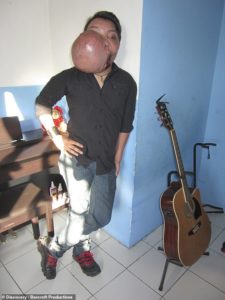
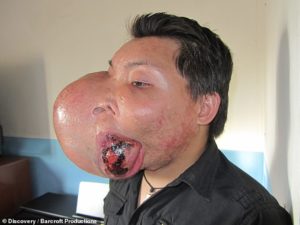
One student’s life took a dramatic turn after doctors removed an enormous facial tumor that had grown to the size of a basketball and weighed approximately 6.6 pounds. The surgery marked the end of a long and painful journey that began in early childhood and reshaped nearly every aspect of his life.
Adrián Espino, now 23 years old, first became aware that something was wrong when he was only six. What appeared to be a small bruise on his cheek slowly changed over time. The mark did not fade. Instead, it expanded steadily, altering the shape of his face year after year. As the growth progressed, it drew attention, questions, and concern, placing an emotional burden on a child who had once been healthy and carefree.
Local media later reported that the operation required extraordinary effort. Surgeons described the tumor as extremely difficult to remove, to the point that tools such as a hammer and chisel were needed during the procedure. The complexity of the surgery reflected the severity of the condition Adrián had been living with for most of his life.
Doctors explained to his parents, Adrián Sr. and Maria, that their son had fibrous dysplasia, a rare bone disorder. They were told there was no cure and that the tumor would continue to grow as long as Adrián continued to grow. Over time, the expanding mass began to restrict his airways, placing his life in danger. Breathing became labored. Eating grew increasingly difficult. Everyday actions required constant effort.
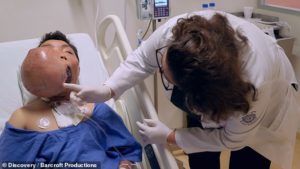
Since the tumor was removed by Dr. Laura Andrade Delgado, the young musician from Chihuahua, Mexico has experienced a profound transformation. The growth weighed nearly as much as a brick, and its absence immediately changed how his body felt and functioned. Adrián later appeared on the TLC series Body Bizarre, sharing his experience with a wider audience.
Maria, his mother, vividly remembers the first signs. She noticed the bruise on his face when he was six years old and initially assumed it was the result of an accident. She recalled telling her husband that perhaps their son had bumped into something. Adrián often cried and held his face, unable to explain the pain he felt.
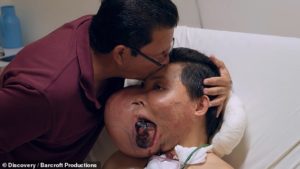
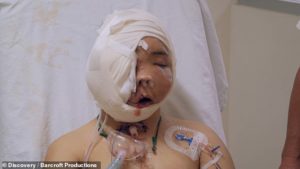
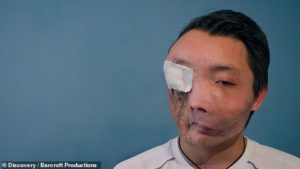
His father eventually brought him to the hospital, where doctors diagnosed polyostotic fibrous dysplasia. This condition causes scar-like tissue to form in place of normal bone, leaving affected areas weakened, misshapen, or vulnerable to fracture. The disorder stems from a genetic mutation that occurs early in pregnancy. It is present from birth, though it may not become visible until later. In polyostotic cases, multiple bones can be affected, though it remains unclear whether other areas of Adrián’s body were involved.
Doctors warned the family that the condition would continue spreading across his face and that surgery would only slow its progress. Over the years, Adrián underwent repeated procedures aimed at gradually reducing the mass. Despite these efforts, the tumor continued to grow as he matured.
As the physical challenges intensified, the emotional toll grew heavier. Adrián shared that he experienced deep depression and thoughts of ending his life. He withdrew socially and struggled with isolation. Still, he held onto two anchors: his family and his sense of pride. He refused to give up.
He spoke openly about focusing on the positive, even during moments of loneliness. Breathing through his nose eventually became impossible as the tumor pressed against the left side of his face. His vision was affected, leaving everything blurry on one side. Misaligned teeth made chewing difficult, turning meals into another challenge.
In search of specialized care, Adrián and his father traveled nearly 1,000 kilometers to Mexico City. Facing surgery, Adrián used humor to manage fear, expressing hope that everything would turn out well.
Before the operation, Dr. Laura Andrade Delgado made it clear that without intervention, Adrián would lose the ability to breathe and eat. During the surgery, she removed large sections of abnormal bone blocking his nose and mouth. The pieces were extracted gradually, totaling 6.6 pounds.
Three months later, Adrián’s recovery has been remarkable. He described intense pain during healing, especially due to tubes used to reconstruct his nostrils. Drinking water caused discomfort. Sleep required sitting upright for a long period.
Now, he can sleep normally. His breathing feels open. He noticed an immediate physical difference, even feeling momentarily unbalanced as his body adjusted to the absence of the weight he had carried for so long.
His father described this surgery as the most difficult of all, with a longer and more demanding recovery. Still, the outcome has opened a new chapter.
Although reconstructive surgery remains ahead, Adrián is focused on the future. He plans to complete his engineering studies, publish a book he has long dreamed of writing, and continue making music. His journey reflects resilience, family support, and the power of perseverance in the face of overwhelming adversity.