The 2028 United States presidential election remains several years away, yet conversations about the potential candidates and political dynamics have already begun to surface. Recently, a hypothetical election simulation shared online sparked discussion among political observers and viewers interested in emerging technologies. The simulation explored what a future presidential race might look like using artificial intelligence to analyze available data and model possible outcomes.
The project originated from the YouTube channel “Election Time,” which frequently produces content focused on political trends, historical voting patterns, and potential future scenarios. For this particular exercise, the channel asked Grok—an artificial intelligence system developed by Elon Musk’s company xAI—to simulate a possible presidential election landscape for 2028.
Rather than presenting a prediction of what will happen, the simulation attempted to create a data-driven model based on early indicators. The system considered factors such as early primary polling, trends in betting markets, demographic voting behavior from previous elections, and historical party nomination patterns. By combining these elements, the AI generated a hypothetical projection for how the nomination races within both major political parties might unfold.
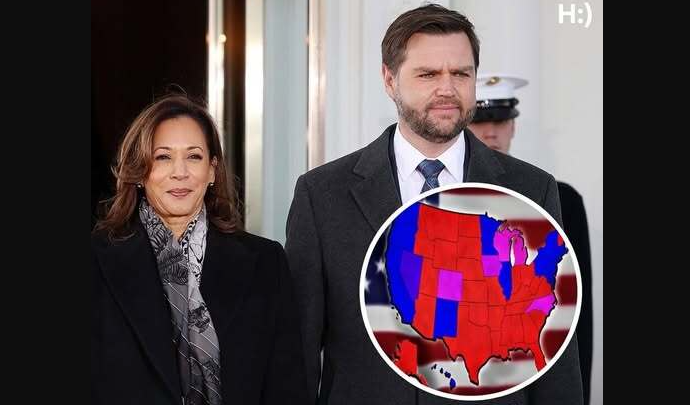
The simulation focused on a potential matchup between Vice President Kamala Harris and Senator JD Vance. Although the 2028 candidate field remains unknown, both figures have frequently appeared in conversations about the future direction of their respective parties.
Within the Democratic Party scenario presented by the model, Harris appeared as the early frontrunner. According to the simulated results, she held approximately 32 percent support in early primary polling among Democratic voters. This placed her ahead of other possible contenders mentioned in the analysis, including California Governor Gavin Newsom, who also appeared as a potential candidate with notable support.
The model suggested that Harris could enter the primary season with a recognizable national profile, given her experience as vice president and previous role as a United States senator. Political simulations often account for name recognition and existing national networks when evaluating possible nomination outcomes, factors that frequently play a role during early primary contests.
On the Republican side, the simulation produced a different dynamic. Senator JD Vance appeared to dominate the early hypothetical polling within the model, receiving close to 50 percent support among Republican primary voters. The projection placed him significantly ahead of other figures included in the simulation, such as Donald Trump Jr. and several additional possible contenders.
The AI-generated scenario suggested that Vance’s strong position in the model could stem from multiple factors, including rising visibility within the party and alignment with influential political movements in recent Republican politics. While the model used existing data patterns to generate this scenario, it remains an exercise rather than a definitive forecast.
Political simulations like this one rely on historical voting trends and statistical modeling. They often attempt to estimate how voters might respond under certain conditions based on past behavior. However, elections depend on many unpredictable factors, including economic conditions, global events, policy debates, campaign strategies, and the actual candidates who decide to run.
Because of these uncertainties, even the most sophisticated models cannot fully capture the complexity of a real election cycle. Early projections frequently shift as new information emerges, and political landscapes can change dramatically within a few years.
Another interesting element of the simulation involves the role of artificial intelligence in analyzing political scenarios. AI systems are increasingly used to process large amounts of data, identify patterns, and test possible outcomes. In the context of elections, these tools allow analysts and researchers to explore “what if” scenarios that would be difficult to calculate manually.
The growing presence of AI in political discussions also raises broader questions about how technology may influence public understanding of elections. While simulations can help illustrate potential trends, experts often emphasize the importance of interpreting such results carefully. Data models provide insights based on current information, yet they do not replace the unpredictable nature of real-world political decision-making.
For viewers of the “Election Time” channel, the Grok simulation served primarily as a conversation starter about the future of American politics. The scenario offered a glimpse into how analysts might begin evaluating potential candidates long before official campaigns are announced.
As the United States moves closer to the 2028 election cycle, the list of possible candidates will likely evolve. New political figures may emerge, while others may decide not to run. Polling data, party priorities, and voter concerns will also change as national events shape the political climate.
For now, the simulation remains a hypothetical exercise created to explore possibilities rather than predict outcomes. It reflects the growing interest in combining political analysis with advanced technology to better understand how elections might unfold in the years ahead.