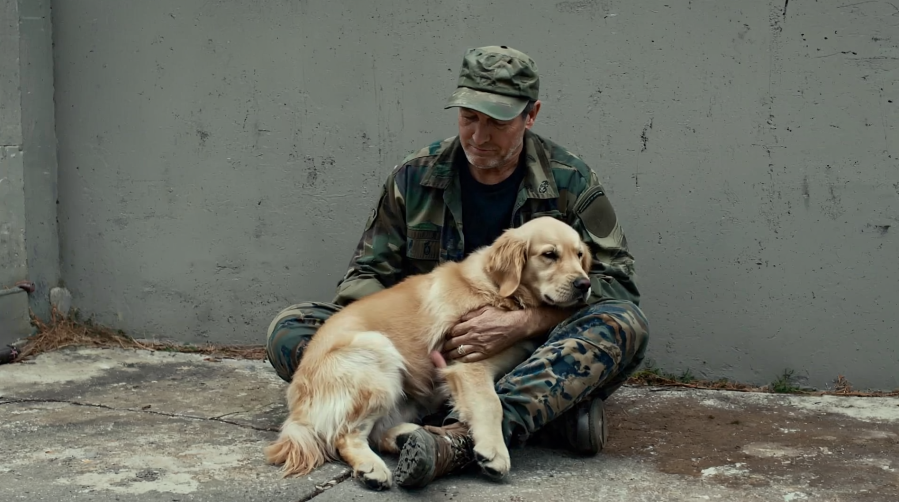
He was sitting cross-legged on a threadbare mat, cradling his golden retriever like it was a child. I only stopped because I saw the shouting first. Two animal control officers, one with a clipboard, one reaching for the leash.
“She’s not neglected,” he kept saying. “She’s all I have.”
They didn’t care. She was too thin, they said. No records, no stable address. That’s when I stepped in.
I asked if the dog was sick. He nodded. Cancer. Stage two. “I sold my car. I left my apartment. Every cent I had went to her treatments.” His voice cracked. “I need a few more weeks of meds. Then she’s clear. I’ll get a place after she recovers.”
The officers looked unconvinced. But I saw the pill bottles. The vet forms in a crumpled folder. The way she leaned into him like she’d die without him.
So I said it before I thought it through—
“Give me the bill. I’ll cover the rest.”
He looked at me like I threw him a lifeline. The animal control guys weren’t impressed. They said they received some complaints and needed to take the dog off the streets. That’s when things got ugly.
“I’ll file a report with the city if you touch her,” I said, stepping between them. “She’s being treated. She’s not neglected. You take her, she dies.”
One of them muttered under his breath, but they backed off when I pulled out my phone and said I was recording. They made a few notes, handed him a yellow paper, and walked off.
The man just stared at me, his arms wrapped around the dog like she might vanish. He didn’t cry. He whispered, “Thank you,” over and over, like those were the only words he had left.
I sat down beside him, feeling the chill from the sidewalk creep through my jeans. “What’s her name?” I asked.
“Riley,” he said. “She’s thirteen. I’ve had her since she was a pup.”
I nodded. “I’m Sarah.”
He looked at me, really looked. “Thank you, Sarah. I’m Marcus.”
I didn’t know what to say after that, so I sat with them a while. People walked by, some staring, some pretending not to see. Riley’s tail thumped weakly against the mat when I scratched behind her ears.
That night, I called the vet listed on the paperwork. It checked out—Marcus wasn’t lying. Riley was halfway through treatment, and the prognosis was actually good. She needed another three weeks of meds and rest.
I covered the remaining cost, and the clinic agreed to continue supplying the medication weekly, as long as someone picked it up.
The next morning, I brought Marcus a tent, a better mat, and some clean clothes from my garage. I also brought him a hot breakfast sandwich and coffee.
He cried this time. Tried to refuse the help, said he didn’t want pity.
“It’s not pity,” I told him. “It’s human.”
That became our routine. Every morning before work, I’d bring him a meal. On weekends, we’d sit for longer. He told me about his old life—how he used to be a school bus driver. How he lost his wife to cancer five years ago. How Riley had been his only anchor since.
Then came the twist I never expected.
One Saturday, Marcus was late meeting me at our usual spot. I walked around the block, worried perhaps animal control had returned. Then I saw him, standing outside a diner, holding a wad of cash.
I panicked. “Marcus, where’d you get that?”
He looked sheepish. “A guy offered to buy Riley. Said she’s a purebred, and he’d give me five thousand cash. I told him to shove it.”
I nearly collapsed from relief.
“But,” he added, “it made me realize something. People see value in her…but not in me.”
“You’re wrong,” I said. “You did something most people wouldn’t. You gave up everything for someone who couldn’t speak, couldn’t earn, couldn’t even ask. That’s value.”
He smiled at that, a tired, weathered kind of smile.
The weeks passed. Riley’s fur began to grow back. She gained a little weight. Her tail wagged more often. The clinic confirmed she was officially in remission.
It should’ve been a time to celebrate.
But then, Marcus disappeared.
I showed up with his usual breakfast, but the tent was gone. The mat, the bowl, the blanket—everything, gone. For three days, I looked. Asked around. Nothing.
Then, on the fourth day, a man approached me while I was handing out flyers.
“You looking for Marcus?” he asked. He was dressed in scrubs. “I’m Dr. Singh. I work at the free clinic down the block.”
I nodded quickly.
“He collapsed near the river two nights ago,” he said gently. “Severe pneumonia. He’s been in and out of consciousness.”
I rushed to the clinic. Found Marcus curled under thin blankets, Riley curled up at his feet as always.
He looked up when he saw me. “I didn’t want you to worry,” he rasped.
“You idiot,” I said, tears brimming.
Dr. Singh pulled me aside. “He needs better care. A real room, steady meals, warm bedding. He’s worn himself out.”
I took a breath. “What would it take to move him to a rehab center?”
Dr. Singh looked surprised, then thoughtful. “We have one that might take him if there’s sponsorship.”
So I signed up. Filled out the paperwork. Paid the deposit.
For the next two weeks, Marcus stayed at the facility. They gave him warm meals, antibiotics, clean clothes. I visited every other day. Riley was allowed to stay too, thanks to a very kind nurse named Moira who bent the rules.
One afternoon, I found a folder on his bedside table. Inside was a handwritten letter, and a copy of his will.
“I’m not dying,” he said when I confronted him. “But you deserve to know.”
The letter explained that he had a sister in Ohio. They hadn’t spoken in years after a family fallout. But now, with things looking up, he wanted to reconnect. He wanted to try and rebuild.
“I don’t want to die with regrets,” he said simply.
I offered to help find her.
It took some searching, but I tracked her down. Her name was Leanne. She ran a small bakery in Dayton. When I called, she was hesitant at first, then silent for a long moment. Then came the tears.
They hadn’t spoken since their mother’s funeral. But she never stopped wondering what happened to him.
Two weeks later, she flew out.
Their reunion was quiet but emotional. She brought a suitcase full of homemade cookies and old photos. Riley wouldn’t stop licking her hands.
Leanne offered to take Marcus home with her. Said he could live in the spare room. She’d help him get back on his feet. He hesitated at first. Said he didn’t want to be a burden.
“You’re my brother,” she said. “You’re never a burden.”
The day they left, I brought them to the bus station. Riley had a new vest, a cozy blanket, and more energy than I’d ever seen. Marcus hugged me for a long time.
“You saved both of us,” he whispered.
“Just paid a vet bill,” I joked.
“No,” he said seriously. “You saw us. When no one else would.”
Three months passed.
Then one morning, I got a thick envelope in the mail. No return address.
Inside was a letter from Marcus. He said he’d found a part-time job at the bakery, helping with deliveries. That he’d started seeing a counselor. That Riley now had her own pillow in Leanne’s living room, and a backyard to chase squirrels in.
There was also a check. Five thousand dollars.
“For the next Riley and the next Marcus,” the note read.
And underneath, in shaky but proud handwriting:
P.S. The guy who tried to buy her? Got arrested last month. It turns out he was part of a dogfighting ring. Your warning saved more than us.”
I sat there crying on my kitchen floor.
Sometimes all it takes is seeing someone. Really seeing them. Not as a nuisance, or a lost cause, or a problem to be cleaned up. But as a person who’s trying. A heart that’s still beating. A soul holding on.
That day on the sidewalk, I thought I was helping a dog.
But I think, in the end, it helped me too.
If this story touched you, please like and share. You never know who might need a reminder that kindness still matters.