The house was too quiet.
Not peaceful, not still in the way Sunday mornings could be. It was a different kind of silence — the heavy kind that made your skin crawl and your thoughts race. The kind that filled every room, every hallway, every breath. A silence made not of rest, but of sorrow.
Outside, storm clouds draped across the sky like bruises. The wind pawed at the windowpanes, whispering threats it never meant to keep. Somewhere in the distance, a dog barked, but here — inside the Parker home — the world was frozen in time.
Sarah Parker sat in the nursery doorway, her hands wrapped tightly around a chipped mug of tea that had long since gone cold. She stared at the crib, her eyes unmoving, her chest rising and falling in shallow breaths.
Inside the crib lay her son, Noah.
Born two months early and silent from his first moment, he had never cried. Never kicked. Never smiled.
Doctors called it a profound brain injury — something that had happened in the womb, something no one could prevent.
The words “he may never move” had been said so many times they lost their meaning. Until they were replaced by worse ones: vegetative state. No response to stimuli. Prepare for long-term care.
She didn’t cry anymore. She had passed crying months ago.
From down the hall, Michael’s voice cut through the silence.
“Did you sleep?”
Sarah didn’t answer. She didn’t need to.
He appeared in the doorway a moment later, his hair tousled and his face pale from too many sleepless nights. He carried his exhaustion like a second skin.
“You should try,” he said gently.
She shook her head, her voice a whisper. “And miss the moment everything changes?”
Michael didn’t argue. He hadn’t for weeks.
They had tried everything. Specialists, neurotherapy, experimental music therapy, acupuncture, even energy healers. Each visit ended the same way — with polite sympathy, a pat on the back, and those same empty words: “I’m sorry.”
And yet they stayed. Hoping. Waiting.
That night, something changed.
It started with a soft sound from the hallway. A faint thump — not sharp like a footstep, but lighter, like a soft pad pressing on wood.
Sarah turned toward the noise, her brow furrowed.
At the edge of the hallway stood Max.
He was tiny — barely eight weeks old — a golden retriever with paws too big for his body and ears that flopped when he walked. A gift from Sarah’s sister, who had insisted that maybe, just maybe, a little joy could help.
They hadn’t expected much. Max had been gentle, quiet, almost unnaturally so. He had never barked, never chewed up shoes or furniture. He simply watched. As if he knew.
Now, he stood at the nursery door, his golden fur glowing softly in the lamplight, his eyes fixed on the crib.
“Max,” Sarah said softly. “No.”
But the puppy didn’t listen.
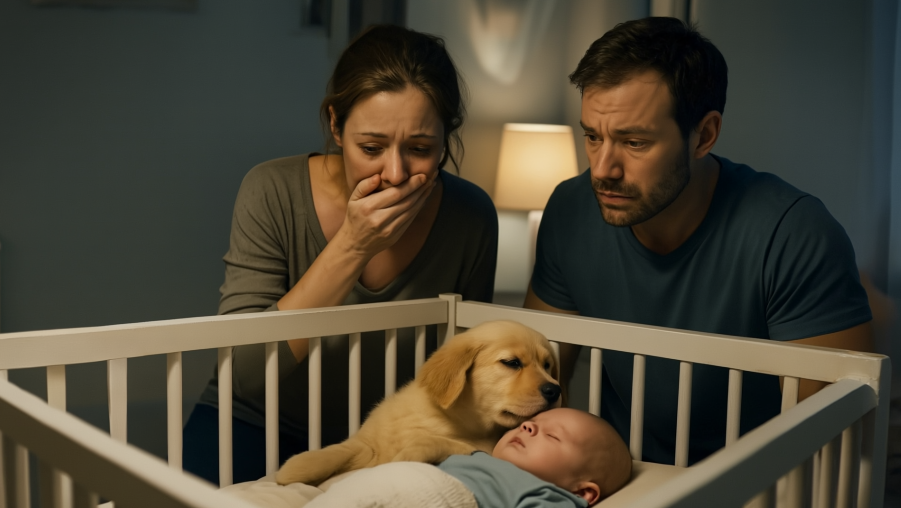
Without a sound, he padded into the room. Sarah rose, panicked, but before she could stop him, Max had leapt into the crib in a smooth, almost dreamlike motion.
He didn’t jostle the baby. He didn’t sniff or paw. He simply curled around Noah’s still body, resting his head near the tiny hand that had never moved.
“Michael,” Sarah whispered. “Do we… stop him?”
Her husband was already standing beside her. He shook his head, his voice barely audible. “Let him stay.”
The silence returned.
Then — movement.
It was so small Sarah almost missed it. A flicker. A twitch in Noah’s fingers. Her breath caught in her throat.
“Michael…” she said, not daring to hope. “Did you see—?”
“I thought—” he whispered. “It couldn’t be…”
They watched. The puppy shifted slightly, nuzzling closer, his wet nose brushing Noah’s hand again.
Another twitch.
Then — a faint curl. Barely perceptible, but unmistakable. Fingers that had never moved… curled.
Sarah’s hands flew to her mouth as tears sprang to her eyes. “Oh my God,” she breathed.
Michael blinked hard, disbelief written across his face. “That’s not… it’s not possible.”
But it was happening.
Max remained still, his small body emitting warmth, heartbeat syncing with Noah’s in a quiet rhythm that defied logic.
From that moment, something began.
The next day, the twitch happened again. Then again the day after. A toe this time. A slight bend at the knee. They recorded every moment, not trusting their own memories. They showed the videos to the doctors.
The neurologist watched in stunned silence, replaying the clip of Noah’s finger curling around Max’s paw.
“This… this shouldn’t be happening,” he finally said. “But it is.”
They called it “unexplained neural activity.” A rare phenomenon. Some hinted it was a fluke. A coincidence. But the Parkers didn’t care what it was called.
All they knew was that their son had moved.
And every time Max lay beside him, the responses grew stronger.
A month later, Noah turned his head toward the sound of Max’s bark.
Two months after that, his eyes followed the puppy across the room.
By the fifth month, Noah laughed — a soft, gurgling giggle — when Max licked his cheek.
They bought a baby-sized walker. Noah sat in it, supported by cushions and belief. Max walked beside him, nose nudging his little feet to keep going. Inch by inch, they made their way across the living room floor.
Neighbors began to hear laughter echoing from the Parker house again. Real laughter. Not forced or strained, but bright and musical.
One night, Sarah sat on the floor with Noah and Max, tears streaming down her cheeks as her son raised his hand — and placed it gently on Max’s head.
A full reach. Intentional. Coordinated.
“I don’t understand how,” she whispered to Michael, watching her son stroke the puppy’s ear.
Michael’s arm wrapped around her. “Maybe… not everything is meant to be understood.”
Doctors ran tests. Brain scans. Blood work. Therapy assessments.
Every chart said improvement.
But no one could say why.
There were no miracle drugs. No new treatments. Only a dog — and a boy who had been still for too long.
The story made its way into local news. Then national. Reporters came, cameras captured footage of Max and Noah playing on the floor together — if you could call it playing. Noah still needed help to sit up. But his giggles, his reach, his responses — they were there.
They asked Sarah for a statement. She said only one thing.
“We thought he was gone,” she said, voice trembling. “And this little dog brought him back.”
A neurologist from Boston offered to fly in and examine Noah personally.
“He’s showing signs we rarely see in children with his prognosis,” she said. “There’s a possibility this isn’t only neurological — it’s emotional, too. Something about that dog… it’s reaching him in ways science hasn’t yet.”
They offered to study Max.
The Parkers politely declined.
Max wasn’t a subject.
He was family.
Years passed.
Noah learned to walk with assistance. Then, astonishingly, without it. By age four, he took his first steps — holding tightly to Max’s collar. By age five, he could throw a tennis ball across the backyard.
Max chased it, tail wagging.
They were inseparable. At school, Noah brought a plush toy that looked like Max. At night, he slept with Max at his feet.
And every year on Noah’s birthday, Sarah lit a candle and sat on the floor beside Max, whispering, “Thank you.”
She still didn’t understand it.
And she didn’t need to.
Sometimes, healing doesn’t come from hospitals or labs. Sometimes, it comes in the form of four tiny paws, a warm heart, and a love so powerful it defies every expectation.
Sometimes, the smallest beings carry the biggest miracles.
And in a house that was once filled with silence, the sound of laughter — and the soft patter of paws — echoed through the halls.
Forever.
This piece is inspired by stories from the everyday lives of our readers and written by a professional writer. Any resemblance to actual names or locations is purely coincidental. All images are for illustration purposes only.